Major Opus Nears Completion

Last summer we went looking for Turkey Jim Covered Bridge in Campton, NH, in order to paint it, but could not find a good vantage point where we could set up our easels.  But a little exploration upriver yielded a good view of the bridge and its reflection in the water.  It was too far away to make for a happy plein air experience, but I snapped a photo and, more importantly, the image seared itself into my imagination.  I vowed to make a studio portrait of that bridge someday.  (My original draft of that immediately preceding sentence was more factual:–  I used the verb “planned” instead of “vowed”.  But “vowed” sounds so much more dramatic!)

So when I pulled out a large  canvas to start something on, the Turkey Jim covered bridge sprang to mind, and I printed out the photograph to help me get in the mood.  My experience with painting on larger canvases is, well, limited.  This one is, I believe, 30 by 40 inches.  My studio is only about 5 feet by 8 feet, so it’s a good thing that I don’t have to lay anything  flat to paint on it (as a watercolorist would like to do).

That was several months ago.  I worked on it off and on, as I found time.  Here is where I was before this weekend.
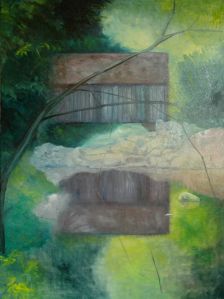
A Work in Progress

The Christmas holidays provided me with extra time off and this year I had no Christmas duties to fill that time with–the best gift I could wish for.  I spent two days on Turkey Jim, adding foliage and a certain special critter, one that I have seen in this part of New Hampshire, but not as often as I would like.

The heron (detail from Turkey Jim)

This great blue heron posed for my camera in balmy Florida, and  has now been transported to the chilly North.  Isn’t it extraordinary that this bird can thrive in both locations?  Probably it travels South in the Winter.  Hmmm.  Maybe this heron has actually summered in New Hampshire, and possibly descended from the one I met years ago at the base of Mount Pemigewasset.

After admiring my lovely heron for an afternoon (whilst dabbling with the foliage) I suddenly realized that the heron was not reflected in the water.  Thank you, gods of art, for letting me be the first to notice that!  My photo was enormously helpful–the heron was facing to the right instead of the left, so when taped the photo upside down next to the spot where I wanted the reflection, it kept me on track.  Reversing curves in a reflection is a little bit like trying to pat your head while drawing circles on your stomach.

A painting as large as this one (40″ by 30″)  is hard to photograph.  No matter how hard I try to line up the camera lens perfectly I still get a slightly skewed image.  Cropping hides the problem as long as there are not too many vertical or horizontal lines that need to be perfectly on the vertical or horizontal.  In the case of Turkey Jim, only the bridge needs to be perfectly horizontal.  The dilemma gave me an idea, however. In addition to photographing the whole painting, I captured  small sections of the painting, to test whether each could stand on its own as a decent work of art.  Here is a slideshow of each section as well as before and after versions of the entire painting:

This slideshow requires JavaScript.

By now, I hope, you are dying to examine the entire painting more closely!

The Whole Picture

Turkey Jim is close to being finished.  I will ponder it for a while, looking for trouble spots.  If you sight anything, please let me know.  Sharon–any elves or pixies pop out at you?

Aline Lotter is currently exhibiting:

at the Gallery at 100 Market Street in Portsmouth; at the Sage Gallery in Manchester; at the Hatfield Gallery in Manchester; at the Bartlett Inn in Bartlett; at the Red Jacket Inn in North Conway; and at her studio by appointment.  And if you happen to eat at the Bedford Village Inn, check out the painting in the foyer.

Link to website: www.paintingsbyaline.com
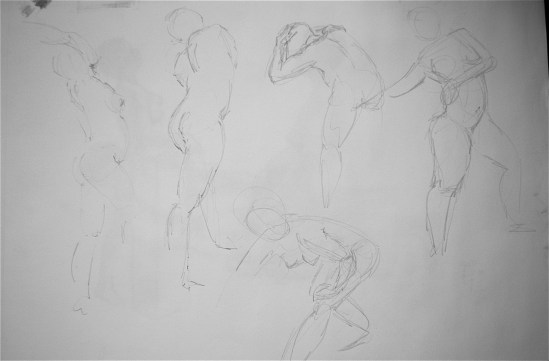
Three Hours of Life Drawing

I hesitated to expose an unedited display of everything I did in the course of a life drawing session–not all of it is worth going down in history–but I’ve got this blog to feed and I have done so little art this week that I am desperate.  First you have to agree not to sneer.  If you can’t promise that, you should refrain from going any further.

Our Saturday Life Group seldom varies from the following regimen:  five quick poses of one minute each, then a five-minute pose, then a ten-minute pose.  These total 20 minutes and earn a 5-minute break for the model.  Then a 20-minute pose.  In theory, at this point we have used up only 45 minutes of our three hours.  Over the next two hours and  15 minutes, we will typically ask for two different poses, broken up by breaks every twenty minutes.  The length of each “long” pose is usually between 40 and 50 minutes.  Once, maybe twice, since I have been a member, we got one longer pose over that two-hour period.  At that duration, I can start thinking about drapery and background, because I generally work  fast.   My Tuesday workshops with Peter Granucci are, more and more, informing my choices on Saturday morning, and one of things I am working on is speed.  Slowing down.  Getting it right in the beginning.

But one-minute poses don’t allow for getting much of anything right.  What you must do for a one-minute pose is quickly decide what you want to capture–the gesture, for example, is a good choice.  I had been using newsprint paper, both purchased and saved from packaging (one of my art suppliers uses crushed paper as packing material).  Peter frowns on using inferior paper for even the quick sketches–you should be practicing on the same quality of paper that you intend to use for your masterpiece.

So (coincidentally) this week, I decided to obey Peter, and left the newsprint at home.  Here are my five one-minute poses:

The first one, the one on the left, is my favorite.  I went for the delightful posture, and attacked it by first marking a few key points, then connecting them.  You can pretty much see those marks, which are slightly darker than the other marks.  After that pose, I pretty much fell apart and struggled to find my way.  But it doesn’t really matter–whatever comes of these exercises, they do warm you up, get you moving your arm and thinking in the  right mode.

Here is how far I got on the five-minute pose:

Getting it right entails measuring and lining up.  I do a  lot of that by eye, but sometimes I need to do some actual measuring and lining up using a straightedge.  For this one, I don’t remember using a tool.  I think I placed the forward foot in relation to the calf of the closer leg, but it doesn’t look correct now.  Instead of making sure that I got that relationship absolutely correct, I was busying myself with the more interesting light and shadows.  Aside from the mistake in foot placement, this drawing is not bad for five minutes, but it illustrates how haste makes waste, and why I must slow myself down even when I have only five minutes to complete the drawing.

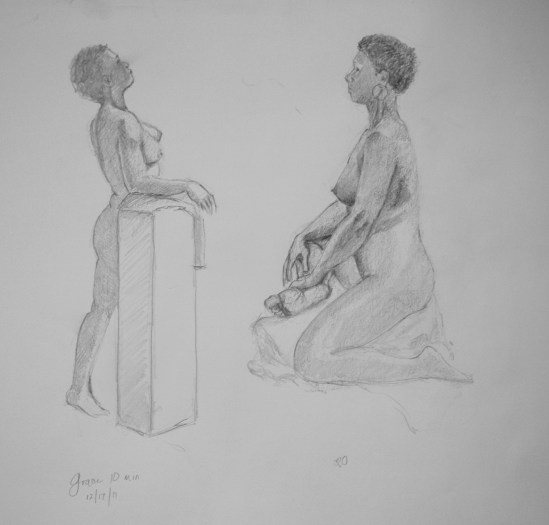
Next up is a ten-minute pose, which seems wonderfully luxurious at this point in our sessions.  Usually I switch to charcoal at this point, but Saturday I decided to stick with the pencil because I must use it in Peter’s workshop.  Using a pencil forces me to slow down.  Because the pencil is so confining, I also chose to draw smaller, which led to two drawings on the same page–the ten and the twenty-minute poses:

With both of these, I tried really hard to slow down and get all the parts in the absolutely correct places.  These are OK, I think.

For the last two “long” poses, I gave myself permission to do my drawings in charcoal.  It seems weird to me now, but I used to be afraid of charcoal.  I can remember asking permission to start my first charcoals drawings with a pencil sketch.  Probably I was worried about being unable to erase, which is really silly because nothing could be easier than to obliterate a charcoal mark with a swipe of a finger.  But the best thing about charcoal is your ability to create shadows with a smear of a finger.  So much quicker than hatching with a pencil.

I like this one best.  We got two 20-minute poses and I was finished with the pose then, but some people wanted more, so she went back into it for another 7 minutes, and I used that time to create another version of her head.  She has a wonderful face to draw.

The final long pose was one I struggled with, which is a little strange because you would think this pose is easy:

I got hung up on her hand, and redrew it multiple times, and am still not happy with it.  But the bigger problem lies most likely in my beginning — too fast perhaps.  Looking at the pose now, I think she looks too uncomfortable.  Yes, she was leaning on her far-side arm, but her legs should look more relaxed.  I’m pretty sure I did the requisite measuring and checking, but something is not quite right.

After our session concluded, we went over to Joey’s house for the most wonderful party, to celebrate a great season of drawing.  We will start up again in January.

Aline Lotter is currently exhibiting:

at the Gallery at 100 Market Street in Portsmouth; at the Sage Gallery in Manchester; at the Hatfield Gallery in Manchester; at the Bartlett Inn in Bartlett; at the Red Jacket Inn in North Conway; and at her studio by appointment.  And if you happen to eat at the Bedford Village Inn, check out the painting in the foyer.

Link to website: www.paintingsbyaline.com

“I See Naked People”

“I see naked people” was adopted last year by my life drawing group (SLG, or Saturday Life Group) as its motto on the occasion of its 20th anniversary.  I didn’t get it at first.  It’s supposed to evoke the little boy’s shocking statement in the movie ” The Sixth Sense “:  “I see dead people”.   We had t-shirts made up with the slogan on the front and an outline of a nude figure on the back.  I wore mine fearlessly to Home Depot and the like, oblivious to the curious stares until someone would ask me about it.

Recently, as a result of several visits to an exhibit at the Boston Museum of Fine Arts, I came to realize that what we see in SLG isn’t naked people at all–we see nudes.  The MFA exhibit was the Nudes of Edgar Degas.  The best of his nudes are pastels of  nude women engaged in some kind of bathing activity with their backs turned to the viewer/artist.   One of the many innovations credited to Degas was this rendering of a person unclothed on purpose, that is, for a purpose of her own, rather than a person unclothed and posing for the benefit of an artist who wishes to draw or paint a nude figure.  The naked women by Degas were disturbing, therefore, stripped as they are of an artistic rationale.  Nakedness is shocking, nudity is art.  (If you think this is odd and hard to grasp in this day and age, consider the outrage that greeted Manet’s “Olympia”–she was depicted as a prostitute awaiting her customer, in a pose that had not shocked anybody when it was assumed by Venus, the goddess of love.  See the Wikipedia article here.)

Anyway, this week I am treating you to some nudes.  And what connects my nudes (albeit tenuously) to the foregoing two paragraphs is the word “people” in the SLG slogan.  Usually I don’t see naked or nude “people” because usually I only see one person/model at a time.   Models charge for modeling (clothed or not, but they get a little more for taking off the clothes), so it is  a luxury to have more than one model posing at  a time.  Especially since you can look at only one at a time, really.  I have trouble understanding why simultaneous multiple models would even be desirable– getting one figure right is challenge enough.  Be that as it may, I guess we had some extra money accumulated in the kitty, so one morning  a few weeks ago I went into SLG to find not one, not two, but THREE models undressing for our benefit!  Fortunately, I could not see all three of them well enough to incorporate all three into a single drawing.  Two was hard enough, thank you.

Double the Pleasure

We had two hours (less break time) to work this double pose.  Our third model took his pose on the other side, forming a kind of triangle.  Yes, he was a male.  Radical!

This past Saturday, we were back to the normal single model, suddenly seemingly so easy!

sketch, standing figure

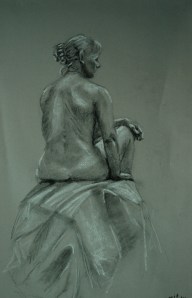
seated figure

I remember complaining in the past about getting more than my fair share of back views, and although I still do seem to get a lot of backs, I’m not complaining anymore.  I have been humbled.  Backs are hard enough to do.  The challenge is to keep it simple even while suggesting the complexity of the bone and muscle structure beneath the skin.  I am still working all that out and thus may be faulted for overdoing the complexity thing.

While rooting around in my stacks of older drawings looking for something suitable to submit for an exhibit, I came across this one:

His Dreaming

Funny how a drawing I don’t even remember making could magically appear and rise to the top of my favorites.   I am fascinated to see how I used a light brown chalk to highlight his hair and applied those white strokes of light just as if I were as expert as, say, John Singer Sargent.  Yet I recall nothing of the process.  Probably it went fast, and was followed by something else that loomed larger in my mind.  I usually make a note of the length of pose and the date on my drawings, so I am able to confirm that it was a 40-minute pose, and it turns out I had to accompany my granddaughter to a court hearing right after the drawing session.  Yes, a court hearing could obliterate whatever came before it.

After patting myself on the back for the discovery of “His Dreaming”, I tore up many, many others that embarrass me now.  God forbid I should be subjected to the fate of Degas with  my inferior projects unearthed after my death and exhibited in a museum (I should be so lucky, but this is “My Dreaming”) alongside the good stuff, where pompously overinflated amateurs (like myself) can sniff and proclaim them to be worse than unremarkable.

That I am getting better is proved by the callousness with which I tossed my inferior stuff, and I think my progress can be attributed to the work I have been doing with Peter Granucci.  What we do in his figure workshop is all practice, practice, practice, so there’s not much to show off–yet.  He has promised that exhibit-worthy projects lie in our future.  (As if a venue could be found for an exhibit of nudes.  Naked people.  Oh, the horror.)

Aline Lotter is currently exhibiting:

at the Gallery at 100 Market Street in Portsmouth; at the Sage Gallery in Manchester; at the Hatfield Gallery in Manchester; at the Bartlett Inn in Bartlett; at the Red Jacket Inn in North Conway; and at her studio by appointment.

Link to website: www.paintingsbyaline.com
Studies, Ending, Beginning

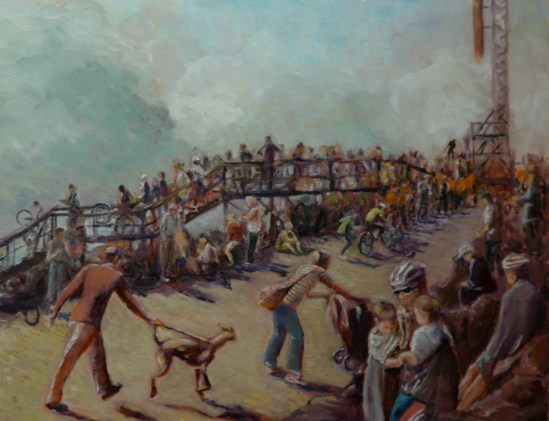
This is the last study for my large Mt. Washington Bike Race painting.  I numbered it “4” but in fact it is 5 if you count the two portraits in the series.  I have started on the big canvas, but the drawing is so rudimentary that I am saving it for a future post, when I hope I will have something of interest to display.

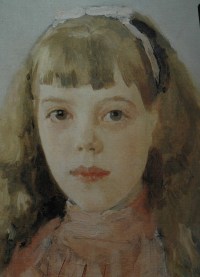
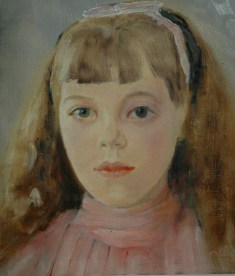
Meanwhile I would like to share with you a minor triumph–well, sort of a triumph and certainly a very minor one.  Last Summer (can’t believe it has been that long ago) in the Portraits course I was taking with Cameron Bennett, he crushed me with the observation that an eye was too low on a copy of a Serov portrait that he had assigned us as homework.  Here is a link to my report on that last effort.  Last week I finally got around to correcting that flaw.  I used a ruler.  I laid the ruler under the eyes of the original, then under the eyes of my copy.  I couldn’t find any discrepancy, yet I had to agree the there was something fishy about my eye.  Of course, the color was wrong, but could that obvious flaw have create the misimpression that the eye was too high or low?

Original, by Valentin Serov      

My copy of Serov portrait (A)

My copy, after retouching eye

Original Portrait by Valentin Serov

Finally, one more workshop piece, from our (NH Plein Air artists) most recent meeting of the Peter Granucci workshop series, which ironically, requires indoor practice from photographs.  The subject this month was snow.


Snow Shadows

Improvements

DSC_3049

Above is a new and improved version of the Rockport Harbor painting from last week.  I’m hoping you might be curious to see what can happen to a plein air painting after the artist gets to stare at it in the studio for a while.  It all started when I decided that the shape of the red fish house was not quite right.  Perspective errors are the worst–they haunt me forever unless I fix them.  And once I dive into a painting to make one correction, chances are pretty good that I will find other ways to improve on a painting, even a painting that started out not so bad.   (With a bad painting, I’m like a dog with a bone–I won’t give it up.)  So, after correcting the shape of the fish house, I made the following changes:

Sky:  horizon color–greener

Red fish house: adjusted values of lighted and shaded sides

Blue fish house: changed color of  roof

Boats:  added clean whites to sun-struck surfaces

Water:  brought up reflections of boats, toned down reflection of red fish house

Stone abutments:  eliminated highlights, contrast

Rockport Harbor WIP

After making those changes, I submitted the painting to Patrick McCay’s critical gaze in my EEE class, and, following his advice:

Foreground shrub: added darker shadows, to better compete with the dark in the middle boat

Middle boat:  inserted lighter shadows into the deck , so that the boat stopped attracting the eye

Red fish house: grayed down the red on the fish house–to comport with aerial perspective rules.

I think it’s done now.  Unless something else starts to bother me about it. But I am deep into more studies for the Mount Washington bike race painting and unlikely to give Rockport Harbor another going over.

Here are two Mt. Washington studies, one finished (maybe) and the other, not quite finished–hope you like them!

View of race with vista

At the Finish (WIP)

Aline Lotter is currently exhibiting:

at the Gallery at 100 Market Street in Portsmouth; at the Sage Gallery in Manchester; at the Hatfield Gallery in Manchester; at the Bartlett Inn in Bartlett; at the Red Jacket Inn in North Conway; and at her studio by appointment.

Link to website:  www.paintingsbyaline.com