IPAP weekend

IPAP stands for International Plein Air Painters, and every year in September, IPAP, the organization, calls on the painters to get outside on a particular weekend and paint. Our local organization, the NH Plein Air group, or guys, or whatever, responded to the call. It is our tradition to select three different locations over the weekend (weekend for painters generally includes Friday). So while in other parts of the world, I imagine painters piling up at their glamorous locations, we spread it around New Hampshire.

I participated on the first two days of our event. Friday we painted at Twin Bridge Park in Merrimack. It’s one of those places that you would never notice unless you got out of the car and explored. From the parking lot, you take a trail down toward a baseball field and playground, but then veer off into the woods, and descend farther, following the sound of rushing water, to a trail alongside Baboosic Brook. Due to the recent storms, the Brook was a torrent.

My chosen scene, featuring Sharon Allen behind the tree.

Because of last week’s workshop on layering water, for my second painting I chose this scene:

The water was moving very slowly over the flat rock in the foreground, which just happened to be catching beams of sunlight. The light enables you to see the shapes and shadows formed by the rock’s submerged surface, the ripples catch the blue of the sky, there’s foam, there’s vegetation, there’s unsubmerged rock. There’s not enough time! I had only an hour to work on this painting, so I kept my rendition of this scene abstract:

I like this painting for what it is, but I would like to paint another version from my photograph, to see if I can better capture the effect of the light and seeing-throughness, to coin a phrase. (Probably “transparency” is the synonym, but that word has secondary meanings and who needs that?)

Saturday morning I could not give up the new year’s first meeting of the Saturday Life Group, so I was not at the appointed IPAP location until the afternoon. We painted in the most northerly end of the Amoskeag Millyards in Manchester. Old mills, because of their locations on waterways, near falls, offer a large range of subject matter. It was my idea to paint there, but turnout was disappointing. I guess most plein air painters prefer natural landscapes over the man-made ones. I, on the other hand, even welcome the odd vehicle into my paintings from time to time:
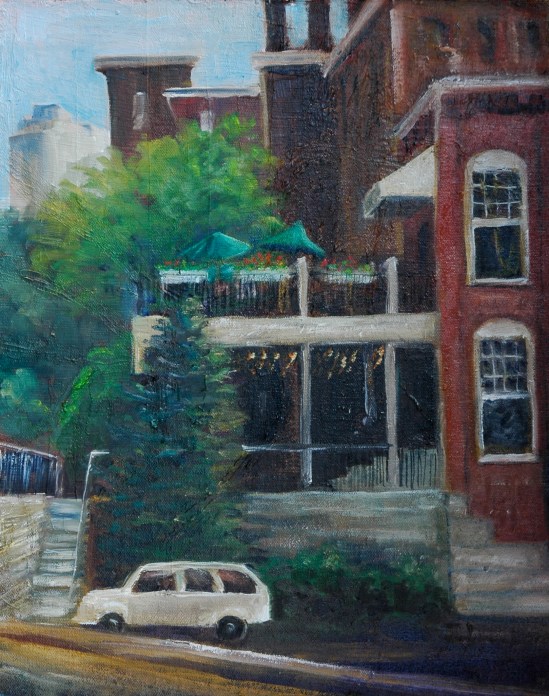
The building in the foreground is occupied by a restaurant (Fratello’s–good Italian fare). All of the buildings in the Millyard have been repurposed of course–there is no milling going on there. In another one of them, at the southern end of the city, is the artist’s studio where we have our figure drawing on Tuesdays.

NEWS FLASH! A new fine art gallery is opening in the arts and cultural neighborhood of Manchester, 70 Lowell Street, just down Lowell Street from the new building of the NH Institute of Art. Called the “Sage Gallery . . . . a Fine Art and Metaphysical Meeting Place” (how quixotic is that!), it is owned and operated by the former director of the Manchester Artists Association Gallery, Janice Donnelly. I have seen the space and it is terrific, and of course the location is also terrific, not to mention the director–yes, also terrific. Yes, I will be exhibiting there. I think the hours are generally 11 to 4. If you can, please stop by and encourage Janice’s courageous venture.

Layering Water

This week I was almost a full-time artist. Tuesday, I attended a figure workshop in the morning and painted at the Bedford Farmers’ Market in the afternoon:

Friday I tended Gallery (Manchester Artists Association) and passed my time by painting a sunset with reflections in puddles, thinking to prepare myself for Saturday:

Saturday I attended another one of our periodic single-issue-landscape workshops with Peter Granucci; the topic of the day was handling see-through water, that is, water shallow enough to allow you to see to the bottom. More about that later.

Sunday Sharon and I met up with other NH Plein Air artists at the Fruitlands Museum in Harvard, Massachusetts. Our mission was to paint, but we also visited the art musuem on the grounds. On exhibit from their permanent collection were paintings by the Hudson River painters; on special exhibit were paintings by New England impressionists from the turn of the century. Only one name was familiar to me–Childe Hassam. My favorite of the heretofore unknown impressionists was a guy called Clifford Grear Alexander. I googled him, but other than his dates (1870-1954), no biographical information is available. Both Sharon and I were struck by the fact that many, if not most, of the paintings in these two exhibits were of New Hampshire scenes.

Farm House at the Fruitlands Museum, 11×14; when I got bored by this painting, I applied high contrast outlines to see the effect. I like it.

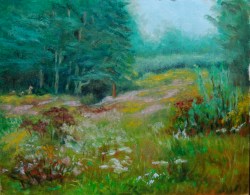
Meadow at the Fruitlands Museum, 11×14.

Monday, today, I put more time in on the Meadow because I had only one hour’s work into it on location. One of the docents had told me she saw a doe with two fawns at the tree line, so I added them to the scene. I wish I had a better grasp of deer anatomy, but people keep referring to our Great Dane as a deer, so I put her in the painting, hoping she passes as a deer from a distance.

The title of this blog, “Layering Water”, comes from the Saturday workshop. The point of the workshop was to learn to see all the layers created by water, and then, armed with that understanding, represent them in a painting. There is the reflection on the water, which requires that the water be relatively still. There is the surface at the bottom of the water, which requires either no reflections, or that any reflected object be in shadow–you cannot see through a reflection if the reflection is lit. If you can see the bottom rocks, mud and whatever, you need to note color changes and value changes but much more subtly than if the water was not present to obscure the view. Sometimes it’s hard to decide whether you are looking at a reflection or at something that exists under the water, especially if your reference has no context. Peter started us off with photographic examples that made our heads spin. Then we worked on two assignments. Here are my results:

The assignment on the left was relatively straightforward. Below, on the left,  is a closeup of one of shadows formed by the submerged rocks.  The closeup on the right is reflected grass–note that the reflection is darker because the underside of the blade of grass is not lit by the sun.


The second photograph was hard to deciper.  We believe that the lighter shape at the top may be an overhanging rock. The middle section is supposed to represent a partially submerged rock extending toward a fully submerged ledge. Why is the water line so dark? I still don’t know what to make of the dark shape between the overhanging ledge and the submerged ledge, but in the middle of it is another rocky shape that suggests the whole dark piece is a shadow cast by — something outside our view, or the overhanging ledge? Peter wouldn’t say. He took the photo but maybe he couldn’t remember, or maybe he just enjoys torturing us.

Snow Painting

Next August, I plan to participate in a special exhibit at the Arnold Arboretum in Boston, of paintings painted au plein air by members of the New Hampshire Plein Air group at the Arboretum. We are trying to cover all four seasons of the year. So we had to do winter. On January 7, the first group of us (about six in number) descended upon the Arboretum with our usual gear, plus all those things designed to keep us from freezing to death. I staked out a spot on the Willow Path, which is just inside the main gate, not far from the bathrooms in the visitor center. At least I had a bit of a hike to get to this spot. Others who shall remain nameless set up their work stations in the parking lot.


Willow Path in Winter

Willow Path in Winter

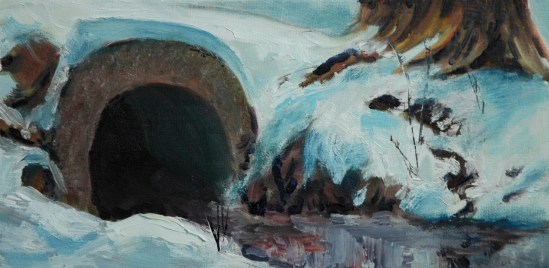
After finishing the painting above, I had a little extra time, so I produced a 6 by 12 panorama of a nearby culvert, which may seem a little weird to you. I chose it to seize the opportunity to include a richly dark area in my composition. Contrast creates drama.

Culvert in the Arboretum

Culvert in the Arboretum