Urban New Hampshire

I have saved up a number of challenge paintings for this post.  The challenges came from the subject matter.  Although landscapes in general are less demanding than other genres because nature is so variable in its beauty, the same cannot be said when architecture, vehicles or people become prominent in the scene.  Perhaps I have been setting myself up for a higher failure rate.  But I can’t learn if I stick to easy subjects.  I’m not sure which of these are failures and which are the successful embodiment of a new direction in my artistry.  I’m feeling my way, so to speak, across the landscape of my creativity.

Newport

First, a large (20×16) rendition from a photograph taken when I realized I had forgotten my chair.  I simply cannot stand to paint for two hours at an easel.  Old bones, or something like that.  So I photographed my inspiration and tried not to become a servant of the photo.  This is a vacant mill (it is for sale) in the Town of Newport, New Hampshire.

The Ruger Mill, Newport, NH

The Ruger Mill, Newport, NH

The lead in to this view of these sunken buildings intrigued me the most:  that curvy downward driveway must have been a nightmare when shifts changed.  The river that powered the mill flows out of sight in the back of the buildings.  I believe that same river is the waterway that led to my next Newport painting.  A one-lane covered bridge next to a rolling park is a kind of hybrid between straight landscape and architecture, but no one can deny a bridge is a construct subject to the laws of perspective.  It was threatening rain the day I was in Newport for this painting, and after I scouted the various aspects of the bridge, it did rain, furiously.  I waited.  After all, I was several hours away from home and there wasn’t any reason to hurry home.  After about 20 minutes I got lucky.  The rain stopped and the sun even came out intermittently.  For an hour.  Suddenly–that means without warning–it started raining hard again so I packed up quickly and headed home.

Newport Covered Bridge

Newport Covered Bridge

I studied the quick block-in long and hard.  I knew the perspective was probably wrong.  The bridge was level, but looks as if it is slanted upward in my painting.  The reflection reinforces that notion.  I consulted the photograph taken when I was scouting, and it shows a bridge going straight and level.  But I really, really wanted to trust what I blocked in at the site.  After all, I was seated while painting, and I had been standing to take photographs.  If I changed the bridge and the reflections, I would have all those stripey shapes that I hate so much.  Ergo, slant stays.  For the good of the art.

Exeter

Again this year I participated in the paint-out fundraiser for the American Independence Museum in Exeter.  I had scouted locations the day before, when I was delivering paintings to our pop-up gallery on Water Street, and spied a good riverfront vantage point on private property that had a sign warning “No Trespassing Fishing . . . [other forbidden activities]”.  There was nevertheless a guy fishing .  I asked him about the sign, whether it was vigorously enforced.  “What sign?” he asked.   He had never noticed, but it didn’t matter:  he lived in the condo complex and gave me permission to paint there the next day.  First, I painted the buildings across the river, but I included a vigorous evergreen that partially blocked my view, instead of moving to the right where the shrub would not block my view.  That meant painting a close up of a potted plant, in addition to the architecture in the background, not to mention the river itself and a boat tied up to a landing.  I felt it might be possible because I had chosen a large panel, 16×12, for the project.  But the evergreen defeated me.

Exeter Riverfront

Exeter Riverfront

Almost from the same spot, I found a charming bridge that I wanted to paint.  The evergreen was in the way again.  For this one, I did stand up, because I really had to in order to see over the shrubbery.  But I knew I only had a hour to paint because the wet paintings were due back at the Museum for the wet paint sale, so I figured, for an hour I can stand.  Note the different treatment I tried out for the same shrub in the second painting.

String Bridge, Exeter

String Bridge, Exeter

Neither painting found a buyer, but in my haste to set up, I mispriced them as if they had been framed.  Just as well, because when I got them home, I improved on the shrubbery.  Not so much but I was happier.

Last week, I was back in Exeter to see if the pop-up needed any help.  It didn’t, so I went up Water Street and painted the scene looking down and back to where our gallery is.  Shrubbery was replaced by automobiles.  They moved in and out of the parking spots in front of me.  What can you do?  I never got a good enough handle on what existed behind the cars, so I had to include the cars.  Maybe I can develop that into a specialty!

Water Street, Exeter

Water Street, Exeter

Portsmouth

Market Square in Portsmouth was the site of an organized paintout last Wednesday.  Only four painters that I was aware of, which including me and Flo, actually participated.  Flo and I settled on the shady corner kitty-corner from the dominant building, North Church, whence I included North Church and the street running to the right and down.  Blocking my view on the right was a tree and Flo, who painted the picturesque row of storefronts behind me.  It would not have been realistic to paint Market Square without vehicles or people.  So I grabbed a few impressions–one trolley and one van for vehicular traffic, and two couples for the human sort.  Traffic is so annoying; it moves.  The parked cars in Exeter were a piece of cake by comparison.

Market Square in Portsmouth

Market Square in Portsmouth

New Boston

Last is the painting I did at the Farmers’ Market last Saturday in New Boston.  A call had gone out on the NH Plein Air list inviting plein air artists, and I answered the call.  I was the only one to do so.  I’m not sure, in retrospect, whether the idea was for the artist to be selling artwork or to be creating artwork.  I had assumed creating, because in years past I had done the same at the Bedford Farmers Market.  So I created.

Under Dogwood, New Boston

Under Dogwood, New Boston

For a little while, I had a group of musicians in the gazebo, but alas, they had to leave after an hour, and without warning!  Well, challenges, right?  Another difficulty was the Dogwood tree.  Since it was in the foreground, like the nasty evergreen shrub in Exeter, I felt I had to do more than suggest a generic tree with white blossoms.  It should convey the idea of a dogwood tree.  Conveying the idea of musicians was much easier!  Go figure!  (Pun not intended.)

So there’s an assortment.  Is anything happening here in terms of this Painter’s Progress?

Aline Lotter is currently exhibiting:

with the East Colony  artists for the rest of June and all of July at 163 (167) Water Street, Exeter, NH; at the Bedford Public Library; at the Bartlett Inn in Bartlett;  at the Bernerhof Inn in Glen; at the Red Jacket Inn in North Conway;  at the NH Institute of Art, 77 Amherst St., Manchester; and at the law offices of Mesmer and Deleault at 41 Brook St in Manchester.

As usual, you may view paintings with prices and order prints, iPhone cases and the like at my Fine Art America page. If the painting you are interested in is not there, or if you prefer to bypass that experience, you may contact me by email to alotter@mac.com.

If you want to add a public comment to this blog, go to the bottom of this page where it says “Leave a Reply”, and enter your comment in that box. I love to get public comments, so don’t be shy!
Lupine Worship

Every year in June, our NH Plein Air group organizes an outing to Lupine country.  “Lupine country” in NH means primarily Sugar Hill, because Sugar Hill encourages the propagation of lupines in support of its annual Lupine Festival.  Sugar Hill is a drive of about two hours from Manchester, where I am.  But great lupine patches do exist elsewhere.  You might therefore think we are a little mad to drive for two hours to find paintable lupines when we could find a closer patch, or even create our own patch at home, given proper conditions.  But we plein air painters are a travelin’ sort, and we would hike into the wilderness for miles when younger and just as mad.  For an example of such a mad artist/hiker/camper, see this blog.

(“Lupine”, also spelled “lupin”, is pronounced with a short “i”, although one online authority allowed as how the long “i” is OK when the word is used as an adjective.  For example, we went to lupIne country to find lupins.  I only bring it up because there seems to be a difference of pronunciation in these here parts.)

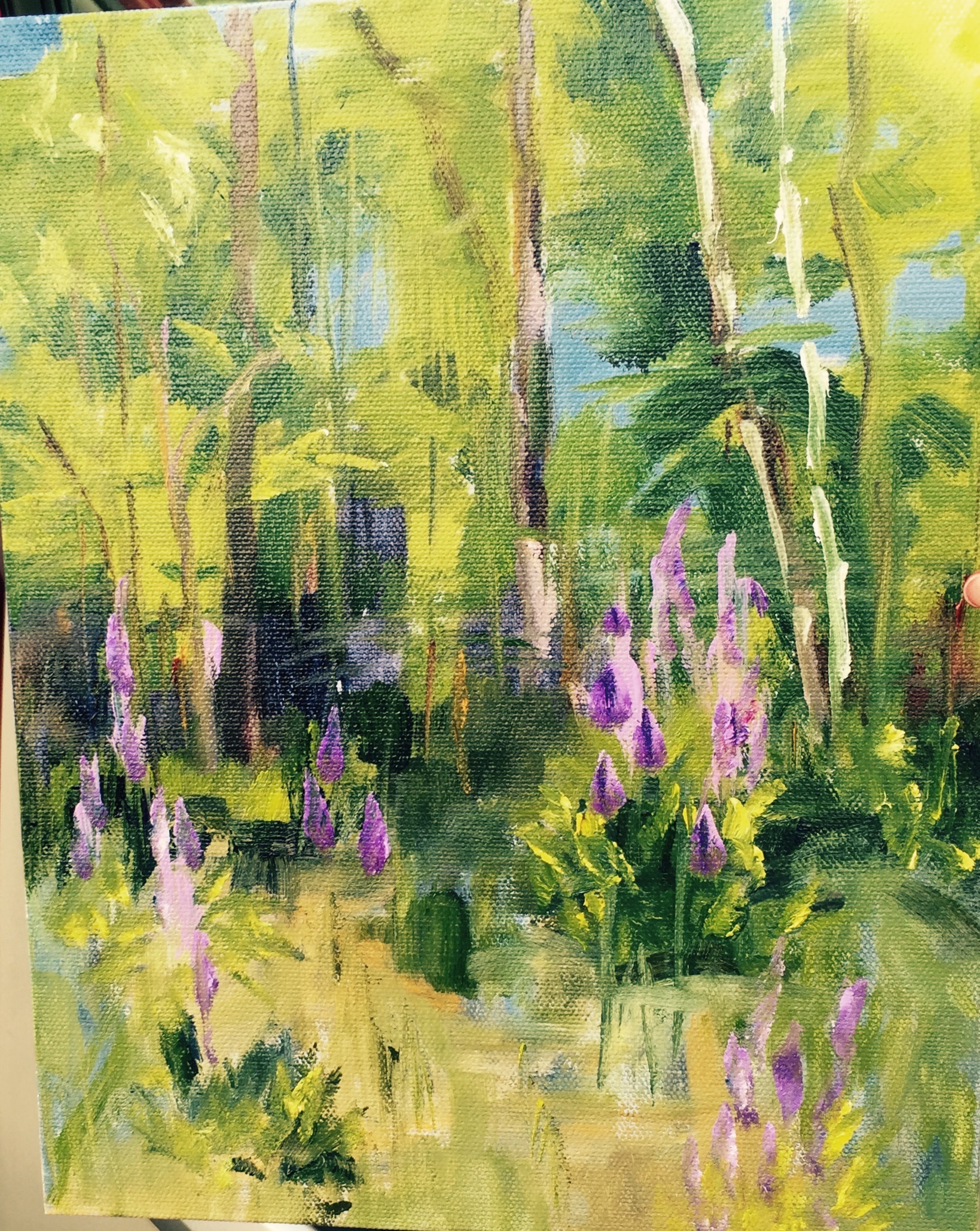
My companion on this year’s lupine hunt was Flo Parlangeli.  As if a two-hour drive wasn’t long enough, the adventurous spirit in which we set out Wednesday morning motivated us to take a detour around the Pemigewasset Wilderness, through Crawford Notch, where we had heard of a glorious lupine patch in years gone past.  Alas, tales of its demise had not been exaggerated, but enough remained to justify a quick painting from each of us.

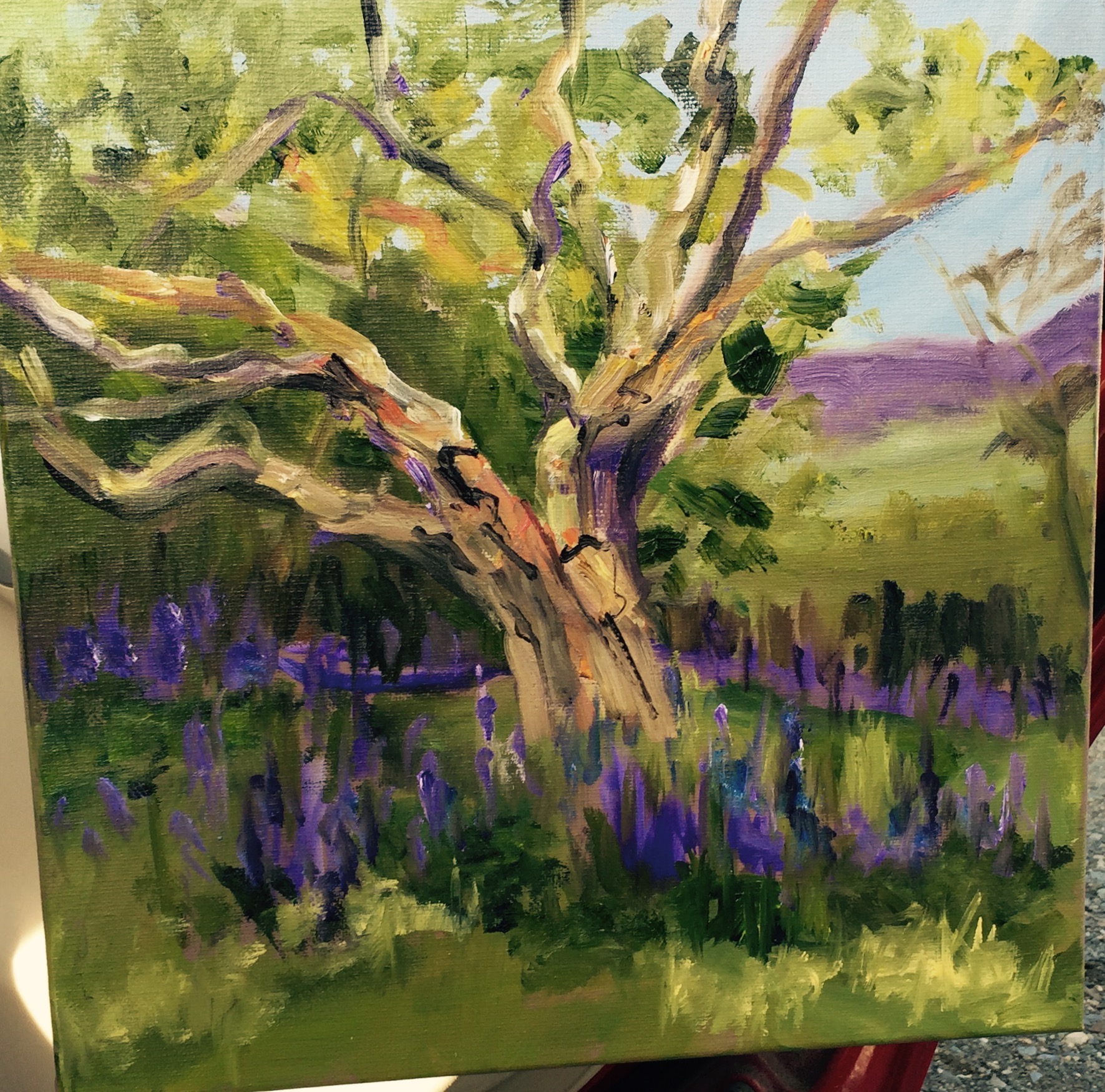
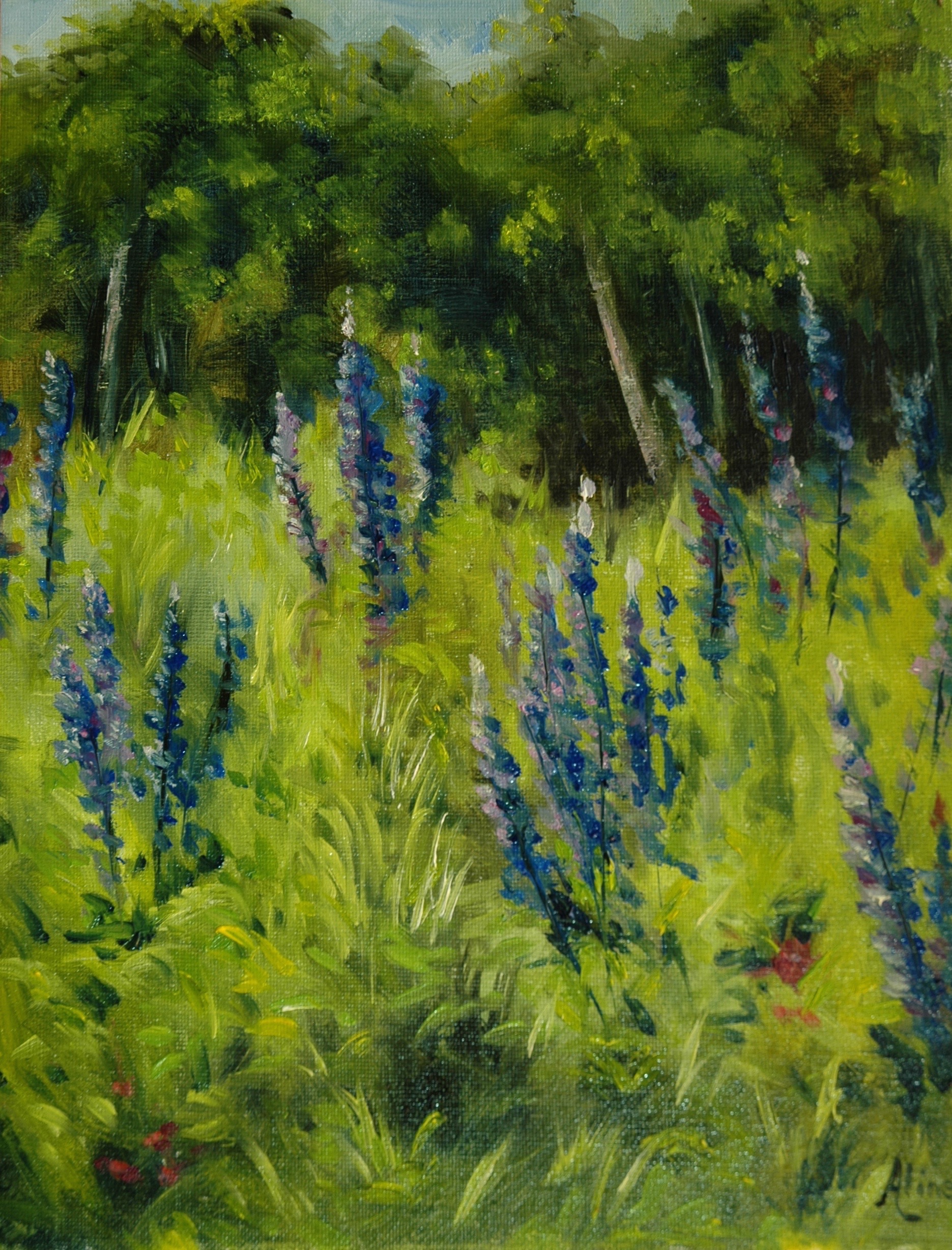
Lupines in Crawford Notch

Lupines in Crawford Notch

Flo's Crawford Notch lupines

Flo’s Crawford Notch lupines (a quick iPhone snapshot)

Lupines are predominantly blue or purple up here, but pink and white exist in small numbers.  As you can see, I prefer blue lupines to purple lupines, so I exaggerate in that direction.  The blue of lupines has been something that has frustrated me from the beginning.  Back in 2009 on my first foray (just before I started blogging, so there’s no entry recording that experience), I thought it was the Ultramarine Blue that was preventing me from getting just the right shade of violet.  Today, looking back, I realize that my red must have been the culprit–it must have leaned toward orange, so when mixed with blue, the hues were neutralized toward brown.  My next stab at lupines occurred in 2011, with better results, I just revisited my blog entry and found this tidbit of wisdom, which I had forgotten between then and now:

  • I have never been satisfied with the color of my lupines in paint, but got a clue from Michael Chesley Johnson in his recent blog on painting lupines in New Brunswick: when the blue of the flowers is applied to a surface of wet paint, the blue sinks into the paint underneath, muddying the blue; so the painter must go back after the oil paint has set up a little bit, with fresh blues to represent the glorious blue of the real life flowers. This I did, and I also blended in a tiny portion of a rose color that I don’t take outdoors with me, to achieve the purply blue lupines.

Unfortunately, the image that I used to illustrate the above statement does not now seem to me to be effective in that regard.

Field of Lupines in Jaffrey

Field of Lupines in Jaffrey

Then in 2013, Stab No. 3  but I was still not entirely satisfied that I had captured the essence of Lupinness (Lupinity?):

Lupines, AFTER

Lupines in 2013

Wednesday, I took with me Magenta and three blues (Cerulean, Ultramarine and Cobalt).  After squeezing them all out on my palette, I kind of swirled them together in an effort to get the impression of purply blues in various proportions.  (Taking a leaf from the Impressionists playbook.)

After that hour in Crawford Notch, we headed back west to Sugar Hill country and proceeded to get  totally and inexcusably lost when we were within only a few miles of our goal.  Another hour wasted!  We remained cheerful because it was a perfect day in June and we were surrounded by wild loveliness, some of it the color of lupines.  After returning to Sugar Hill, we explored its usual offerings, but settled in a unexpectedly cozy spot across from the Sunset Hill Inn, next to the golf course parking lot.  (Sunset Hill House was the scene of two Snow Camps that I blogged about in years past.  Then it failed, and we ended up for Snow Camp last January at the Bartlett Inn.  But Sunset Hill Inn has opened in the same location, with renovations ongoing, solar panels installed on the roof, and a very welcoming Brit in charge.)

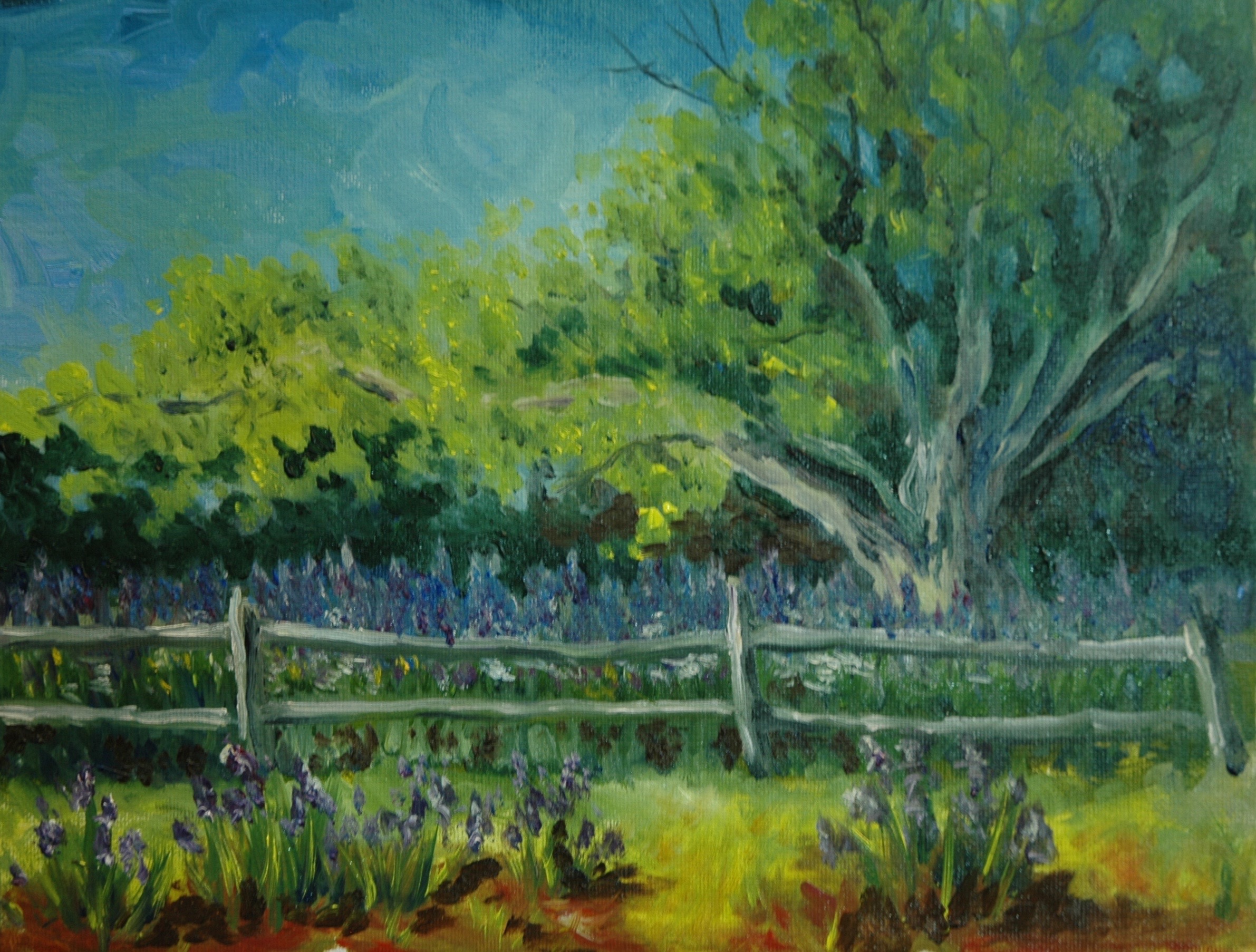
Lupines with Irises

Lupines with Irises

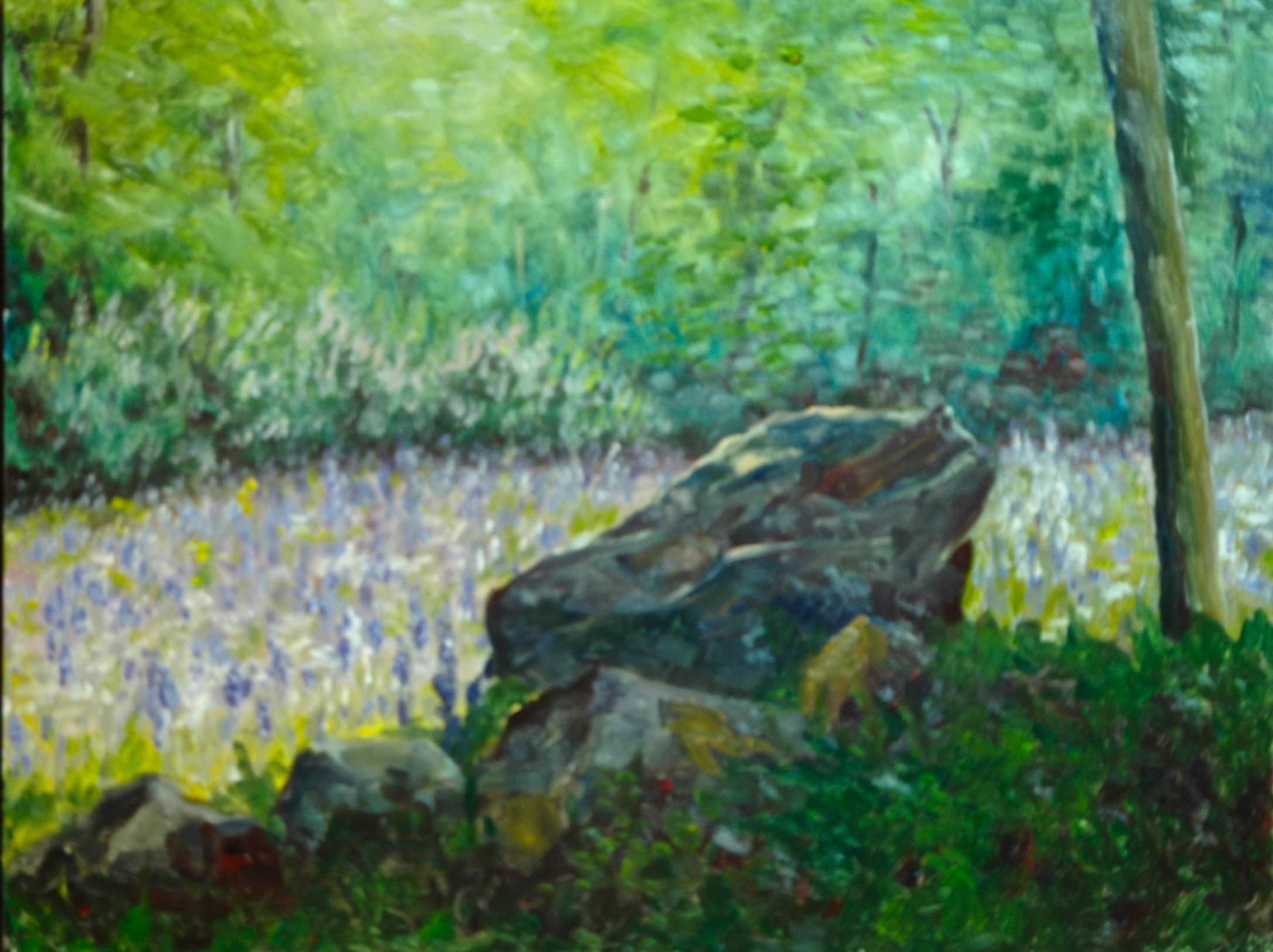
Flo's Sugar Hill lupines

Flo’s Sugar Hill lupines  (another hasty snapshot)

I must say that the photographs that I took of my own two paintings in my studio do not truly convey the lightness, the sunlightness, that exists in the originals.  But what else is new!  The only times I have seen photos that looked as good as the paintings is after they have been converted into giclee prints of the painting.

So what have I learned as a result of the lupine hunt and the writing of this blog?  Impressions of lupines work better than portraits of lupines.  Flo’s color sense is so amazing–notice how it led her to emphasize the deep purple of the flowers and the yellow tint in the gnarly tree.  I must work harder on not being literal.

Flo would say that hers are not finished paintings.  She intends to work them up in her studio, I think.  I considered making improvements to my two but decided against it.  Not that they are perfect, but they are what they are–an impression of a string of moments in a delightful spot on a delightful day in June.

However, I will be taking a second look, with Michael Chesley Johnson’s rediscovered advice in mind.  It is true that you can’t avoid getting some yellow from the surrounding greenness mixed into the blue–which grays back the purplyness (purplity?)

Aline Lotter is currently exhibiting:

with the East Colony  artists for the rest of June at 163 (167) Water Street, Exeter, NH; at the Bedford Public Library; at the Bartlett Inn in Bartlett;  at the Bernerhof Inn in Glen; at the Red Jacket Inn in North Conway;  at the NH Institute of Art, 77 Amherst St., Manchester; and at the law offices of Mesmer and Deleault at 41 Brook St in Manchester.

As usual, you may view paintings with prices and order prints, iPhone cases and the like at my Fine Art America page. If the painting you are interested in is not there, or if you prefer to bypass that experience, you may contact me by email to alotter@mac.com.

If you want to add a public comment to this blog, go to the bottom of this page where it says “Leave a Reply”, and enter your comment in that box. I love to get public comments, so don’t be shy!
Ah, Youth!

There must be a trick to it, one as yet still being kept secret from me:  How to portray youthfulness?  I have hear it posited that the facial features of children fit into a smaller area of the head.  As we age, the features enlarge and spread out.  But what about a teenager?  When do their features settle down in the spots preordained for their adult selves?  Why is it so hard to portray rosy young woman without making her look like a made-up hussy?  I guess it’s really the same old issue, that of getting a likeness, just with the added complexity of pinpointing an age range.

Monday’s model was my nineteen-year-old granddaughter.  This is how the camera renders her.

Natalie in pose

Natalie in pose

For most of Natalie’s life, and certainly all of my [ten-year-old] life as an artist, I have been trying to capture her on paper.  Every time I try, I fail.  She always comes out looking older, more sophisticated than her much-older sister.   Monday was my first opportunity to paint her from life and I sure hoped that would make a difference.  One issue seemed to be the length of her nose (as I was presenting it), so I shortened it by bringing down the level of her eyes.  That did help.  Note that this adjustment is consistent with the theory that  children’s features are closer together.

As I griped throughout the session, Laura opined that youthful features are best barely suggested as opposed to carefully implanted.  It certainly did work for her painting.  And now, in hindsight, I can think of some great paintings of children where that is certainly true–e.g., virtually all of Sargent’s paintings of children.   Sigh.  Sometimes it is harder to do less.  No, it is always harder to do less!

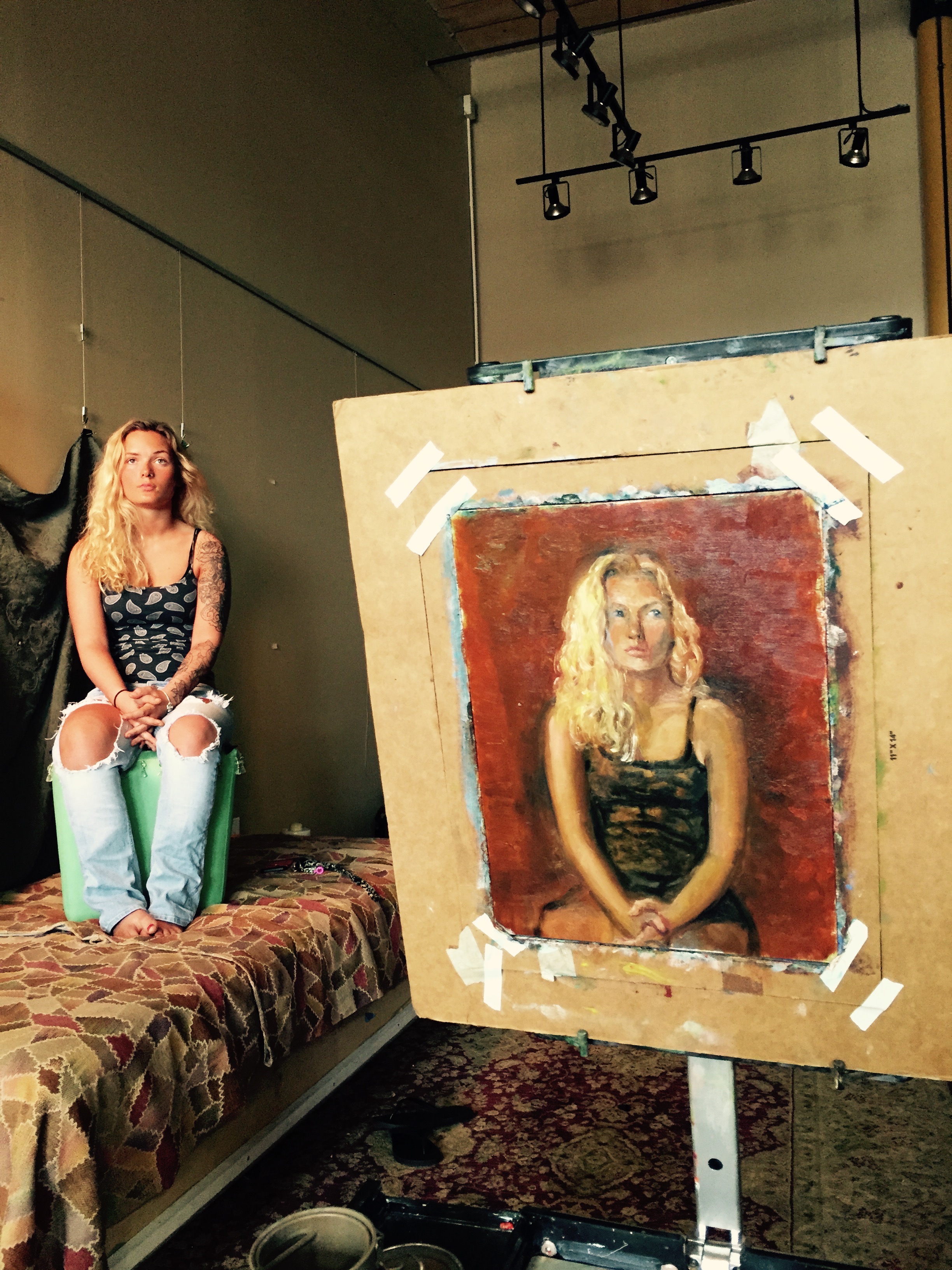
Towards the end of our session, she asked me for a photo of her posing next to my painting, for her to send to her social networking sites:

Natalie as model

Natalie as model

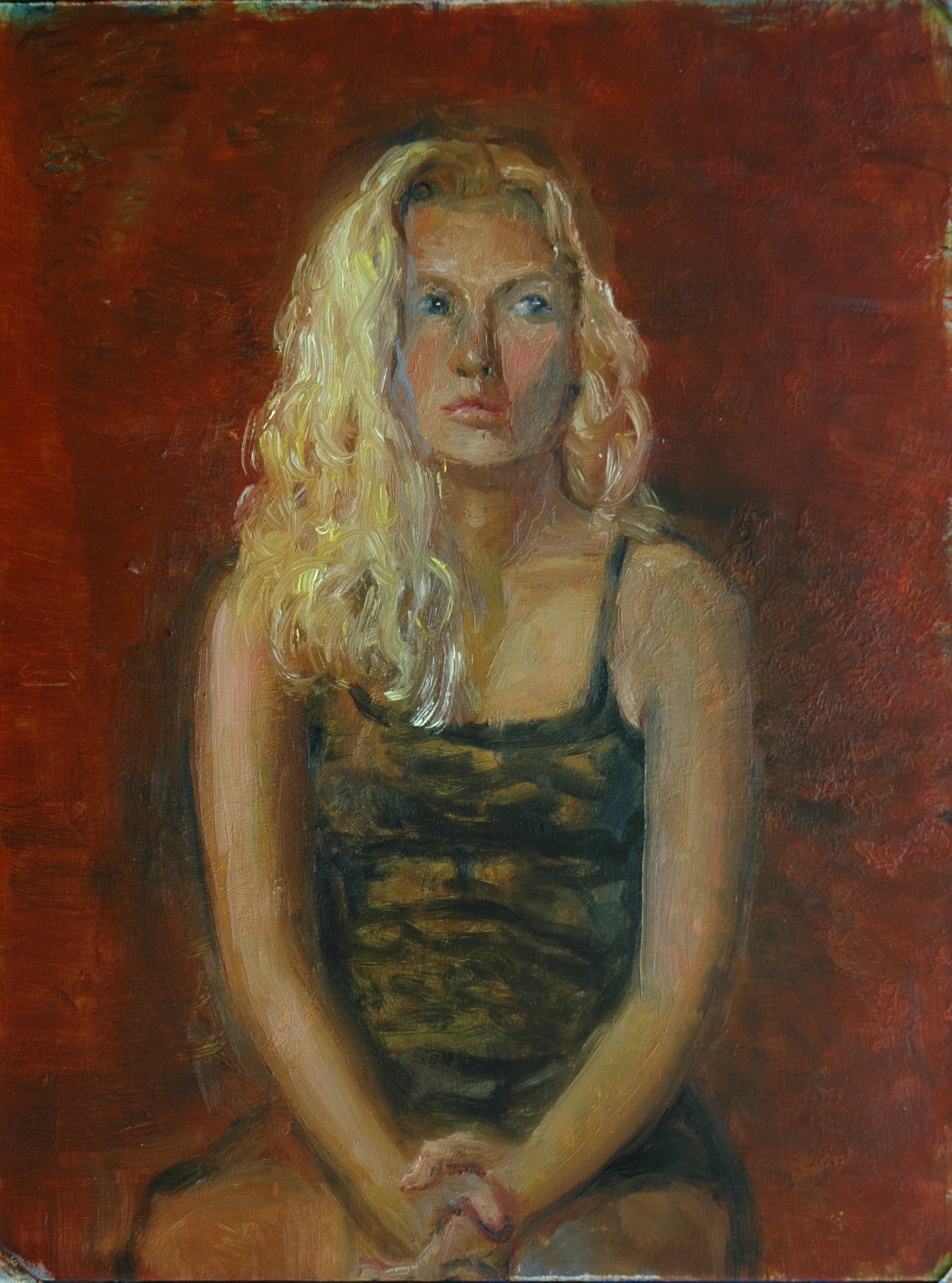
And here is the final.  I would not dare to try to correct anything at this point, so glad I am to have got this close to the goal.

Study for Portrait of Natalie

Study for Portrait of Natalie

Aline Lotter is currently exhibiting:

with the East Colony  artists for the rest of June at 163 (167) Water Street, Exeter, NH; at the Bedford Public Library; at the Bartlett Inn in Bartlett;  at the Bernerhof Inn in Glen; at the Red Jacket Inn in North Conway;  at the Sharon Arts Center in Peterborough, NH; at the Buttonwoods Museum in Haverhill, MA; and at the law offices of Mesmer and Deleault at 41 Brook St in Manchester.

As usual, you may view paintings with prices and order prints, iPhone cases and the like at my Fine Art America page. If the painting you are interested in is not there, or if you prefer to bypass that experience, you may contact me by email to alotter@mac.com.

If you want to add a public comment to this blog, go to the bottom of this page where it says “Leave a Reply”, and enter your comment in that box. I love to get public comments, so don’t be shy!
Monadnock

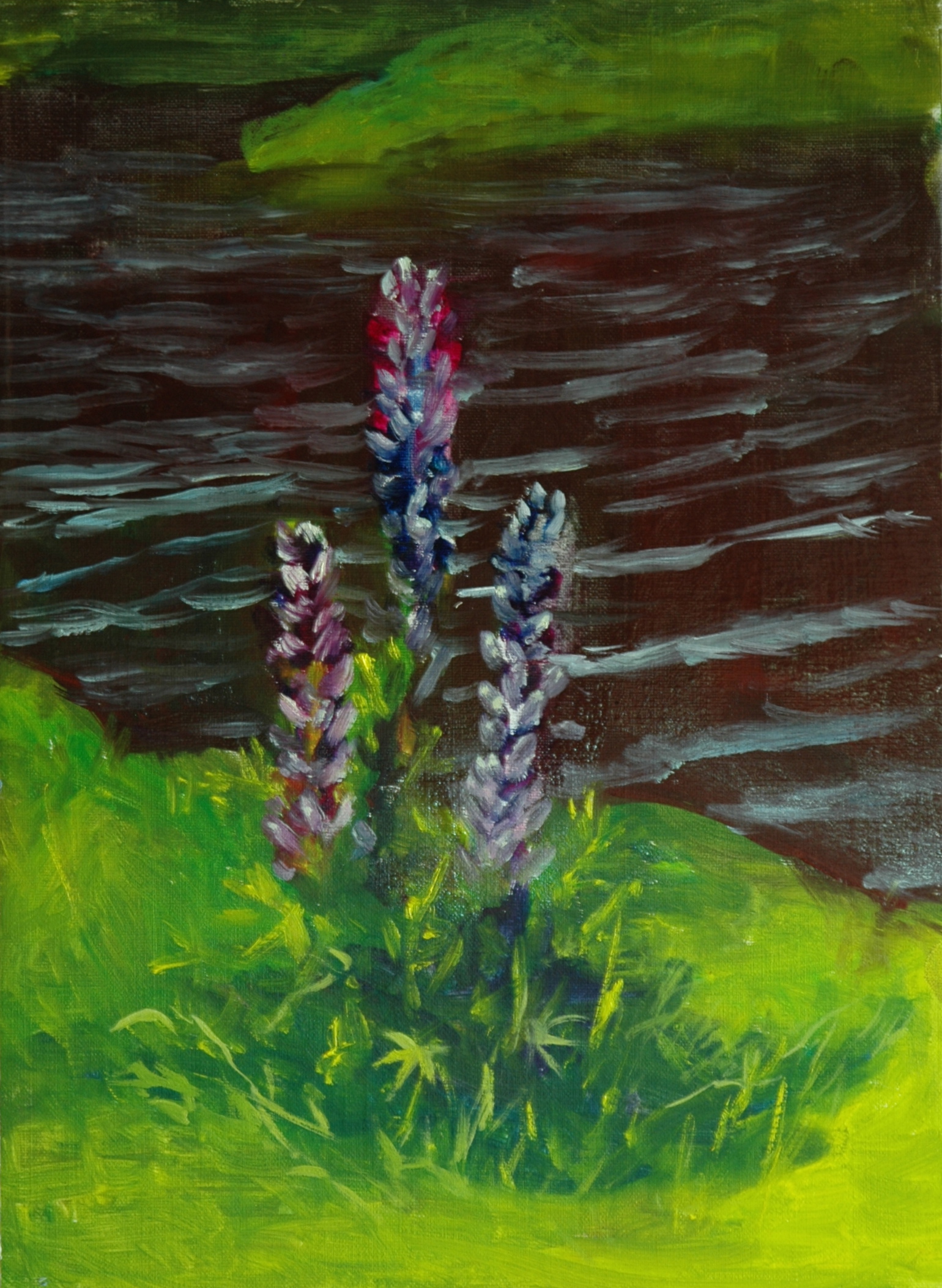
“Monadnock”– a word applied to a lone mountain rising from the land.  Wikipedia claims it comes from a native American word, but I have my doubts.  Maybe the “nock” portion, but come on, “mona” must be from “monos”, the Greek word that we combine to signify singularity–monopod, monocle, monotony.  Mount Monadnock in western New Hampshire is, they say, one of the most climbed mountains in the world–second only perhaps to Fujiyama in Japan.  It provides a fairly easy day hike with a lot of bare rock face from which to admire the views.  I used to do it once a year.  My husband, in the sixties when we visited his aunt on Snow Hill, would run it in the morning from Snow Hill and back again.  Before breakfast.  Looking back, I wish I had gone with him, but I didn’t get into mountain hiking until decades later.

These days, I paint Mt. Monadnock, usually from ground level.  Last Friday, however, Cindy, Fran and I drove to the top of Pack Monadnock to paint one of the many vistas presented there.  All three of us chose Mt. Monadnock as our subject matter.  Pack Monadnock and its neighbor North Pack Monadnock are East of Mt. Monadnock, and there is yet a third, Little Monadnock, to be found in southwest NH.  We like our Monadnocks, but here’s the only one that has achieved star status:

Wapack Trail (Southward)

Wapack Trail (Southward)

The black flies were unmerciful, but an occasional breeze and generous slathering of bug repellant helped to keep us focussed on our painting.  The Wapack Trail is well-used, so we had lots of company complaining about the black flies.  The State maintains the road and the vistas here, and charges each visitor by car $4 each–except “seniors”; I get a free ride.  Thus is the manned fire tower cost offset, partially anyway.  By the way, that yellow triangle painted on the rock in the right foreground is the trail marker for the Wapack Trail, which runs along the ridges of the Wapack Range, from Massachusetts to Greenfield, NH.

I could go on and on about my connections to Monadnock and the reasons I am drawn to paint it, but that would bore the heck out of most people.  So here is a successful figure painting from Monday’s life group session:

Bridal Gown

Bridal Gown

Our model was Tam, who comes here from Vietnam.  She posed for us in her wedding dress.  She was exquisite.

Coming up in Exeter are two events worth noting:  Bruce Jones has arranged for East Colony artists to exhibit their paintings at a storefront on Water Street, for one month, while the owner looks for a buyer for the space.  Our exhibit will coincide with the first Friday Art Walk on June 5, and the American Independence Museum paint out on Saturday June 6.  I’ll be participating in both.

Aline Lotter is currently exhibiting:

with the East Colony  artists for one month at 163 Water Street, Exeter, NH; at the Bedford Public Library; at the Bartlett Inn in Bartlett;  at the Bernerhof Inn in Glen; at the Red Jacket Inn in North Conway; at the Library Arts Center in Newport, NH; at the Sharon Arts Center in Peterborough, NH; at the Buttonwoods Museum in Haverhill, MA; and at the law offices of Mesmer and Deleault at 41 Brook St in Manchester.

As usual, you may view paintings with prices and order prints, iPhone cases and the like at my Fine Art America page. If the painting you are interested in is not there, or if you prefer to bypass that experience, you may contact me by email to alotter@mac.com.

If you want to add a public comment to this blog, go to the bottom of this page where it says “Leave a Reply”, and enter your comment in that box. I love to get public comments, so don’t be shy!