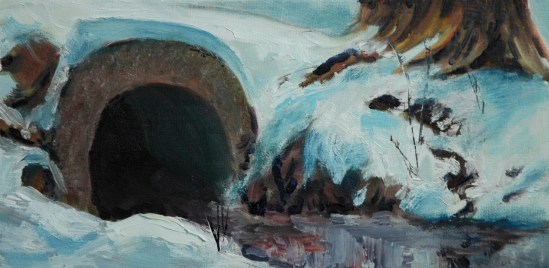
Not a Waste of Time

I got so immersed in what I was doing last weekend that I totally forgot about documenting something for my blog.  That’s a good thing, right?  I was watching TV (of course) last night, on BBC America, a new show called “2012”.  The characters are responsible for putting on the London Olympics.  One of them was keeping a video blog, following her progress in getting in shape to run the marathon at the Olympics.   Her blog and the training was intended to demonstrate support and enthusiasm, etc. for the Olympics, but she inadvertently divulged some inside information, which promised to land her in hot water, so she ordered the whole blog removed from the web.  (Hope you were able to follow all those clauses–we sometimes can’t resist a good long compound sentence!)  Then she explained her action to the omnipresent interviewer something like this (I didn’t take notes so please just take this as the message my brain received, not necessarily the message that was directed to my brain):  “Well I was only keeping the blog up to talk about my training for the marathon, and I was only training for the marathon to have something to put in the blog.”  Loved that.  The rest of the show is pretty good, too.  I so admire the way the Brits serve up humor–gently.  But to get back to the point–I am glad that I am not (yet) painting merely in order to have something for the blog.

Such a build up.  Now for the letdown.  My big project of the weekend is not fit for public eyes.  It may never be publishable, but I don’t feel my time was wasted.  I am working toward a concept piece in order to qualify for another WCA show, this one called “Add Women and Stir”.  I searched among all my available artworks for something to shoehorn into that theme–that is how I usually match painting to show–but nothing even remotely qualified.  So I researched the phrase ( meaning, I “googled” it), free-associated words, tried out some ideas, and finally came up with a concept that I like.  It’s the kind of concept that, if it does not make it into this show, will just sit around gathering dust for the next hundred years.  Actually, that will happen even if it does make it into the show.  But nevertheless, I firmly believe it is NOT A WASTE OF TIME.

Why not?  Because it forces me to stretch, probably beyond my ability; because it exercises my imagination; and because it gives me a goal to work toward in this summer where for one reason or another I am not painting much outside.  So what if the result of all this imagining and stretching is amateurish!  Let’s regard it as a preparatory study.  Some parts of it are OK–the parts where I had something real to look at:

Jewelry Box

My old satin and velvet jewelry box, which I have owned since I was a teenager, looks an awful lot like that.
ERA YES

The parts that I had to conceive of in my imagination?  Not so good.  Even with all my practicing with TV heads, I cannot paint a believable head out of pure imagination.  Today, therefore, I  searched the web for models to inform my ultimate vision.  I have latched onto an image of Queen Elizabeth that I look forward to trying out.  Already, though, I have learned a lot by doing what I only knew in theory before.  I now understand why somebody as accomplished as John Singer Sargent was making sketches of the murals in the Boston Public Library, trying out different positions of the figures, different gestures of the fingers on the reins, before he attempted to paint on the walls.  So should I feel like an idiot for failing to produce a masterpiece at this point in my endeavor?  No, but I should feel like an idiot for thinking I could just pop out a decent representation of my concept in one weekend’s time.

Meanwhile, I have been saving up some nudes to share with you.  Now seems like a good time to do that.

Study in Brown, Mustard Yellow and Lime Green (Seated Nude Woman)

“Study in Brown, etc.” goes back to before our Tuesday sessions got to be so popular that we could not afford to hide the back of the model in either this arm chair or the brown leather recliner that I got so good at painting.

Palm Study (Nude seated on pink draped block)

Feeling a little desperate for something different in a pose, we came up with “Palm Study”.  This model’s posture is always so perfect that just to get her to look down was something.

Last is the best since “In the Artist’s Studio”:
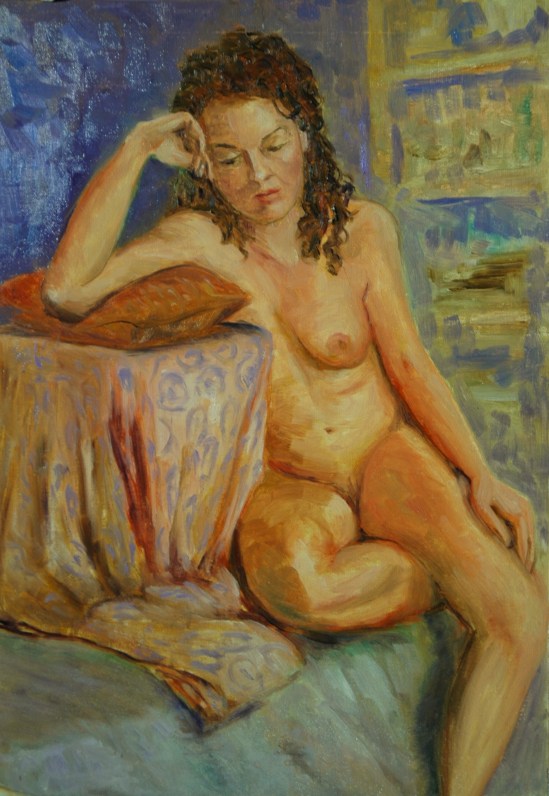
Back in the Artist’s Studio (Nude Leaning on block)

Same model, same studio, same pillow–different pose, different background.  Hence the title.  I hope you enjoy it!

Aline Lotter is currently exhibiting:

at the Hatfield Gallery in Manchester; at the Bartlett Inn in Bartlett; at the Epsom Public Library in Epsom; at the Bedford Public Library, in Bedford; and at her studio by appointment.
What I Learned This Week

Don’t bite off more than you can chew.  That was Lesson No. 1 this week.  To rephrase in artist’s terms, don’t try to paint/draw larger than you can take in at a glance, unless you are able to move away from the easel frequently to judge what you are doing.  Another way of  not biting off more than you can chew  is to “sight-size” your drawing.  I learned this at least once before, I’m sure, but perhaps it just doesn’t sink in until all the other obstacles to good drawing have fallen away.  I prefer to think of my recidivism that way, so that it appears I am making progress, not just the same mistakes time after time.   I will explain, elaborate, and, to quote the Car Guys, obfuscate:

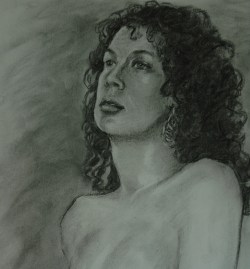
At Tuesday life group, we are starting to attract more artists that I originally would have thought we could fit into our studio.  Last Tuesday, I decided to forgo the paint and try to complete a charcoal portrait of our model.  I got up real close to the model.  That is supposed to be a good idea for doing portraits.  I work sitting down because my legs and back start to hurt if I stand for very long.  Because I was low and close to the model, I had artists working on either side of me and behind me.  I was pretty much trapped in place.

From my perspective, the portrait was looking pretty good.  It was larger than what I could see, so not “sight size”.  “Sight-size” means drawing the image exactly the same size as the image being read by your brain.  You can hold your drawing up next to the model to check how your are doing.  If you are not doing “sight-size”, the smaller your drawing, compared to what you see, the easier it is to judge the accuracy of your drawing.  Think of it as a built in “back up”.  Obviously for someone like me, who has to sit close to her drawing most of the time, drawing sight-size or smaller is the way to go.   Going big is tricky–the more you enlarge on the image that is hitting your brain, the more scope for error.  Proportions become especially hard to judge.

Portrait in Charcoal

Only when I got my Tuesday portrait home did I realize how far off the mark I was.  You may not be able to judge how disappointing this was as a portrait, because you don’t know the model.  This is not the first portrait I have done of her, however, and all of the others were more faithful to her likeness, so if you have been following along for a while now, you know this model too.  Examples here.  The hair looks good though.

Lesson No. 2.  Maybe not so much a lesson as an insight:  I’m getting hooked on paint.  I usually love working in vine charcoal, but Tuesday, as I smeared my charcoal around,  I wanted to mix color, not shades of gray.  It didn’t help either that I was drawing on relatively slick Bristol board instead of my usual Strathmore Charcoal paper, which has a texture that is characterized as “laid”.

Lesson/Insight No. 3.  Laid paper is laid (textured weave) for a reason.  Exactly what it is that makes “laid” so appealing is hard to articulate.  I should probably look it up to see what other artists have said but I really want to try to come up with something intelligible myself.  The weave definitely contributes  to the look and feel of the drawing . . .  the charcoal settles into the nooks and crannies–or not, depending on how much smearing the artist does. Does this satisfy some kind of primal artist hunger for the unexpected result?   When the unexpected happens and not in a good way, fixing  is easy.  When unexpected happens but in a happy way, artist takes credit.  Note to self:  do not use vine charcoal on Bristol board again.  I used charcoal pencil on Bristol board once, to good effect with a no-smear technique (getting it right from the first mark).  See here.

Lesson No. 4.  Worrying about why your painting does not sell in the wet paint sale after a paintout is a waste of time and psychic energy.  You can’t change  what you do, so don’t try to analyze why two terrific paintings got left on the table.  Hmmm.  The table.  Maybe it would have made a difference if the paintings were upright, as on an easel!  Darn, I forgot to bring the pieces of cardboard that would make an easel out of my Art Cocoons.  What a dummy I am!  Here are the paintings:

South Corner, Forbes House

View of Boston from the Forbes House Driveway

The location of our paintout was the Forbes House and Museum in Milton, Massachusetts.  My first painting took some liberty with the color of the Greek Revival house, in that I added orange to the tan because there was a pinkish cast bouncing off the house when the sunlight hit it.  The pink glow under the soffit was really there, so the house had to have pink in it, right?  (In the interest of full disclosure–I am going in for cataract surgery next week, and I’ve heard that colors will look different after I get my new eyes.)

The second painting is the view across the road from the Forbes House.  I liked how the two fruit trees framed the distant city skyline.  I finished this painting so fast, that I filled my remaining time until the wet paint sale by cleaning my palette.  It was good to have a clean palette.  It was good to have two plein air paintings that I am happy with.  So it was a good day even if my offerings were shunned.

UPDATE:  The Women’s Caucus for Art has two exhibits going on:  “Flowers, Interpreted” at the Epsom Public Library; and “On Target,” at the Bedford Public Library (going up at the end of this month).  In earlier blogs, I discussed each of my contributions:  Starry, Starry Night for On Target, and for Flower, the brown fairy called  Iris, Interpreted.  Even if you don’t remember those discussions, you might enjoy these exhibits.  Many different media will be represented, with special emphasis on photography in the Flowers exhibit.  Given the parameters of  “On Target,” I’m expecting some crazy stuff.  Certainly my contribution is nothing like anything else I have ever done.  Also at the Bedford library is my “Enchanted” painting on view for the summer, per “Artist of the Month” vote by the Manchester Artists Association.

Aline Lotter is currently exhibiting:

at the Hatfield Gallery in Manchester; at the Bartlett Inn in Bartlett; at the Epsom Public Library in Epsom; at the Bedford Public Library, in Bedford; and at her studio by appointment.

Confessions of a TV Addict

Conventional Wisdom would have it that no artist should be wasting her time watching TV.   TV can be a terrible time-waster for anybody, not just for artists.  Not watching TV has become, however, an article of faith for those artists who are into preaching to other artists.  Most of the articles of faith are true enough, and it’s good to be reminded from time to time to find your own style, treat  your collectors well, and always be working on improving your art.  But I can’t give up TV (or the movies that I use a TV set to view).  I just don’t understand those people who complain there is nothing worth watching on TV.  (For those people, not watching TV is no sacrifice on the altar of Art anyway, so they have no business preaching to people like me who enjoy the dramas and documentaries available on television.)  I enjoy a whole host of programs, mostly dramas and documentaries.  I even get into some of the “reality” shows -for example, “Too Cute” on Animal Planet is not to be missed!  I also believe an artist should not cloister herself from what is going on the the Real World but has a duty to keep informed on current events.  The Daily Show and Stephen Colbert are “must” viewing for me.

As much as I disagree with those sermons about demon TV,  I do feel guilt over my addiction, and I confess as often as possible, hoping to purge the guilt. One, maybe even two, earlier blogs make the same confession, and I still have not repented.

Thanks to my DVR, however, I have found a better method to assuage my guilt.  I keep a sketchpad, pencils and eraser nearby. It adds about an hour to my viewing time, but on a good night I will have two well-developed drawings at the end. I wait until something on the screen catches my artist’s eye, pause the program, work on my drawing as long as necessary, and then resume the program or go to bed, depending on the hour.  (Obviously, I watch TV alone.  Couldn’t do this otherwise.)  None of these drawings will end up in a museum, but it’s great practice that I would not be getting if I were reading a book.  (Books are apparently approved time-wasters, regardless of the subject matter.)

Here are 52 images, some containing more than one drawing, dating from about mid March to last night.  I hope they demonstrate progressively better drawing.  I have numbered them in roughly chronological order, and intend this slide show to set them before your eyes in that same order, but who knows?

This slideshow requires JavaScript.

I think –I hope–you might notice that I am getting more nuance into facial muscles, and am developing the drawings to a finer conclusion.  I am also getting more stubborn about the likeness, not giving up until it looks right.

Now when I sit down to watch TV, I am looking forward more to the drawing activity than to the TV watching non activity.  I notice a dearth of children’s faces, so I will be concentrating on them in the future.  And more animals.  Love animals, but it’s hard to demonstrate rigorous likenesses with animals, so not so much of a challenge.  I hope you responded to  the eyes of the lion, though.

Aline Lotter is currently exhibiting:

at the Hatfield Gallery in Manchester; at the Bartlett Inn in Bartlett; at the Epsom Public Library in Epsom; at the Bedford Public Library, in Bedford; and at her studio by appointment.
Imagination

Last Thursday I attended the opening reception for an exhibit of the landscapes of Eric Aho at the Currier Museum.  Really interesting abstracted landscapes.  Eric and the curators presented a slide show during the reception that was SRO.  I was lucky enough to get a choice seat next to Mary McGowan.  Mary founded the McGowan Gallery in Concord, and proudly reported (sounds better than “bragged”, doesn’t it?) that she had exhibited some of Eric’s paintings back in the day.  (Mary has recently retired from the Gallery, passing on the job of discovering new talent in the New England region to Sarah Chafee.)    We, Mary and I, being of similar age, conferred over the idea of taking up painting at an advanced age.  A sensitive subject for me.

Mary said she had always liked to paint, but would not take it up in retirement.  Her eye was too good.   “My eye is better than my hand.”  She meant she would be so hypercritical of her own work that she would not be able to enjoy the results.

That got me thinking.  Do mediocre painters paint mediocre pictures because they don’t see what’s mediocre about them?  Is the reason I am not churning out masterpiece after masterpiece that my eye is deficient?  No, I think I know what’s good and what’s bad.

So is the problem technical–a lack of skill–the hand, as Mary would put it?  Skill is not something that comes and goes.  It grows, or it declines, and yes, you can have a bad day, but once you learn how to apply  paint to a surface, to achieve a certain effect, you have the “hand”.

The critical element is something I used to call “inspiration”, but earlier that day I had watched a lecture online, broadcast from the Cornell University alumni reunion that was I skipping, on the subject of imagination–the importance of imagination to the advancement of the human race.  Who first realized the value of fire?  Who first thought of using a wheel to move heavy objects?  The realization of fire, the concept of a wheel, each required the thinker to form an image in his mind of the usefulness of such a thing–to imagine something not yet in existence.

Between that lecture and Mary’s casual remark, I came to the conclusion that what makes a great painter is imagination.  Mary’s eye knows a good painting when she sees one.  Her hand could be taught how to achieve what the eye wants to see.  But in order to know what the eye wants to see, imagination is required.

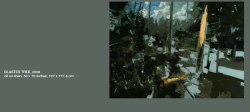
Let’s take Eric Aho, for example.  Landscapes are the most familiar of painting subjects, and the most popular.  A well done landscape takes a fair amount of skill.  Not the greatest amount of skill, but a landscape done by a skilled artist is going to be much better than one done by an unskilled artist.  But this required imagination:

(This reproduction of his webpage constitutes “fair use” under the copyright law.  I hope.)  Art in the 20th and 21st centuries has become all about the idea underlying the work.  Skill is assumed, or even discounted.  Think  Jackson Pollock.  He was not particularly skilled at the painterly underpinnings such as drawing.  But he was fiercely determined to be an artist, and he had imagination.

All this deep thought made me realize that what I have been doing, mostly, in my making of paintings is developing skills.  Every once in a while, an idea trinkles into my head and produces something special, like last week’s “In an Artist’s Studio.”  Repeated here for your convenience and also because I just love to show it off:

In an Artist’s Studio (Nude Woman Reclining)

Acquiring skills is important.  If, last week in the artist’s studio, I had been struggling harder to get the proportions correct and the skin tones plausible, my mind would not have had the luxury of considering the composition, which made all the difference between an exercise and a showable painting.

My regression from that pinnacle continued downhill this week.  I won’t even show you the entire painting.  It will be consigned to the “dust bin,” an antiquated term which seems  more fitting somehow than the trash can.  It contained a few OK parts, which I have cut out for you here.

Head of Nude Woman

Hands of Nude Woman

That was Tuesday.  Sunday I decided to paint a portrait in my three hours with the model–another “exercise”, I guess.

Head of Nude Man

It looks better in person.

Remember my “Iris Interpreted”?  Little brown fairy (Grace again) ensconced in a giant iris.  From  June 16 to  July 21, it will be exhibited as part of the Women’s Caucus for Art “Flowers Interpreted” annual show.  The site of the exhibit is the Epsom Public Library.  There will be an artists’ reception on Friday, June 22, 5 pm to 7 pm.  Come if you can.

A continuing exhibit without reception features seven of my landscapes in the Bedford public library, on the bottom floor, through the month of June. After June 30, one of my paintings, a rather long and tall one called “Enchanted,” will remain hanging there for the summer because it won that privilege by a vote at the annual meeting of the Manchester Artists Association.  Look for the tiny frog near the bottom.  It’s hanging near the children’s book section, so I’m hoping the children pause long enough to delight in the frog.

Aline Lotter is currently exhibiting:

at the Hatfield Gallery in Manchester; at the Bartlett Inn in Bartlett; at the Library Arts Center in Newport; Bedford Public Library, in Bedford; Epsom Public Library in Epsom; and at her studio by appointment.
Link to website: www.paintingsbyaline.com

Breaking Through the Sticky Curtain–Not

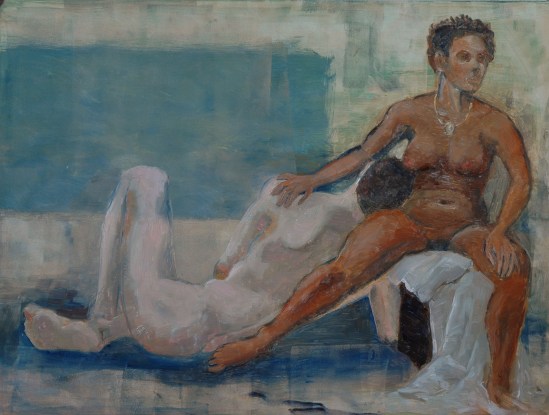
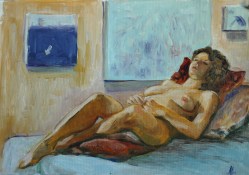
In an Artist’s Studio

Last week I mentioned the occasional magic of a painting that seems to complete itself,  all in one session (process known as “premier coup”  or first strike), and contrasted that happy event to my more common process of reworking and fussing over a painting.  Well, Tuesday morning, in the course of my regular Tuesday Life Group,  magic struck.  The result is above.

I long to be able to paint the way John Singer Sargent did.  I don’t mean I want to make paintings that resemble Sargent’s (although I would not turn down such a precious gift); rather I want to be able to place a brush stroke with confidence in just the exact right place for it, and not have to amend the color or value.  Sargent worked like a fiend for many years in order to attain such apparently confident perfection.  But even after he achieved the pinnacle of his brilliance, he continued to practice and try out options before putting paint to surface.   I have heard he sometimes restarted a portrait many (like, 20!) times before finding satisfaction.  So how can I , who have been painting for only six years, and painting people for maybe half that period, complain that about having to try this color, then try that value, and just generally operating in a constant state of experimentation?  Who do I think I am, anyway?  Not John Singer Sargent.

In “The Artist’s Studio”, however, I got a lot of strokes right, plus, perhaps most importantly, an interesting composition. Even the brashness of the spots where the canvas is showing through seems to bear witness to my energy, and pleasure.

In the past, I would have heralded such an accomplishment by proclaiming I had achieved a Breakthrough in my Painter’s Progress (the title of this blog, you know).  I would have expected every painting after the Breakthrough painting to follow in a trajectory of improvement because some kind of veil of ignorance had been lifted–I had seen the light, I knew where to go–finally.  But of course, the trajectory operates more like the stock market, up, up, and  . . . down.  I think of it now as a sticky curtain.  You can push through with great effort, glimpse the other side, once in a while even make some kind of a mark on the other side, but you never quite break contact with that sticky curtain on the other side.  You get sucked back.  Well, I get sucked back.

So I wasn’t surprised when the glow created by “In an Artist’s Studio,” only lasted until Sunday, when I sat down to paint, within three hours, another painting from life.   The Sunday painting is much more accomplished that what I was doing a year ago, even six months ago, and I consider it  a well done exercise.  I am proud of it, proud of my progress.  But glowing?  No.

Sunday Model June 2012

Aline Lotter is currently exhibiting:

at the Hatfield Gallery in Manchester; at the Bartlett Inn in Bartlett; at the Library Arts Center in Newport; and at her studio by appointment.

Link to website: www.paintingsbyaline.com

Drawing to Perfection

. . . by which I mean, drawing TOWARD perfection.   It may be that technical skill in drawing is not so important in today’s art world, but I believe that it is something every true artist has to work at, at least until she gets inspired to do something so out of the box that drawing skill becomes irrelevant.  (I’m thinking Jackson Pollock and Willem de Kooning, for example.  Jeff Katz?)   I figure that if I work at getting my drawings both beautiful and accurate for another, say, five years, I might then be in a position to move on.  That leaves me plenty of time to be great, provided I live as long as my mother did.  So that’s the Plan.  First:  perfection.  Second, greatness.

This week was a week without painting.  So I plan to unveil a bunch of new TV heads and two drawings from life, all with my stated goal of perfection in mind.  I’ll start with the TV heads.

David Cook, My Favorite American Idol

If you were not watching American Idol four years ago, or the 11th season program last week, you don’t even know who David Cook is, much less what he looks like.  He’s pretty.  But what inspired me to make these two drawing was the interesting attitudes and facial expressions.  (He was singing.  I hope that’s obvious.)

One of my favorite series is The Mentalist, and I think I’m not alone in that.  So you might recognize this portrait:

The Mentalist’s partner

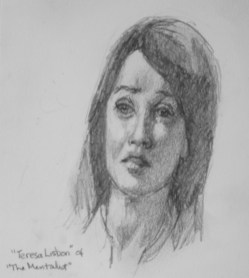
Teresa Lisbon.  I’m sorry, I never learned the name of the actress who plays Lisbon.  This is her expression upon witnessing Patrick Jane’s declaration that he is quitting his job as a consultant for the California Bureau of Investigation.  She’s worried about his mental health.  Does it show?

Heroic Journalist

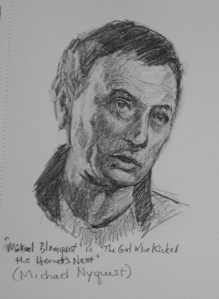
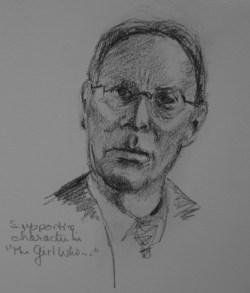
Heroic Journalist in “The Girl who. . . ” series (Swedish movies)

Character from “The Girl Who Kicked the Hornet’s Nest”

These are two characters from the movie, “The Girl who Kicked the Hornet’s Nest”, third in the trilogy that started with “The Girl with the Dragon Tatoo”.  One is the star (Swedish version) Michael Nyquist, and the other is a supporting role.  I had earlier drawn a portrait of our American version of Mikael Blomquist, Daniel Craig:

I think it is not as good as my more recent (by a few weeks) ones, which, if true, would be such an excellent indicator that I might reach my 5-year plan goal.

Last night I added  to my collection of heads–Sherlock Holmes and Dr. Watson as currently depicted on PBS.

Sherlock Holmes (Benedict Cumberbatch)

Dr. Watson (Martin Freeman)

Holmes is played by a guy whose name is Benedict Cumberbatch.  I have been noticing him for some time now, bemused at how the Brits can allow a  comedic name like that out there, attached a guy looking so incredibly nerdy, and make a hero out of him.  So refreshing!

So those were practice.  The real test comes with the life drawing.  Last Tuesday I had three hours to create this drawing of a lovely nude back.  I could have used the same three hours to make an oil painting, and it might have come out well and been quite charming, but I’ve done a lot of painting lately, and I felt the need to hunker down and strive for the pure perfection of form and value as expressed with the lowly pencil.

The Perfect Back

The Perfect Back

To bring you up to date, hot off the press, as it were–just a few hours ago, I parted company with Dee.  Dee is a fellow artist whom I got to know from the Saturday Life group, before he moved to the Midwest.  Back in New Hampshire for a few days, he give me the gift of posing for me today.  I chose do a  portrait in pencil.  Before he left, I grabbed this photo to use later in perfecting my drawing:

Dee, for real

And here what I accomplished after two hours–a good start on the trickiest parts.

Portrait of Dee

The other news of the week is very disappointing.  The Sage Gallery, which I have been touting since it opened last September, suddenly called it quits.  As far as I know, not a single painting was sold (other items did attract buyers–stained glass, sculpture, photographs, etc.).   She (Janice Donnelly) got lots of media exposure, but somehow could not connect with the  serious art collectors.  Are there any serious art collectors in the area?  Maybe not.

Aline Lotter is currently exhibiting:

at the Hatfield Gallery in Manchester; at the Bartlett Inn in Bartlett; at the Library Arts Center in Newport; and at her studio by appointment.
Link to website: www.paintingsbyaline.com

On My Own . . . Sort of

No more class on painting the contemporary portrait.  No more Saturday life group.   Both are victim to the school calendar and to the need of the graduating Bachelor of Arts students at the NH Institute of Art for space to exhibit their senior projects.  (This is a wonderful exhibit, by the way; if you can get there during the run, you really should go.)  Even my Sunday morning ad hoc group was cancelled.  I had no organized artist activities for a whole week, and I had two whole weekend days with no workshops.  In short, I was on my own.

First I chose to clean up some paintings in waiting.  I went all the way back to my Florida trip in March for this one:

Marco Island Medical Center

The main focus of this plein air painting was the reflections in the big picture windows, and I was happy enough with how I portrayed them.  But the painting was unremarkable, dull, boring.  I thought I could jazz it up with new treatments for the tree and the grass.  Better now, right?

Next I turned to last week’s painting of our model in the brown recliner–painting No. 4 of her in that thing.  I did a little bit of this, a little bit of that, refining some areas, blurring others.

The Pose, Take No. 4

This might be Stage 2 in a multi-stage painting.  I’m thinking I would like the arm on the left more in the shadow, and perhaps all of her shadows should be darker.  I don’t care for the Barbie doll look of her features, but I’m not quite sure what to do about that.  What I do like is the new treatment of the aqua drape and  the background.

Another past painting touch up victim was last week’s “Iris Interpreted”.  I hope you like what I did to her face and the lower right corner.

Iris Interpreted

Finally, I struck out for new territory.  But it was territory based on last week’s drawing of the black and white couple.   Here is a glimpse of my set up as I copied the drawing into paint:

High Contrast in the making

Try as I might, I could not make his skin less white and her skin more black. That happens sometimes–the painting refuses to be what I want it to be.

I discovered the magic of a brayer on this painting.  The brayer is a roller of soft rubbery material.  It picks up and removes paint.   If you don’t clean it constantly, it also lays that paint down again somewhere else.  (I think it was actually meant to be a printing tool–and not one that comes in direct contact with the ink.)  You can see the effect in the background.  As I become bolder, I might even obliterate my carefully drawn figures in this way.

High Contrast

For the figures, I tried to keep the paint thick.  I was working on a slippery panel, so that was difficult.  Maybe that’s why I couldn’t get the effect I wanted.  Is this a good painting?  Good enough to forgive the flaws that I find so frustrating?

Aline Lotter is currently exhibiting:

at the Gallery at the Sage Gallery in Manchester; at the Hatfield Gallery in Manchester; at the Bartlett Inn in Bartlett; at the Library Arts Center in Newport; at the NH Institute of Art in Manchester; and at her studio by appointment.

Link to website: www.paintingsbyaline.com

P.S.  Honey is recuperating from her surgery, and is getting back her spunk.

Extreme Faces

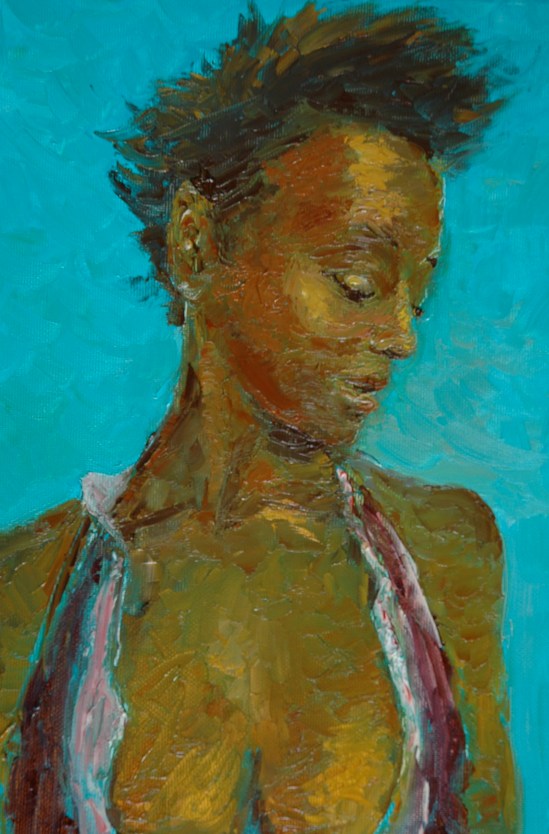
Thursday night in my Contemporary Portraits class, I decided to Go Big.  On a panel of 20 inches by 16, I filled all the available space with my model’s head.  Supersized.  Bigger than life.

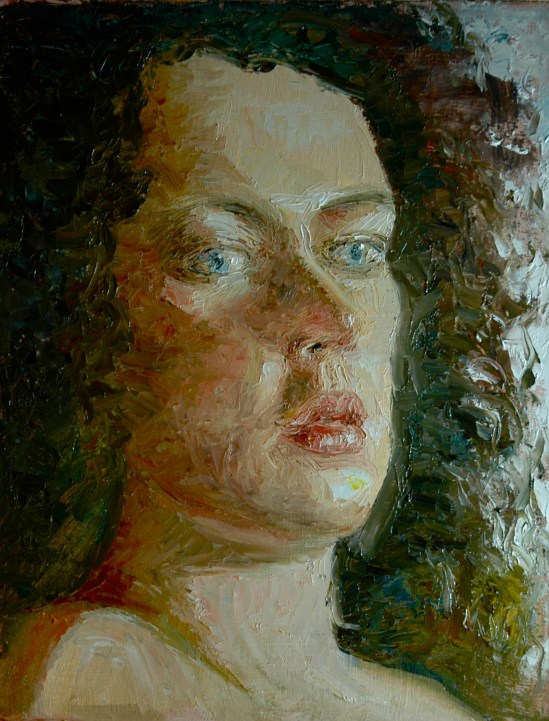
Downcast

I started out with some idea of using the palette knife, but found that when covering a whole lot of canvas, a big brush is more efficient.  Then I found that I liked the big brush strokes as well.  The image becomes almost pixelated as a result.  (What word would I have found to describe that effect if we hadn’t got “pixelated” from the computer industry?)  You can probably tell I also deployed the knife here and there.

I am struck by the fact that, with the bigger format and the bigger brush, it was easy to forego the details.  Puzzling.  You would expect that the larger the format, the easier (in my case, read “more tempting”) it would be to paint in details like eyelashes.  The big brush must be the key.  I am now eager to find out what will happen if I deploy the big brush on a smaller panel.

However, this revelation did not come to me until just now, so when I set up for my Sunday painting, I chose the palette knife for a small, 11×14 surface.  First, I should explain that our model and pose has not changed for three weeks.  I already have two paintings done from that pose, which you can examine in the last two blogs.  The first was whole body.  The second was head and chest.  So Sunday I closed in even farther, thinking to replicate in miniature the big-head experience from Thursday.

Knifed Closeup

Interesting how you can see practically every scrape of the knife in this photo.   It looks so much more impressive online than the original  painting.  I think that’s because you can’t tell online how large the actual painting is.   Or in this case, how small.

By studying this image and the following ones, I finally figured out what was bothering me about this painting.  The nose is too narrow–way too narrow.  So I am going to have to fix that soon, before all the thick paint dries.

Last week I talked about how much I admired Bill Turner’s treatment of the blouse on our model, so this week I am providing the proof that was missing last week.  Here is Bill’s portrait, still not finished but I hope he doesn’t touch the blouse!

Bill Turner's portrait of Becky

And yes, I have to admit, the arm and elbow are pretty special too.

While I am sharing the works of other painters, I know you will enjoy this version of Becky, which was also still a work in progress  when I snapped this picture:

Bea Bearden's portrait of Becky

Bea’s specialty is the eyes.  She always paints spectacular eyes, and gets fantastic colors in the skin tones.

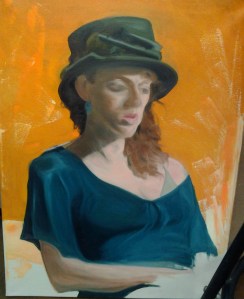
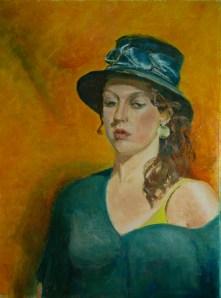
Note that the color of the hat in both of these versions of Becky.  Now compare the color of the hat in my version:

Girl in Green

I started out painting a black hat until Cameron told me the hat was green.  Although close up it was clearly more green than black, I  could not see the green when the hat was on Becky’s head and under the spotlight.  (I hear cataracts affect color perception, so maybe it is time for eye surgery.)  We don’t have to match the local color if our muse takes us in a different direction, but in this case, I was OK with imagining the green.  My blouse color, being more green than the other two, was a deliberate choice.

Aline Lotter is currently exhibiting:

at the Gallery at the Sage Gallery in Manchester; at the Hatfield Gallery in Manchester; at the Bartlett Inn in Bartlett; at the Red Jacket Inn in North Conway; and at her studio by appointment.

Link to website: www.paintingsbyaline.com

Speaking figuratively . . .

is a lot easier than drawing figuratively.  And painting figuratively, especially without the coverup advantage that clothing provides, is hardest of all.  I admit that I am torturing that adverb “figuratively” –pretending that it can be substituted for the phrase “about the figure” in one sense and for the phrase “of the figure” in the other two examples.  I don’t make a lot of use of puns,so I figure (there’s that word again0–definitely no pun intended), I’m entitled to a little wordplay.  In face, half the fun of blogging is finding ways to make plays on works.

But figurativity is relevant.  This week, the subject is figures.  Beautiful figures in reality.  And paintings and drawings  that aspire to be beautiful in their own right.

My experimental palette knife work carried over into this palette-knifed figure study:

Girl in Brown Recliner

This painting is the output from one of our Sunday morning sessions.  Don’t you love the chair?  I do, but have to admit it looks better in person (in the painting itself).  I will get another crack at this model and pose, but instead of trying to correct errors in this one, I will start over with a new painting or drawing.  Paint that has been ladled onto the canvas with a palette knife just is not conducive to being overpainted.  Case in point: last week’s portrait, which I declared cooked after that session ended.  I would never try to add another layer of paint to that.  My first palette knifed portrait was not as heavily impasto’d, so I was able to rework  most areas.  (Both of those portraits can be seen in last week’s blog.)

Here’s another palette knifed portrait, but it’s also a little riské, so it fits in my theme for this week:

How Demure is She?

“Demure” is another one of my contest entries on Fine Art America, wherein I am given a photo of which to make a painting.  Because of the restrictions placed upon my use of the photo, I can’t reproduce it for you.  You will just have to trust me when I say that you would recognize this woman as the same one in the photograph, despite the radical colors and rough knife strokes I have adopted.  Or you can go online to Fine Art America and check out the current contest for “painting from photographs”.

I am kind of pleased with the ways I am finding to depart from the literalness of the subject matter without sacrificing the rigor of getting the essential elements right.

Not that I always get them right.  Au contraire.  Last Saturday I came away from our Saturday life drawing sessions with a couple of drawings that I felt good about.  This one, however, no longer looks good to me:

Reclining Woman

Through the fresh eye of the camera, I can now see that her head is way too big for her body.  I think of some deKoonings, Picassos etc. and ponder, so what?  They drew people with diminished bodies, and no one claims that they didn’t know how to draw.  Hmm.  Well, let’s move on:

Crouching

The arms on this figure got crumpled up somehow, but I still like the overall look of the thing.  It’s so . . . Degas.  Mind you, I am not all that admiring of Degas’ drawings, so this is not necessarily a self pat on my back.

Faring a lot better is this multi-colored drawing, which some of my fellow artists begged me not to touch after the first model break (20 minutes into the pose).  I continued working on it anyway, but not in any significant way.  I worked on the drape, clarified some values, things like that:

Seated Woman in Color

With an extra five minutes left for the pose, I sketched this head of the model:

Five-Minute Head

As you might have deduced, had you thought about it, our Saturday models come top-lit.  The light streams down from an overhead skylight, at least when the sun is shining.

OK, here are some guy drawings that I saved up from last month:

Seated Man

Contemplative

The composition of this one is interesting, and if his hand is a little too big, that’s better than being too small.  Our guy models use those poles a lot–not only do they give the model something to handle but they also give the model a place to rest his/her hand/arm, so as to provide more variety in the pose.  I also use the pole as a check of my  placement of limbs; if the angle of the pole is correct, the body parts have to come together with the pole in the correct way or I have got something wrong.  (Same model, same pole were featured in my mid-January blog titled “Why is this Man Digging a Hole in the Nude?”  Still a good question but now you know the answer.)

I suspect that I have written way too much tonight, but can’t trust my judgment.  It is  late, and I am  tired.  My usually upbeat Monday was discombobulated by the discovery that we had been burglarized; my desk, in particular, had been “tossed”.  My losses were not catastrophic, but still, it put me off my stride.   And Monday being Bridge Night, contains no slack.  (The cards were kind to me, which certainly helped put me in a better frame of mind.)

One last item of interest:

POP UP!

A pop up art exhibit will appear at the White Birch Brewing Company in  Hooksett NH Friday (5 to 7 p.m.) and Saturday (noon to 5 p.m.) this week.  April 13-14.  Food for the Friday night reception will be provided by cooking students from nearby Southern NH University.  Don’t sit this Friday the Thirteenth out, huddled in  your closet.  I believe a tour of the brewery with beer tastings can also be expected.  Whoo’ee!

Oh, yes,  I am participating.   I haven’t picked all the pieces that I will be exhibiting (and selling) yet, so if you have one you’d like to see there, let me know.  The theme is “New Hampshire Proud” but only one piece is required to represent that theme.  If you Google the theme, you will find elegantly composed publicity for this event. Support your local artist and your local brewery at the same time as enjoying food from your local  univeraity.  Doesn’t get much better, right?

Aline Lotter is currently exhibiting:

at the Gallery at 100 Market Street in Portsmouth; at the Sage Gallery in Manchester; at the Hatfield Gallery in Manchester; at the Bartlett Inn in Bartlett; at the Red Jacket Inn in North Conway; and at her studio by appointment.  AND, for two days only, April 13-14, at the White Birch Brewery in Hooksett, NH.

Link to website: www.paintingsbyaline.com

Playing with Knives

This week I am going to catch you up on the last three weeks of my class in painting the contemporary portrait.  (At the NH Institute of Art, with Cameron Bennett)  I have talked about this class before, but we didn’t have a live model then.  Now we do.  In fact, for the last two classes we have had two models to choose from–Rebecca and Randy.

This would be my fourth portrait of Rebecca over the past couple of years, but the first completely in profile.  Not exactly my choice–in my absence (Florida), a makeup class was scheduled.  The day before I flew South,  we had had a snowstorm here in NH and strangely, that class got cancelled.  (Strangely, because it wasn’t all that much of a snowstorm but it was almost the only one we got all winter, and a big deal was made of it.)  My Florida trip, so carefully planned to coincide with the Institute’s vacation week, cost me a class after all, and when I showed up the following week (in time for class despite a flight cancellation and rerouting to Boston), it was to find all the prime spots around the model had been claimed the week before.Each class is three hours long.  Three hours on a portrait of a live model is not very long at all.  A total of 4 classes had been scheduled for Rebecca’s pose.

Because the idea of this course is to do something outside the box (you know, “contemporary?”), I decided to try  using only palette knives.  I took one picture on my phone before all the canvas was covered:

WIP No. 1

At the end of that first session of three hours, I took home this version of Rebecca’s profile:

I was happy with the freshmess, the vivid red, the clear skin tone, the sharp edges.  I thought I was finished, except for a few minor details.  Eye too high, for example.  The likeness needed to be improved a little–Cameron suggested exaggerating the size of her eyes and mouth, then carving back on them in order to get closer to accurate.  He also complained about the harshness of the shadow on her neck.  I expected to be able to fix those items in perhaps an hour, then be on my way to something new.

Becky, WIP No. 3

Notice the earring?  I don’t think she was wearing it the week before, but now that she was, I had to bring it in, with its delicious shadow.  In this version, her lips are exaggerated.  I spent that entire 3-hour class bringing the painting to this point. Before the next class I would carve back on the lips, but not the eyes :

Becky, No. 4. Final?

Above is the portrait as I presented it  for critique at our last class.  I wondered if perhaps I had overworked the painting as compared to the underdone 3-hour version.   Nobody seemed to endorse that thought, but as a result of the critique,  I do intend to do something about the background on the right side–it is too flat and dull.

The critique having used up our first hour of class, we had only two hours left to work on actual painting.  I got a spot in front of Randy, our other model, and went to work, knives flying.  Cameron came around and suggested that I take photos as I progressed over the two hours:

image

There’s no white canvas showing because I slathered paint all over the canvas before starting to carve out the figure.  That was my new out-of-the-box experiment for this week.  Cameron saw what I was doing, and advised me to start the figure by scraping away the excess paint.  Otherwise I was going to be in for a big headache, trying to paint over thick, wet paint base.  I might have come to that conclusion myself, perhaps the hard way.  (Doing it wrong first.)

image

Here I was just trying to get biggest stuff (features) in the general proximity of where they should be.  Ear, nose, chin, neck.

image

Getting close.  Eyes too close together.

image

This, my final version (I think). shows his mouth finished and his right eye moved to the left.  See–I even signed it over there on the left.  My model claimed that he liked it.  Nose is too long, however.   Nose length is something I have trouble with–always too long.  If I were going  for the best possible likeness, and had more than two hours, I hope I would have scraped out half the face and started over with a smaller nose.  Which half?  Tough choice.

Likenesses notwithstanding, Cameron likes this portrait of Randy better than my portrait of Rebecca.  My granddaughter, however, displayed some funk, complaining that she could not see the features.  Obviously too young to see outside the box.  (Don’t worry–she won’t see this–she doesn’t read my blog.)

I’m happy about both paintings, but I do think I am happier with Randy.  Perhaps that is just the power of Cameron’s suggestion.

What is it about painting with the palette knife that appeals to me?  Mostly, it keeps me from getting bogged down in details. Because as much as I love the details, I love more to see how the merest suggestion of form is enough for the brain (well, most brains) to translate into form.  It’s magic.  Details of a different magnitude are still vitally important–if a single stroke of light can create the impression of an eyelid, so can such a stroke in the wrong place create a lantern jaw.  Done that.

Aline Lotter is currently exhibiting:

at the Gallery at 100 Market Street in Portsmouth; at the Sage Gallery in Manchester; at the Hatfield Gallery in Manchester; at the Bartlett Inn in Bartlett; at the Red Jacket Inn in North Conway; and at her studio by appointment.

Link to website: www.paintingsbyaline.com

Overcome by Hydraulics

This week ‘s tale is of the three-day workshop I took with Stapleton Kearns at the NH Institute of Art in Manchester.  Stape, an active landscape painter, member of the Boston Guild, formerly of Rockport, writes a blog for other painters, and in that blog he had at one time discussed the anatomy of waves and other items of interest associated with the painting of seascapes.  One point stuck with me:  most of the dramatic, wave-crashing seascapes could not be painted on location–the painter, or at least her easel, would not have survived the first crashing wave.  So I already realized we were not going to be heading out to paint waves from life (as if any such thing were available in Manchester, New Hampshire).  I  assumed we would be relying on some use of slides or photographs in order to paint our seascapes.   That’s what we had done in my  intro to waves with Peter Granucci–I recounted that learning experience in my blog of July 17 last year.

I do like surprises.  I also just love being reminded that the mastery of painting is much, much harder than one might imagine, and takes a lot, lot longer than the time one has available.  So, boy, was I ever pleased with this workshop!

First, there were no slides, no photographs to use as reference.  Stape demonstrated on three separate paintings, one each day, how, without any reference whatsoever, he designs a seascape and works in the elements of the sea: waves, foam, rocks.   All three paintings were fantastic  little jewels.  If only each afternoon I could have followed his example.  The first day I mimicked his design, with a decent result.

Theoretical Wave

The second afternoon, I tried to invent my own composition.  The big wave element was not working for me.  Several times I wiped it out and started over–not because I could not construct a decent-looking wave.  After all, the one I had done the day before was passable.  But  this one was too fussy looking.   I was still working on it the last day, near the end of the workshop, so I asked Stape to come over and tell me what I was doing wrong.  He sat down, squeezed out a half tube of white on my palette, mixed in some blues and grays, and pushed paint aggressively all over the offending areas.  The wave is now barely recognizable, but the energy was exactly what I had wanted.

Stape's wave

What a monstrous lesson for me!  I had been so caught up in the hydraulics of wave action, worrying about whether this brush stroke or that one was consistent with the physics of waves, that I forgot to just be a painter.

Stape also had us doing simple exercises, not necessarily related to seascapes.  Below on a single panel are his demonstrations of three of the exercises:

Stape's painting exercises

The top one was a demonstration of how to paint a wave over and into white paint: After a generous layer of white paint is laid down,  you manipulate your blue paint over and into the white to create a wave shape.

The one below and to the left shows the opposite technique: lay down the dark blue paint first, then come in with the white to shape waves.  Sounds simple; looks simple.  Ain’t simple.  Allow me a year or two to practice that one.

The orb in the bottom right was his illustration of the rule that nothing in the shaded half can be as light as the darkest value in the lighted half.   And vice versa.  This rule is important to all subject matter whatever the media, but is easily overlooked when you get lost in waves. Confusion in the waves leads to ambivalence in assigning values–is this spot lighted or shaded?  Stape’s advice:  commit to one or the other.  You start with a 50% chance of being right, plus another 25% from some other logical assumption–wish I could remember what–so taking that plunge with odds so in favor of you has to be better than not choosing at all (leaving wishy washy values).  Even if I can’t remember where that 25% comes from, I shall remember to commit to light or shade, no matter what.

The overall lesson imparted was the one I hate most to hear: to be a good painter, you must paint every day for ten years.   I cannot accept the extremity of that pronouncement, but I admit that I need a lot more practice (especially in seascapes).  Maybe I should just stick to portraits and figures.

Aline Lotter is currently exhibiting:

at the Gallery at 100 Market Street in Portsmouth; at the Sage Gallery in Manchester; at the Hatfield Gallery in Manchester; at the Bartlett Inn in Bartlett; at the Red Jacket Inn in North Conway; and at her studio by appointment.
Link to website: www.paintingsbyaline.com

Mary Crawford Reining

Continuing my report on my 2-week vacation on Marco Island as the guest of Mary Crawford Reining, here I present for your awe and delight a slideshow of 11 of Mary’s paintings, 10 of which were painted during my stay. Mary is, as I mentioned two weeks ago, really into painting sunsets.  Me, not so much.  While she was working on the sun, sky, clouds, etc., I would be faced in a different direction, painting the effect the light of the setting sun on various objects, like her cat, her mahogany tree, and so on.

This slideshow requires JavaScript.

I guess there is one that doesn’t fit into the colorist label, but for the most part, Mary revels in colors of the highest chroma.  She does not gray anything down!

Just to be fair, I added comments to her paintings too, which you can access by clicking on the image.

Mary's Sunset No 1

Mary's Sunset No. 2


Mary's Sunset no. 3

Mary's Twilight Palms


Mary's Esplanade Fountain


Mary's Palms through the Lanai

I included her painting of the Esplanade fountain just because it was there, and why not?  I should have photographed some of her larger opuses as well, but I wasn’t thinking straight.  It was really, really HOT down there, and humid too!  No, one does not retreat into air conditioned interiors.  Especially if one is a painter.  What good is a lanai open to nature if you are going to hunker down in a closed-in building?

Mary's Farmers Market No. 1

Mary's Farmer's Market no. 2

Mary's Corkscrew Swamp

Mary's "Mangos"

Mary's Bridge (Work in Progress)

Two years ago, I posted a lot of bird photos that I captured in SW Florida.  I have a few more of those plus alligators, but another day.  I might have to supplement this post, already in two parts, with a third part, sublime wildlife photos from Marco Island.  But I have that time problem, so don’t hold your breath!

Aline Lotter is currently exhibiting:

at the Gallery at 100 Market Street in Portsmouth; at the Sage Gallery in Manchester; at the Hatfield Gallery in Manchester; at the Bartlett Inn in Bartlett; at the Red Jacket Inn in North Conway; and at her studio by appointment.
Link to website: www.paintingsbyaline.com

14 Days, 13 Paintings

Actually, there was briefly an additional painting, the first one, which would have made the total 14, but I wasn’t loving it, so I painted over it. Usually my first painting in a series turns out to be the best, but I’m glad when a pattern stops repeating.  I would like to think that at any point in the timeline I might be creating a masterpiece.  On the past two Mondays, as blog substitutes I posted snapshots of 9 paintings, taken on my cell phone.  I did not have the patience to work out how to add text to the pictures, although obviously I managed to do just that for a few pictures the first week.   (I should have taken notes.)

Now that I am home, I can upload photographs taken with my Nikon SLR.  (Until I got back to my computer, I had no way to move photos from my Nikon to WordPress.)  Because there are so many, I decided to put the entire array in a slideshow.  If you are very observant, you will notice that some of the nine paintings received improvements after the posting of the cell phone photos.

This slideshow requires JavaScript.

One painting, you might have noticed, was not a plein air landscape of Marco Island; it was a portrait from a photograph for another Fine Art America contest.  But I did it on Marco Island, so it gets included in the slideshow.

To save me time, which I am desperate to stretch right now, I am also posting the individual images in order to give  you access to my comments for each one.  Just click on the image that interests  you, and a pithy remark may or may not appear.  The paintings below are presented roughly in the order in which I painted them.

Cleo, Watching the Sunset

Mary's Mahogany Tree

Papaya Tree and other tropical delights

Waterway

Corkscrew Swamp -- the Anhinga airing his/her wings

Lanai in Shadow at Sunset

Strong winds

Marco Island Farmer's Market

Corner Cafe (Mango's, in the Esplanade)

Bridge over Canal

Picture windows, reflecting neigborhood across the canal behind me

Missy, the 3-month old "teacup pot belly pig" who accompanies one of the vendors at the Farmer's Market.

My hostess, Mary Crawford Reining, is an accomplished artist in just about any medium you can name.  Unlike me, after we parted ways after our high school graduation, she never stopped making art, even though she mothered four children and is still married to their father.  (Domesticity may present the biggest obstacle to creative endeavor.)  Mostly, however, she seems to prefer watercolor and pastels.  I don’t know of a term to affix to her style, but I do believe she is what you would call a “colorist”.  You will see what I mean when you proceed to the next blog entry.  (I could not separate my photos into two different slide shows within the same blog entry.)  So continue on, please, for an entirely different art experience!

Aline Lotter is currently exhibiting:

at the Gallery at 100 Market Street in Portsmouth; at the Sage Gallery in Manchester; at the Hatfield Gallery in Manchester; at the Bartlett Inn in Bartlett; at the Red Jacket Inn in North Conway; and at her studio by appointment.
Link to website: www.paintingsbyaline.com

Painting from Life, Compared

In terms of number and variety, my output last week may seem disappointing–my figure workshop with Peter Granucci skips a week and  last week was a skip week; then my portrait class with Cameron Bennett was taken up with critiques and a demonstration painting by Cameron; and finally our Saturday life group (SLG) was cancelled because our model was sick with the flu.  However,  the Sunday clothed-model group met as planned, and resulted in a piece that makes me happy.  No, make that thrilled.

Profile of Sabrin

This is Sabrin, the same model that we had the last two weeks.  The first week with Sabrine I painted a 3/4 portrait from a 3/4 view on the lighted side (see that week’s blog).   The next week, I drew her in profile in charcoal (last week’s blog).  This week, I found myself again on the side with a profile, but with an exciting new headdress and the full three hours to paint.  I actually finished in about 2 and 1/2 hours.  The panel was small–only 12×10.

Her headdress pattern comes from gold threads.  I created the impression of a gold pattern by simply drawing through the wet paint with my “color shaper”, which is a rubber-tipped point.  I used the same technique to create her earring.  When the paint dries a little more, I will add some sparkle to the gold threads, her earring and the gold chain around her neck.

You might be able to see that I added cerulean blue to the highlights on her skin.  The light bounced off her skin so brightly that it was hard to determine exactly what color it should be (never pure white!  Lois Griffel’s voice echoes in my brain).  I decided to use the blue of the sky, even though she was lit by a combination of natural light from the window and a spotlight from the same direction.  The blue works, I think.

I have to confess I got the idea of using blue light from two sources–one is Peter Granucci who uses the blue light on rocks and other surfaces lit by the sun, and the other comes from a class at the Institute conducted in the same room where I take my portrait class with Cameron Bennett.  The students left their works in progress in this room and their assignment was apparently to paint the lit surfaces of a human figure in a bright aqua blue.  Sounds bizarre, right?  But it was remarkably effective.  My experiment with the same was much more subtle.

Last week, the piece I was happiest with was a painting of a portrait from a photo I did not take, indeed from a photo of a person who was a total stranger to me.   How does the one compare to the other?

Contest Portrait, Final

I love both of them equally.  I can’t come up with a way to measure the merit of the painting from life over the painting from a photo–even knowing intuitively that the former ought to be better than the latter.  But maybe any judgment would be contaminated by one common attribute that helps them both–I didn’t care about getting the exact likeness of either one, which freed me to just paint beautiful, as I see beautiful.

Aline Lotter is currently exhibiting:

at the Gallery at 100 Market Street in Portsmouth; at the Sage Gallery in Manchester; at the Hatfield Gallery in Manchester; at the Bartlett Inn in Bartlett; at the Red Jacket Inn in North Conway; and at her studio by appointment.

Link to website: www.paintingsbyaline.com

A Splurge of Portraits

“Splurge” seemed the right word, so I looked it up, and indeed, there is a secondary meaning that covers what I feel I have today:  an extravagant display.  Beginning with the figure workshop with Peter Granucci last Tuesday, through the class with Cameron Bennett, and and ending today with my last–no, my most recent–edits of the Sami and Noodles portrait, my week was full of figures and faces, most of them falling squarely under the category of portraiture.  Oddly enough, my favorite of the week is the most unlikely candidate.  I entered a contest to paint a portrait from a supplied photograph by Shan Peck–he is the photographer and the contest administrator and the juror.  It’s not a big deal, just a fun thing to do, and it became a project to do in my class with Cameron.  I can’t reproduce Shan’s photo here–he made a point of forbidding any use of it other than to paint the portrait–but you can link to it here.

Since we were encouraged to upload our works in progress, I snapped a few of those on my cell phone (had to figure that out first–what a banner week!).

WIP for contest

Contest Portrait, Final

Our Sunday model, Sabrin, was slated to keep the same post and dress as she had last week, so I went prepared to draw a charcoal portrait of her.  She was very late in arriving, however, so another artist volunteered to sit for us.  As a result, I came away with two charcoal portraits, one better than the other.  The first did not capture a good likeness.  If I had had the time, I hope I would have achieved a likeness.  As it stands, I believe I exaggerated the size of her nose.

HH Profile

The profile of Sabrin came out well, I think, likeness or not.  Her mouth was very interesting and challenging to capture.

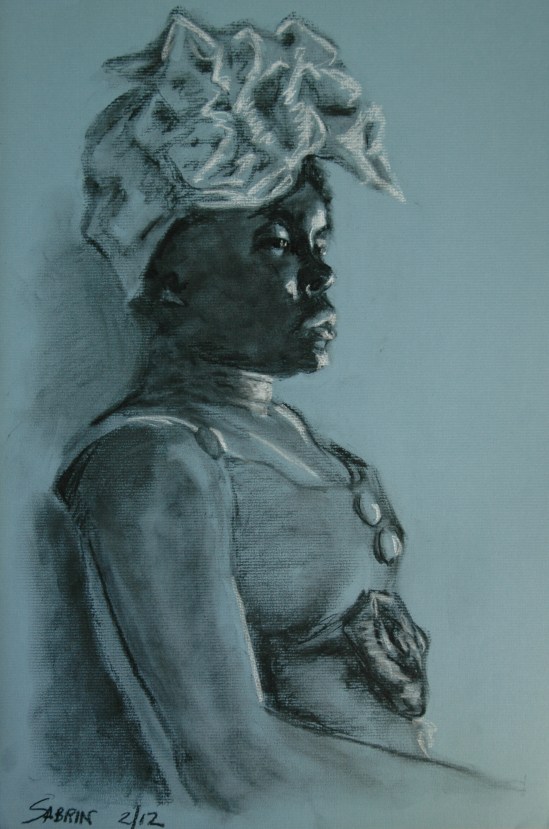
Sabrin, in charcoal and profile

While we are on the subject of portraits, I took another crack at the portrait of Sami and Noodles.  It’s harder to capture children, I think, because you have to keep a light touch.   Their features are so delicate.   For that very reason, though, painting portraits of children makes for terrific practice in making marks at the precisely correct spot to provoke a translation in the viewer’s brain that matches reality.  Our eye/brain supplies so much of the information that an artist who tried to lay out all the information before you, especially in a child’s face, comes across as heavy-handed and awkward.  As a result of trying to avoid heavy-handedness, I spent most of my time today painting out the details that I had so carefully laid in earlier.  I may not be there yet, but at least I know where I want to be.

Sami and Noodles

I’m not done yet.  Remember, I promised a “splurge”.  Tuesday, Peter suggested that my last drawing was worthy of working up to a finished piece.  I had that drawing pad with me Saturday when my car broke down, so I was able to pass the time waiting for the tow truck by working on that drawing.  Never has such a usually tedious wait passed so delightfully.

G, in pencil

Nude woman in chair

Wait, there’s more.  Saturday morning (the regular Saturday life group) I completed two charcoal drawings with which I was happy.  One of my favorite models–it’s remarkable how much difference a good model can make to the drawing.  Last week’s was uninspiring.  This week’s–well, it’s what keeps me going back.

R, reclining

R, seated, in blue and yellow

I think that’s it.  Seven days, seven happy figure/portrait projects.

Aline Lotter is currently exhibiting:

at the Gallery at 100 Market Street in Portsmouth; at the Sage Gallery in Manchester; at the Hatfield Gallery in Manchester; at the Bartlett Inn in Bartlett; at the Red Jacket Inn in North Conway; and at her studio by appointment.

Link to website: www.paintingsbyaline.com

Skin Tone Struggles

Sabrin, No. 1

My painting of Sabrin (pronounced Sabrine) is the result of one three-hour session with the model yesterday.  It was quite the exercise in skin tones, and I am still not happy with the arm closer to us–it’s too gray.  It’s so easy to tip over from a fresh color into mud, and I believe white is to blame most of the time.  I must have painted her chest a dozen times trying to get the value and the color just right.   While I labored over the skin color and her facial features, I succeeded in portraying the hands with my initial strokes.  So I am leaving them alone.  No finishing touches for them.   I wish I could produce an entire painting with that kind of verve and bravura.  Some day, perhaps.

Earlier in the week, I reported to Cameron Bennett at my contemporary portraits class with the two works I had done the previous Sunday (see previous blog).  Got good marks on one and failing marks on the other.  He didn’t like the quick head sketch one bit.  Not one tiny bit.  The other, the whole figure pose, was “charming”, but the head too small and the neck too long.  I received orders to fix that.  He gave me some really interesting suggestions on how to go about fixing a head that was already very good, just too small.  The best one:  take a photo of the original painting and use that to copy a larger version onto the original.  I never would have thought of that.  Here is that painting again, so you can see what we were talking about:

Adrienne in her tough guy outfit

He especially liked the feet, by the way, singling them out right away as a major contributor to the charm of the gesture.  Yea!  (I had started with the feet because they were my favorite feature of her pose.)

In other news from that class, I may have finished the reclining nude that I started last week.  Her head is looking too small to me now, but it is farther away so maybe I can argue perspective.  I labored over painting her face with just enough definition and would hate to have to start that over again.  You might recall that this is one of the heads that Cameron did not like in the original charcoal version of it.

With about a half hour left in the class, I started on another translation from charcoal to oils, this time looking for some new aspect to try out, to make my work “contemporary”.  I decided to paint the skin tones without white–or less white–and to isolate the red and yellow ochre ingredients.  Red for the shadows.  I ran out of time just at the point where I had wiped out the face in order to start it over, so what you will see below is truly a “work in progress”, not just an almost finished work needing a few tweaks here or there.

Study in Perylene Red and Yellow Ochre WIP

I also managed to put in a few hours this week tweaking older paintings.  One that is nearing a finished state is my original portrait of Sammi and Noodles.  I added yellow reflections in Noodles’ eyes, which gives away the origin of the image as a photograph.  But so what?–the image just cried out for that yellow in just that place.

Sammi and Noodles No. 1, almost right

Aline Lotter is currently exhibiting:

at the Gallery at 100 Market Street in Portsmouth; at the Sage Gallery in Manchester; at the Hatfield Gallery in Manchester; at the Bartlett Inn in Bartlett; at the Red Jacket Inn in North Conway; at the McGowan Fine Art Gallery in Concord; and at her studio by appointment.

Link to website: www.paintingsbyaline.com

Two Steps Forward, One Back

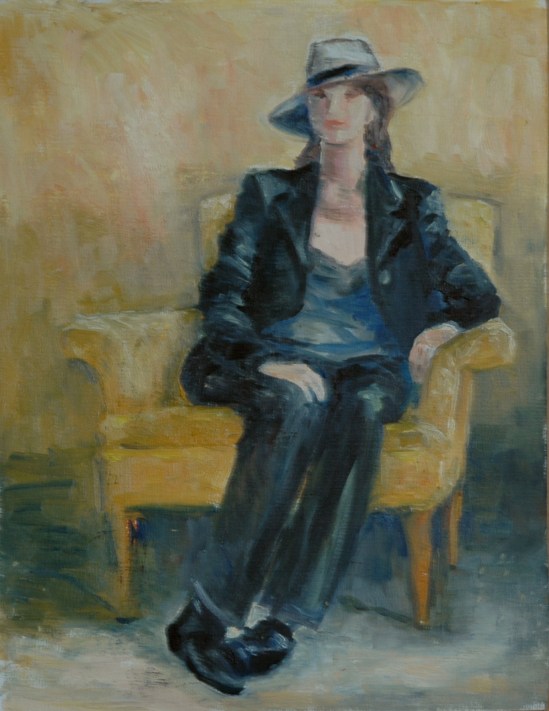
Adrienne in her tough guy outfit

It was a great week in terms of activity.  Wednesday the Granucci workshop group met for 4 hours of live nude drawing.  Thursday the Bennett class met for painting the contemporary portrait.  Saturday the Saturday Life Group met for its usual three hours of live nude drawing.  And Sunday I joined a new group that meets for three hours to paint or draw from a clothed model, who keeps one pose for the entire time.

Peter (Granucci) started us on shadows, and I am happy enough with my results to share with  you for the first time some of my drawings from that workshop.

Two quick poses from Granucci workshop

Exercise in Shadowing

Thursday night, I took in my drawings from Saturday and Wednesday in order to choose one to use as a basis for painting.  I narrowed it down to two:  the more developed one above, and one from last week, the reclining figure.  I was happy with both of the faces on these two, until I asked Cameron (Bennett) for advice on which to choose for my painting.  He didn’t like the faces.  I was so taken aback that I forgot to ask why.  Anyway, together we chose the reclining figure to paint:

Translation into Oil

Our model on Saturday was the same person who was modeling for SLG the first time I joined.  That was perhaps 4 years ago, and she hasn’t changed a bit.  I have mentioned before how I just accept a bad angle and try to make the best of it.   This week I tried, but I did not make the best of it.

Rear View

Extreme Foreshortening

In fact, I may have done better with the shorter poses, which were in pencil:

Series of poses from SLG:--5, 10, 20 minutes

Sunday morning I  joined up with my friend Bea to go paint at Adrienne’s studio, the same studio where we meet for the Granucci workshop.  Adrienne had arranged for a Sudanese model dressed in her native regalia, and Bea in particular was looking forward to painting the dark skin tones–she even prepared a special palette.  But the Sudanese model never showed up–signals got crossed or were not even received, apparently.  So Adrienne herself modeled for us, too upset to paint anyway, she said.  She held the same pose for the entire three hours, with generous breaks every 20 minutes or so.  I finished a small painting of her entire figure (the painting that leads off this post) and had a half hour to spare, so I started on a painting of her  head.  I was hoping that the limited time would push me to capture the essence with minimal strokes, a la Caroline Anderson (whom I have adopted as my muse, as recounted in earlier posts).

Alas, on my way home, the tape I had used to keep the full body portrait secured to its support came loose, and smeared the head portrait.  In the course of repairing the head, I lost the freshness and simplicity of the original.

How to Sport a Fedora

The full body one was easy to repair, and I don’t think I lost anything essential to it.

So I am kind of down in the dumps at the end of a relatively productive week, which is probably why I couldn’t bring myself around to getting this post out on time.

Aline Lotter is currently exhibiting:

at the Gallery at 100 Market Street in Portsmouth; at the Sage Gallery in Manchester; at the Hatfield Gallery in Manchester; at the Bartlett Inn in Bartlett; at the Red Jacket Inn in North Conway; at the McGowan Fine Art Gallery in Concord; and at her studio by appointment.

Link to website: www.paintingsbyaline.com

Concentrating on Portraits: Faces with no Features?

Of all the works I labored over this week, the above detail from a charcoal drawing comes the closest to being an actual “portrait”.  It looks like the model.  In fact, the entire drawing could be called a portrait in that it not only looks like the model, but it conveys the model’s attitude, which I have called “Proud”:

Proud

If you are a regular reader of this blog,  you already know that I am taking a course in contemporary portraiting at the NH Institute of Art, with Cameron Bennett.  One of the points that he made in our first class was that anything representing the subject can qualify as a “portrait”–if that is what the artist intends.  (One out-there example brought up by one of my smartypants classmates was Andy Warhol’s tomato soup cans.  She/he said he practically lived on tomato soup; therefore the soup-can paintings could be considered self-portraits.)

So suddenly I feel free to call my anonymous figure paintings “portraits” too.  I’m thinking of the studies I painted from the photos I took at the  Mount Washington Bike Race, discussed and reproduced in several of my posts from last fall.  As you will see below, I’m still working from those photographs, and I’m still trying to work more loosely.  To that end, I have stuck printouts of Carolyn Anderson paintings all over my easel to help me remember how little I need in order to convey eyes, nose, etc.  (Forget the mouth altogether.)  All this fits splendidly into another theme or goal, which was urged upon me by various art teachers to whom I have paid good money to criticize and guide me.  And that goal is to eliminate the detail.  I was never quite sure which details I should eliminate, so now I am on track to eliminate all of them, so that should produce something like progress, eh?

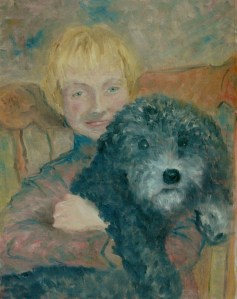
Last week I was struggling with a portrait of Sammi and Noodles, which got way too detailed.  (To see it, go back to last week’s post.)  Thursday night, I went to class bearing that sorry effort, along with my photograph of Sammi, and my drawing from the week before.  (All in last week’s blog.)  But I (wisely, I think) decided to make a fresh start on a new painting of the same subject.   Again I was seduced by the dog Noodles.  (Maybe I should just give up and do nothing but pet portraits.)   The depiction of Sammi was horrible.  I can’t show you how horrible because I smeared it out even while Cameron and I were shaking our heads over it.  He got into the spirit and started moving paint around with his fingers too, in random and varied directions, to show me how Carolyn Anderson would probably have attacked the painting.  (I use the word “attacked” to convey both possible meanings.)  Then at home yesterday I practiced on both versions of Sammi and Noodles, and here they are as they exist today, side by side:

No. 1, version 2

Sammi 2

xxxxxx

xxxxxxx

I’m not satisfied with either one, but don’t you agree that version 2 shows me moving in the desired direction?  I decided it was time to move on and apply whatever I learned to another project.  Here is the result:

Fans

I’m feeling good about this one.  The paint is very thick and still very wet, which is why I could not get a decent photograph of it . .  .  also why the colors may be a little too muddy, but I’m not going to worry about that right now.  The important thing is, I conveyed the gestures and attitudes of these three people without painting distinct features on them.  My previous Mt. Washington studies (yes, this too is from that race) had started to become that kind of thing, what with the loosely painted crowds.   Notice the crowd depictions above!    Maybe too abstract?  Hey, I’m feeling my way here.

But back to the portrait, the real thing, that I started you with today, the charcoal of “Proud”.   My favorite thing from this week.  I believe–I could be wrong, but I do believe–that there is no offending detail in that portrait.  I am going to take it in to class this Thursday and see what Cameron has to say.

Aline Lotter is currently exhibiting:

at the Gallery at 100 Market Street in Portsmouth; at the Sage Gallery in Manchester; at the Hatfield Gallery in Manchester; at the Bartlett Inn in Bartlett; at the Red Jacket Inn in North Conway; and at her studio by appointment.

Link to website: www.paintingsbyaline.com

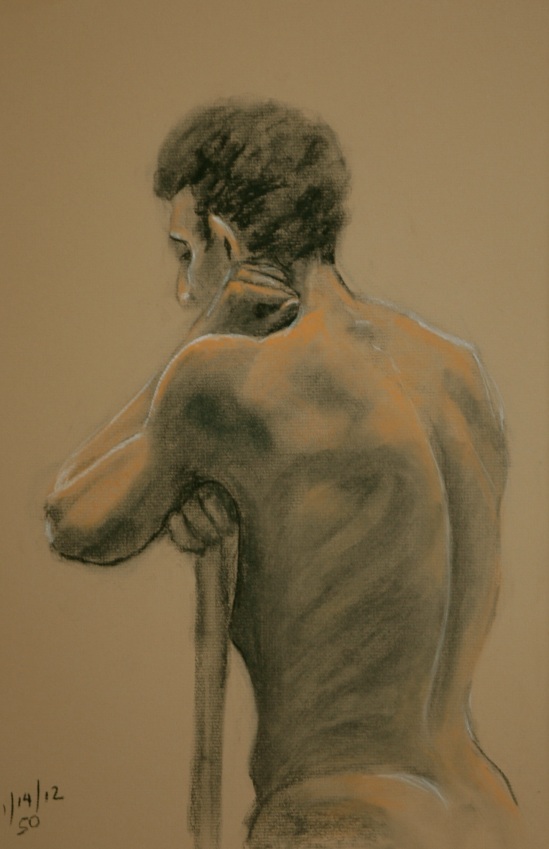
Why is this man digging a hole, in the nude?

J's back, three-quarter.

"This should have been easy"

Portrait of a young man resting on the handle of the shovel, contemplating the hole he has dug for himself.  Why is he digging a hole for himself?  Unimportant.  Why is he nude?  Hmmm.  He’s in a nudist colony?

I struggle with the titles of my nudes.  The models must adopt a pose that they can keep for 20 minute stretches (sometimes longer), so the figure is contemplative, dreaming, sleeping, reposing. . . well, you get the idea.   One could simply title this one “Nude Male”, but that would not distinguish it from all the other nude males in the portfolio.  One could number one’s nude males.  Or one could come up with some witty thought superimposed on the model, which is what I attempted to do today.  I was inspired by the captions attached to the animals photos that circulate the internet, which captions awe me with their inventiveness.  I think, however, that it works better for cats and dogs than it does for  a naked human being.  The caption needs to acknowledge the nudity somehow, to make it work better for the nudes.  Something like, “Only five more minutes and I can put on my pants.”

On this point Degas’s bathers had the advantage–their natural nudity, nakedness, did not have to be explained away.  (By the way, that exhibit at the Boston Museum of Fine Arts will be closing February 2.)

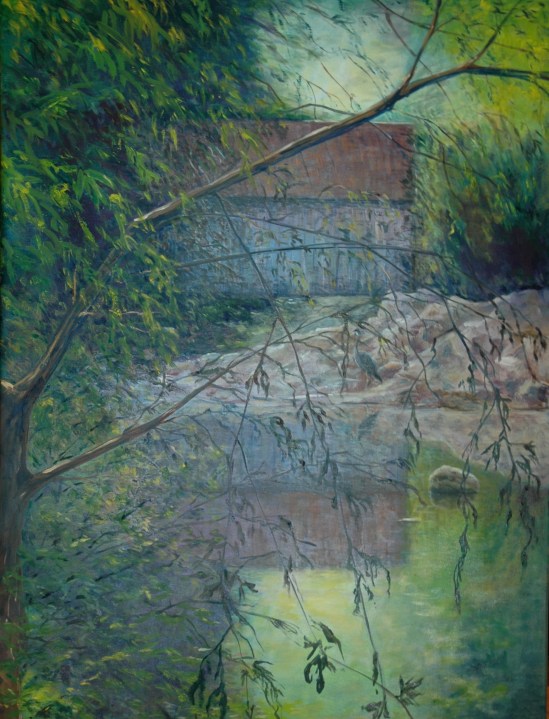
Today’s nude was the pick of last Saturday’s life drawing session.  Sunday I finished the reverse-painting-on-glass and delivered it to the owner, who was pleased.  I also finished the Covered Bridge.  In response to an excellent observation from one of my followers, I removed some offending slashes of white, which I guess I had intended to symbolize water laps.  When you paint loose, the results can be brilliant,  or when not so brilliant, just careless.  An artist needs another, more objective eye to catch those things, and it  doesn’t have to be another artist’s eye either.  I always listen to a criticism and act on it, unless I am very sure of my own contrary view.  (Many times, the stated objection does not actually identify the real problem–it could be something nearby that throws the viewer off.)  In addition to making that and other various improvements to the body of the Covered Bridge painting, I painted the sides of the canvas in colors approximating the action going on the main canvas.  The painting can now be hung without a frame, as a “gallery wrapped” painting.  That is important to me, as the artist, because otherwise I would have to invest in a frame in order to exhibit the painting.

The rest of Sunday was devoted to another project:  homework for my fifth (at least) course at the Institute with Cameron Bennett on portraits.  But this time, something different–for him and us.  We are trying to BE different, paint somehow “out of the box”, using as possible inspiration other contemporary portraitists who are painting in styles newly invented or at least newly applied.  The only artist on the list supplied by Cameron whose name I even recognized was Chuck Close.  I am not drawn to emulate his monumental portraits.  The artist I am drawn to is Carolyn Anderson.  Her portraits are so loose as to be almost not even there.

Detail from portrait by Carolyn Anderson

In class I tried to emulate Anderson in pencil, drawing a portrait from a photograph:

Drawing from photo of Sammi and Noodles

After drawing my careful image, I erased a lot of it so as to leave ghosts of the image.  This exercise was the starting point of my painting effort yesterday, but yesterday I tried to be looser right from the get go.  Nevertheless, when I reach the point where I thought everything was correctly placed, there was a lot of smudging and subtracting.  Not enough!  This is still a work in progress–don’t judge it too harshly, and remember what I am going for:

Sammi + Noodles portrait

This isn’t going to be easy!  Especially for me, who has been accused of getting too hung up on the details.  I love the details.  It’s a mystery then, why I am so beguiled by Carolyn Anderson’s way of painting.

Aline Lotter is currently exhibiting:

at the Gallery at 100 Market Street in Portsmouth; at the Sage Gallery in Manchester; at the Hatfield Gallery in Manchester; at the Bartlett Inn in Bartlett; at the Red Jacket Inn in North Conway; and at her studio by appointment.

Link to website: www.paintingsbyaline.com

Out of the Comfort Zone

People are always urging artists to get out of their comfort zone.  What exactly is wrong with a comfort zone, anyway?  I wish I knew — I wish there was something  that I could nail every time out.   But there are certainly ways of making art that I am more comfortable with than others, and I’m not talking about the difference between painting in my studio or getting outside in zero degree weather.  I am most comfortable painting and drawing in a representational way, in a traditional way, in oils, on a stretched canvas, panel, or in the case of the drawings, a pad of paper.

This week I have decided to go public with three new things that are out of my comfort zone.  Two of the three are combined:  (1) Painting on glass.  (2) Painting with acrylic paint instead of oil, on said glass.  The third:  Painting symbolically, as opposed to realistically.

First, the reverse-painting-on-glass project.  A client bought an old clock at auction that boasted a glass panel reverse-painted with a once-lovely bucolic landscape.  The paint was peeling and  flaking off the glass.  Here is what it looks like :

original reverse-painted scene

He asked me to replicate, roughly, this scene freshly painted on a new pane of glass.  I did some research, and discovered that you can use either oil or acrylic for reverse-glass painting, but acrylics are preferred because of the faster drying time.  I already had some acrylic paint, which I use to tone canvases before painting with oils.  (You can paint with oil over an acrylic base, but should not paint with acrylic over an oil base–for fear of the oil not having dried completely underneath–maybe that is what caused the above painting to start to crumble.)  Except for the gold, which I have only in oil paint, I used my acrylics to make this loose reproduction:

painted side of reproduction

My client did not mind if I reversed the image, so I traced the image with black pen right onto the surface I intended to paint.  I wanted the black markings to show up  in the first layer.

Viewing side of reproduction

I need to work on the gold “frame” and plug up some holes, but basically this is it.  The only way to change anything is to scrape off and start over.

My other uncomfortable project takes a bit more explanation.  I belong to an organization called “Women’s Caucus for Art“.  I am on the Board of Directions for the NH chapter, and also serve as Treasurer for the NH chapter.   Every year the WCA organizes a number of funky exhibits.  I have mentioned the 6×6 here, and I have participated in the annual “Flowers, Interpreted”, and my “Farmers Market” painting was juried into an exhibit on a theme of locally grown food.  My offering for one called “Old Wives Tales” up at Plymouth State College did not make it, nor did my very first submission a few years ago to an exhibit of female nudes called “Go Figure”.   When I saw the art selected, I better understood the meaning of the title.

Point is, they do some weird stuff that my rather sober, traditional take on on images does not fit into, comfortably.  But good sport that I am, I keep trying.  So here is this new one, called “On Target”.  For this exhibit, one must use this as one’s inspiration:

The "On Target" inspiration piece

My first reaction was, “Huh?”  That was my second and third reaction too.  How on earth do I fit that thing into my way of being artistic?  Coincidentally, I had recently watched a movie called “Vincent” by Paul Cox.  Van Gogh is one of my favorite artists.  The movie consists of Van Gogh’s words, written in letters to his brother, recited against images of his paintings and the countryside that he painted, and a few reenactments of his painting process.  I was particularly affected by the reenactment of his painting of “Starry Night”.   Suddenly, it came to me that the targets were very similar in shape (you know, round!) to stars, and that the circles around them were analogous to the  auras that surrounded the stars in Starry Night.  All I had to do was reverse the colors.  I was inspired!  So inspired that I jumped on it right away and spent all of  yesterday on it:

Starry, Starry Night, under its inspiration

I am titling it “Starry, Starry Night” after the Don Maclean song, because that opening theme keeps running through my mind.   As always, it may not be finished yet.   Actually, it may be just my first stab at bringing this idea to fruition.  Does it have enough merit to make it into the “On Target” exhibition?  Stay tuned for word on that.  But if satisfying the theme counts heavily, I think it should.  What think you?  Here is the large, in your face, version:

Starry, Starry Night

Aline Lotter is currently exhibiting:

at the Gallery at 100 Market Street in Portsmouth; at the Sage Gallery in Manchester; at the Hatfield Gallery in Manchester; at the Bartlett Inn in Bartlett; at the Red Jacket Inn in North Conway; and at her studio by appointment.
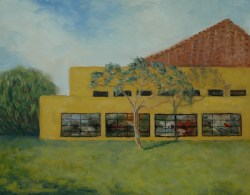
Link to website: www.paintingsbyaline.com

Studies, Ending, Beginning

This is the last study for my large Mt. Washington Bike Race painting.  I numbered it “4” but in fact it is 5 if you count the two portraits in the series.  I have started on the big canvas, but the drawing is so rudimentary that I am saving it for a future post, when I hope I will have something of interest to display.

Meanwhile I would like to share with you a minor triumph–well, sort of a triumph and certainly a very minor one.  Last Summer (can’t believe it has been that long ago) in the Portraits course I was taking with Cameron Bennett, he crushed me with the observation that an eye was too low on a copy of a Serov portrait that he had assigned us as homework.  Here is a link to my report on that last effort.  Last week I finally got around to correcting that flaw.  I used a ruler.  I laid the ruler under the eyes of the original, then under the eyes of my copy.  I couldn’t find any discrepancy, yet I had to agree the there was something fishy about my eye.  Of course, the color was wrong, but could that obvious flaw have create the misimpression that the eye was too high or low?

Original, by Valentin Serov      

My copy of Serov portrait (A)

My copy, after retouching eye

Original Portrait by Valentin Serov

Finally, one more workshop piece, from our (NH Plein Air artists) most recent meeting of the Peter Granucci workshop series, which ironically, requires indoor practice from photographs.  The subject this month was snow.


Snow Shadows

Improvements

DSC_3049

Above is a new and improved version of the Rockport Harbor painting from last week.  I’m hoping you might be curious to see what can happen to a plein air painting after the artist gets to stare at it in the studio for a while.  It all started when I decided that the shape of the red fish house was not quite right.  Perspective errors are the worst–they haunt me forever unless I fix them.  And once I dive into a painting to make one correction, chances are pretty good that I will find other ways to improve on a painting, even a painting that started out not so bad.   (With a bad painting, I’m like a dog with a bone–I won’t give it up.)  So, after correcting the shape of the fish house, I made the following changes:

Sky:  horizon color–greener

Red fish house: adjusted values of lighted and shaded sides

Blue fish house: changed color of  roof

Boats:  added clean whites to sun-struck surfaces

Water:  brought up reflections of boats, toned down reflection of red fish house

Stone abutments:  eliminated highlights, contrast

Rockport Harbor WIP

After making those changes, I submitted the painting to Patrick McCay’s critical gaze in my EEE class, and, following his advice:

Foreground shrub: added darker shadows, to better compete with the dark in the middle boat

Middle boat:  inserted lighter shadows into the deck , so that the boat stopped attracting the eye

Red fish house: grayed down the red on the fish house–to comport with aerial perspective rules.

I think it’s done now.  Unless something else starts to bother me about it. But I am deep into more studies for the Mount Washington bike race painting and unlikely to give Rockport Harbor another going over.

Here are two Mt. Washington studies, one finished (maybe) and the other, not quite finished–hope you like them!

View of race with vista

At the Finish (WIP)

Aline Lotter is currently exhibiting:

at the Gallery at 100 Market Street in Portsmouth; at the Sage Gallery in Manchester; at the Hatfield Gallery in Manchester; at the Bartlett Inn in Bartlett; at the Red Jacket Inn in North Conway; and at her studio by appointment.

Link to website:  www.paintingsbyaline.com

Boats

Rockport Harbor, November 2011

Last Monday, I took the day off to go painting, making a gift out of the  chore of picking up an unsold painting at the Rockport Art Association in Massachusetts.  Accompanying me were my friends, Jackie and Clint.  We explored the entire downtown area before settling on a location across from the T Wharf where Clint and I had painting a month ago.  It was a magnificent day, at least until the sun disappeared behind the buildings.

Drawn again by the fish house known as Motif No. 1, I also had Van Gogh in mind in my depiction of the drying shrub.  At the start, the boats were necessary to the scene, but not necessarily the focus of the painting.  But boats have a way of stealing your attention, of grabbing the eye.  So I give up, and let it become a painting about the boats and not at all about the now-annoying drying shrub in the foreground.

A few days ago, I read another blog exhorting artists to keep all their older work so that they can see and appreciate the progress they are making.   I keep pictures of most of my paintings, and the rendering of boats is particularly difficult.  I searched everywhere to find the first boats I remember having painted; the only images I could find were embedded in an Excel file.  (I used to keep track of all my paintings in an Excel file, but after 100, it got to be too cumbersome.)  The struggle to find a way to include these two proofs of my early ineptitude has taken me all morning.  I finally figured out that if I transfer each image from the Excel file to a Word file, then save the Word file as a web page, the images get converted to jpg images that I can import into iPhoto.  Then I export the images from iPhoto to my desktop, from whence I can upload them into WordPress.  Whew!  Not sure the effort was worth it.

These two paintings were plein air, on Monhegan Island, during a workshop with Stan Moeller:

Monhegan Harbor from Fish Beach

Lobster boats, lobster pound          

Kind of clunky, right?  But not bad as a start.  Bear in mind the damn things are constantly moving and changing their orientation as the tides move under them.

In my search through the archives, I stumbled upon three paintings from another Moeller workshop that also contained boats, earlier than the Monhegan boats by about two weeks:


These three are views from La Napoule on the Mediterranean coast of France.  The boats in these three paintings are too distant, too small to  qualify as boat paintings, but I thought they were worth including since they are the very first boats to appear in any painting by me.

Apparently, I went without boats of any kind for two years after that.  The next grouping is two Rhode Island paintings, again plein air, that I painted in the summer of 2009:

Working Boats at Rest 8×10          

Marina at Allen Harbor, Rhode Island  12×16

I was very pleased with these two paintings, which were done in the same afternoon from virtually the same spot.  The conditions were uncomfortable–very windy, cold, I think, yet sunny.  I just remember being miserable during the first painting  and rushing to finish it.   It’s not hard to see progress between the Monhegan boats and the Rhode Island boats.

Most of my boats are plein air experiences, but there is one prominent exception.  I painted a large (for me, then) portrait of a waterfront in Portsmouth, New Hampshire, and toward the end, stuck in a boat to break up the waterline and add interest:

Portsmouth Waterfront 16×20

That is a real boat–it belongs to someone who lives in one of those buildings. This boat “portrait”, painted from a photo reference, undoubtedly helped me in depicting my favorite plein air boat, “High and Dry”, from 2011 below.

My Rhode Island successes had given me the courage to go for boats on my next trip to  Florida; in 2010 I choose this orange catamaran.

Catamaran

The double hulls made this a complicated project. I was not  thrilled with the resulting portrait.  So I tried again with this one, looking for the magic I seemed to have found in Rhode Island:

Boat Slip

This painting is not about the boat in the background, but about the reflections in the water of the pilings.  But it’s still a boat so it has to count for something.  The boat is certainly better than the Monhegan boats–not as clunky.  But I don’t love it the way I love my Rhode Island boats.  Perhaps I have a bias in favor of working boats.

That Fall (2010) I painted my first New Hampshire boats, but in a way that the painting cannot be assigned a place the scale of good, better or best boats.  These were impressions of boats from a distance, much like my La Napoule boats:

Sunset over Massabesic Lake

The point of this painting, obviously I guess, was the sunset.  The boats are mere window dressing, silhouettes against the light.  Around about the same time, I painted from a photograph taken in Ogunquit, Maine, the following scene:

Reflections

Another case of the boat being window dressing.

This brings me to the most recent predecessors of Rockport Harbor:  two paintings from Florida in March of this year; and one from Wells Harbor in June.

One-story home with Boat

High and Dry (but still perky)

Wells Harbor

Of these three, only “High and Dry” is all about the boat.  “High and Dry” is, in my opinion,  my best boat ever, but it should be:– unlike all other boats, my model for this painting was perfectly stationary.  It’s hard enough drawing or painting a moving object, much less one that demands a level of accuracy approaching portraiture.

Finally, Rockport:

Rockport Harbor, November 2011

Three boats of diminishing size to show perspective, of diminishing detail to show distance, a scene so perfectly matched to the beginning (Monhegan boats) that a comparison is easy.  There has been progress!  But wait–what about progress since Rhode Island boats?  That is far from certain, to me at least.

Aline Lotter is currently exhibiting:

at the Gallery at 100 Market Street in Portsmouth; at the Sage Gallery in Manchester; at the Hatfield Gallery in Manchester; at the Bartlett Inn in Bartlett; at the Red Jacket Inn in North Conway; and at her studio by appointment.

Link to website:  www.paintingsbyaline.com

A Best Week

Some weeks are so full of reportable stuff that I have trouble choosing my topic.  Other weeks, I have trouble scaring up a single decent topic.  I could save up half of the good-week stuff for a dull week, but who wants to plan for dull weeks?  Not me.  On the other hand, I don’t want to bore you either, and really now, wouldn’t  you rather hear about struggles?  This week I can report on a bit of a struggle and its accompanying triumph so that’s what I lead with.

Part I.  Alpaca Love.  You remember the alpaca farm/ranch from last month?

Alpaca Farm v.1

Alpaca Farm in North Conway

This was the plein air painting from the Bartlett weekend, to which, I announced, I would be adding an alpaca closeup.  I had one good alpaca closeup, so I went with that, even though I’d have preferred the animal to be facing more towards the viewer.  My closeup did not include the legs either, so I was winging it with regard to the posture and thickness and general shape of the legs.

Alpaca Farm v.2

Alpaca Farm v.2

Pretty awful, right?.  I wouldn’t even show it to you before–I couldn’t let it sit out there as if finished when I was going to have to repaint the red alpaca closeup.  First, I had to find a better reference photograph.

As it turned out, when I got around to searching my own photographs, I had plenty of good alpaca poses.   Thanks to my powerful Nikon SLR camera, alpacas photographed in the way distance still gave me enough enlarged detail to paint a loveable blond alpaca in just the right pose, in just the right spot.

Alpaca Farm, v.3 (Final)

Part II:  Supercyclists. Earlier this evening, I delivered two paintings to my son in celebration of his birthday.  One of them  you have seen already.

Andy as Supercyclist

It depicts him right after finishing the race up to the top of the Rockpile (Mt. Washington).  Paint still wet on the second one delivered, is my painting of his friend Kori, from the same time, same place.

Whew!

I love the foreground in Kori’s painting.  Strange that where the focus of the painting is the figure of the cyclist, what I love most is how I painted the ground.  I would have liked to paint the face more expressively, but I didn’t really have room for that.  The two paintings are each 12×9, so the faces are quite small.  I wanted to get the likenesses as close as possible, so I had to be careful.  Andy’s worked out better because I had only light and shadow anyway, but Kori’s nose, mouth, eyebrows had to fall in the exact correct places, and no smearing please.

My major painting plan, for which these two 12x9s have served as studies, is still on, but the faces in the big one are not going to get any bigger since the plan is to encompass the entire rockpile.  I think I need to reuse this scene in a longer painting so as to include more of the shadow, and larger overall, so as to allow more of a slapdash face.

Part II:  Lovely Nudes.  Finally, for a change of pace, how about a collection of lovely nudes from Saturday Life Group?  My best from two weeks ago, and all three from this week:

Arrangement of elbow and knee   

Leg on Blue Draped Pillow

Right Side with bent elbow

The back from a left angle

I am wondering if I am getting too heavy-handed with the charcoal.  The “Leg on Blue Draped Pillow” has more charm to it, I think, because I had the pose for only 20 minutes and had to keep a light touch.  I would like to know if you agree.  Or disagree.  Either way, it was a good week.  Here’s hoping for another one coming up!

Tomorrow (Monday) I pick up my painting from The Rockport (Mass.) Art Association.  Unsold.  They invited me to apply for membership, and I thought I would if my painting sold, but it didn’t, so I didn’t.  A bit far to go for the sheer joy of exhibiting.  Although I do hope to get in a plein air painting day tomorrow, which makes a trip worthwhile.  Also tomorrow, paintings are being changed out at the Sage Gallery in Manchester, 70 Lowell Street.   Please visit this new gallery.

My old website, with multiple painting galleries yet to be transferred to this WordPress location, can be accessed at this address:  www.paintingsbyaline.com.  Also there are  all the images attached to earlier blog entries.  Eventually I will move everything here, but it takes a lot of time.

Tale of Woe

. . . Snow woe?  Weather woe?  Maybe lack-of-power woe.  “Power.”  Have you ever thought about the usages of the word “power”.  We use it to describe an attribute of people who attain positions where they can control the lives of others.  Power is also an attribute of an individual who can control his/her own life.  So why does  “Power” also refer to  electrical current to run lights, furnace, phone, internet, microwave, TV, DVD, and radio, to charge cell phones and Palm Pilots?  Because without all those abilities, one is powerless.

Without power (in the technological sense) One is also cold, hungry, and sleepless.  So I write this tale of powerlessness–obviously not from home–in a state of grogginess.  For the first time in my life, I slept with a Great Dane.   I invited her into bed with me when her “mom”, my granddaughter, bailed on us to go spend the night with a friend with “power”.  Honey, the Great Dane, usually sleeps with Tabitha, my granddaughter.  Tabitha thoughtfully lent us her comforter and Honey was dressed in a woolly sweater.  I wore my thermally correct underwear and a snuggly fleece robe-type thing over that.  We were warm enough.  Well, I was warm enough.  Honey was shivering and twitching all night, while I concentrated on hanging on to my share of the bed and waiting for the sun to rise.

Actually, I wasn’t all that hungry because I got to spend a wonderful 4 to 5 hours at a party with artists earlier in the day.  Mill Brook Gallery in Concord held an opening for an exhibit that was enchanting in its originality and breadth.  http://www.themillbrookgallery.com/  I had been invited by Patrick McCay, one of the featured artists, who is my EEE teacher.  (EEE stands for Explore, Exploit, Express–in whatever medium, whatever style.)  Two of his paintings already had red dots on them when we got there.  “We” because I did not have the use of my car yesterday but got a ride with two other artists, Bea Bearden and David Wells.  Through Bea and David I also found myself welcomed to a pot luck supper after the reception.  What a pot luck supper it was!  It deserves commemoration by publication of the entire amazing menu, but I cannot do it justice on the wing with descriptions like “quiche-type thing” and “rice and beans”.  I didn’t go near the pies–no room for dessert.

So in truth I was warm enough and not hungry at all, and only sleepless now.  Yesterday, before going off and partying, I used a few daylight hours to tinker with three paintings that I had started in EEE.  The third one is my newest one, which you have not yet seen.  In order to get enough light in which to photograph it, I brought it to the office with my camera.  No tripod though, so it looks a little fuzzy.

Taking a Bow

As the cyclists arrive at the top, someone throws a gray blanket over their shoulders, which keeps them from getting too chilled after their sweaty exertion.  The top of Mt. Washington is, even in August, likely to be a chilly place.  Andy, who happens to be my son, appears to be wearing a ribbon of some sort, which I only noticed in the course of working on this painting.  Will have to find out the significance of that.

The train car in the background is part of the  Cog Railway.

In this painting, I believe I have become more of an impressionist, which is kind of  what I have set out to do in the EEE class.  My highest goal is to emulate  Sargent and Sorolla, which to me means using the brush strokes expressively.  I really enjoyed working on this painting.  It is another of the studies for the larger work I am hoping to get to, the one of the whole top of the mountain with the crowds, the cyclists, and the mountain vistas.

Aline Lotter is currently exhibiting:

at the Gallery at 100 Market Street in Portsmouth; at the Sage Gallery in Manchester; at the Manchester Artists Association Gallery in Manchester; at the Bartlett Inn in Bartlett; at the Red Jacket Inn in North Conway; at the Rockport Art Association Gallery in Rockport, Massachusetts.

Link to website:  www.paintingsbyaline.com

Details (Death to)

“It’s all in the details” — a statement considered wise when the subject matter is policy. What about when the subject is art? Recently, I visited an exhibit of Dutch and Flemish paintings from the 17th-18th century, wherein the details were really important. Before photography, paintings were valued as records; the tiniest of details were appreciated. But in this day and age, details can be a hindrance to artistic expression. Representation, as opposed to abstraction, is even looked down upon in some quarters. Abstraction is the ultimate in detail-elimination.

Only last week one of my followers commented, “Your drawings are magnificent.  Great attention to detail.  Superb!”  Alas, his approval, to the extent based on my attention to detail, may be misplaced. I have to acknowledge a contrary judgment–that in general, attention to detail is not a good thing, and that in particular, my attention to detail is more of a handicap than an ornament to the quality of my output.
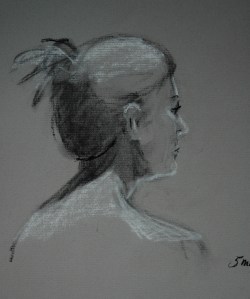
Which is just a long way of saying, I expend too much energy on details.  At one point during the Red Chalk workshop, Rob Liberace asked me to dial back on the details–I was making a virtual skeleton out of our lean model.  Referring to the portrait above, “Kitsch,”  Cameron Bennett suggested last Thursday.  Ouch!

Two experts within a short time identifying the same weakness–there must be something to it.  How did I get to this pass?  Certainly my plein air painting never permitted excessive detail.  One theory–my speed in getting to a near-finished state leaves me all too ready to look for areas to refine.  Instead of reexamining the broadest strokes to make sure those are as perfect as I can get them, I start on what I used to consider the next step–developing the details.  Another theory–I am just not that good an artist.,
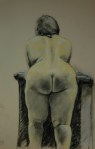
Take this week’s portrait from a live model, posted as the cover image for this blog.  As soon as I caught Rebecca’s likeness and properly placed and sized all her features, I spent considerable time working on the details, or what I was then considering the nuances of her features–especially her mouth and eyes.  It was at the end of that session that I got the “kitsch” remark. Ouch–that still hurts!
Here is the current portrait next to the earlier one done in black and white. Big improvement anyway. (But we had less time to work on the black and white, I think.)

At least when copying a work done by a master, I cannot be criticized for the sin of detail. The detail, or lack of it, comes already supplied. Here is this week’s homework assignment, from a self-portrait by 20th century Italian artist, Pietro Annigoni.

The whole point of copying, may I remind those of you who abhor the slavishness of copying, is to train the copyist’s eye. If I cannot see how my ear is different from the original’s ear, how can I expect to paint a good representation of a real, live ear? So there is the original, on the right, with my copy on the left. Sitting on my easel, my copy looked virtually perfect to me–I fantasized Cameron accusing me of tracing the image.

Here, not so perfect. A decent copy, but far from perfect. I gnash my teeth in frustration! How did the bloody head get so elongated in the original, with me not noticing? This is why artists resort to projecting drawings onto their canvases from photographs, a practice frowned on by purists, and one that certainly does nothing to train the eye. Fury it is that motivates them!

I hereby resign myself to getting beat up upon by Cameron this Thursday because there is no way I am repainting that ear. (In order to narrow the head, I would have to move the ear.)

But back to the topic–Death to Details. With this new anti-detail directive freshly absorbed, giving a nod to Peter Granucci here as well since he also has tried to wean me away from focusing on details when drawing from a live model, I took out a painting that had never satisfied me.  This was a painting based on a drawing made with a live model.  I had no details to refer to –the painting itself was several references removed from the original drawing since I had painted over it several times trying to find a version that pleased me. Could I solve this painting by eliminating even more details?

The only part of this painting that I liked was the hand and the drape at the bottom, so I felt free to mess with the rest of it.  I tried muting the background.  I changed the hairdo.  I refreshed the skin tones and created large splashes of light. Finally, taking a cue from the hand that I did like, I outlined the figure in black.  Suddenly, it looked interesting.  I never use black ordinarily, so this was definitely weird.  I scumbled (a technique for applying a glaze but with a dry brush) more black into the background and it got even better.

Ultimately the color, and maybe the contrast may save this painting.  But my curiosity to obliterate detail is what motivated me to revisit this painting.  Maybe that makes no logical sense, but hey, that’s left brain for you!

Meanwhile, and D, I’m talking to you, don’t praise my attention to detail.  It’ll just make me squirm uncomfortably.

This blog started out over two years ago (!) with no particular angle on my painting adventures, but has begun to develop as a chronicle of my efforts to grow as an artist. So I have come up, finally, with a name for it: Painter’s Progress–playing on the phrase “Pilgrim’s Progress”, a religious tome from a time period when details in paintings were expected and desired.

Snow Painting

Next August, I plan to participate in a special exhibit at the Arnold Arboretum in Boston, of paintings painted au plein air by members of the New Hampshire Plein Air group at the Arboretum. We are trying to cover all four seasons of the year. So we had to do winter. On January 7, the first group of us (about six in number) descended upon the Arboretum with our usual gear, plus all those things designed to keep us from freezing to death. I staked out a spot on the Willow Path, which is just inside the main gate, not far from the bathrooms in the visitor center. At least I had a bit of a hike to get to this spot. Others who shall remain nameless set up their work stations in the parking lot.


Willow Path in Winter

Willow Path in Winter

After finishing the painting above, I had a little extra time, so I produced a 6 by 12 panorama of a nearby culvert, which may seem a little weird to you. I chose it to seize the opportunity to include a richly dark area in my composition. Contrast creates drama.

Culvert in the Arboretum

Culvert in the Arboretum