Improvements

DSC_3049

Above is a new and improved version of the Rockport Harbor painting from last week.  I’m hoping you might be curious to see what can happen to a plein air painting after the artist gets to stare at it in the studio for a while.  It all started when I decided that the shape of the red fish house was not quite right.  Perspective errors are the worst–they haunt me forever unless I fix them.  And once I dive into a painting to make one correction, chances are pretty good that I will find other ways to improve on a painting, even a painting that started out not so bad.   (With a bad painting, I’m like a dog with a bone–I won’t give it up.)  So, after correcting the shape of the fish house, I made the following changes:

Sky:  horizon color–greener

Red fish house: adjusted values of lighted and shaded sides

Blue fish house: changed color of  roof

Boats:  added clean whites to sun-struck surfaces

Water:  brought up reflections of boats, toned down reflection of red fish house

Stone abutments:  eliminated highlights, contrast

Rockport Harbor WIP

After making those changes, I submitted the painting to Patrick McCay’s critical gaze in my EEE class, and, following his advice:

Foreground shrub: added darker shadows, to better compete with the dark in the middle boat

Middle boat:  inserted lighter shadows into the deck , so that the boat stopped attracting the eye

Red fish house: grayed down the red on the fish house–to comport with aerial perspective rules.

I think it’s done now.  Unless something else starts to bother me about it. But I am deep into more studies for the Mount Washington bike race painting and unlikely to give Rockport Harbor another going over.

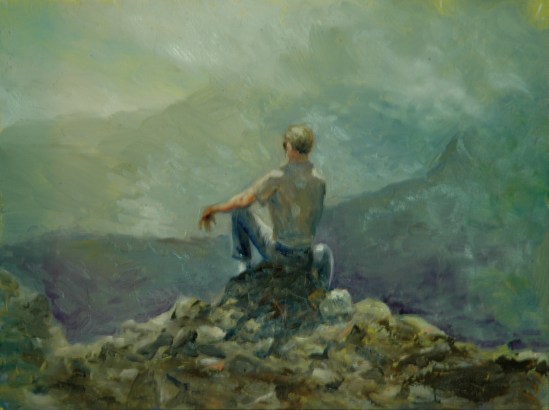
Here are two Mt. Washington studies, one finished (maybe) and the other, not quite finished–hope you like them!

View of race with vista

At the Finish (WIP)

Aline Lotter is currently exhibiting:

at the Gallery at 100 Market Street in Portsmouth; at the Sage Gallery in Manchester; at the Hatfield Gallery in Manchester; at the Bartlett Inn in Bartlett; at the Red Jacket Inn in North Conway; and at her studio by appointment.

Link to website:  www.paintingsbyaline.com

Boats

Rockport Harbor, November 2011

Last Monday, I took the day off to go painting, making a gift out of the  chore of picking up an unsold painting at the Rockport Art Association in Massachusetts.  Accompanying me were my friends, Jackie and Clint.  We explored the entire downtown area before settling on a location across from the T Wharf where Clint and I had painting a month ago.  It was a magnificent day, at least until the sun disappeared behind the buildings.

Drawn again by the fish house known as Motif No. 1, I also had Van Gogh in mind in my depiction of the drying shrub.  At the start, the boats were necessary to the scene, but not necessarily the focus of the painting.  But boats have a way of stealing your attention, of grabbing the eye.  So I give up, and let it become a painting about the boats and not at all about the now-annoying drying shrub in the foreground.

A few days ago, I read another blog exhorting artists to keep all their older work so that they can see and appreciate the progress they are making.   I keep pictures of most of my paintings, and the rendering of boats is particularly difficult.  I searched everywhere to find the first boats I remember having painted; the only images I could find were embedded in an Excel file.  (I used to keep track of all my paintings in an Excel file, but after 100, it got to be too cumbersome.)  The struggle to find a way to include these two proofs of my early ineptitude has taken me all morning.  I finally figured out that if I transfer each image from the Excel file to a Word file, then save the Word file as a web page, the images get converted to jpg images that I can import into iPhoto.  Then I export the images from iPhoto to my desktop, from whence I can upload them into WordPress.  Whew!  Not sure the effort was worth it.

These two paintings were plein air, on Monhegan Island, during a workshop with Stan Moeller:

Monhegan Harbor from Fish Beach
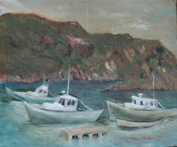
Lobster boats, lobster pound          

Kind of clunky, right?  But not bad as a start.  Bear in mind the damn things are constantly moving and changing their orientation as the tides move under them.

In my search through the archives, I stumbled upon three paintings from another Moeller workshop that also contained boats, earlier than the Monhegan boats by about two weeks:
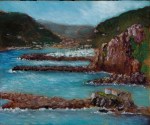
   

These three are views from La Napoule on the Mediterranean coast of France.  The boats in these three paintings are too distant, too small to  qualify as boat paintings, but I thought they were worth including since they are the very first boats to appear in any painting by me.

Apparently, I went without boats of any kind for two years after that.  The next grouping is two Rhode Island paintings, again plein air, that I painted in the summer of 2009:

Working Boats at Rest 8×10          
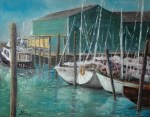
Marina at Allen Harbor, Rhode Island  12×16

I was very pleased with these two paintings, which were done in the same afternoon from virtually the same spot.  The conditions were uncomfortable–very windy, cold, I think, yet sunny.  I just remember being miserable during the first painting  and rushing to finish it.   It’s not hard to see progress between the Monhegan boats and the Rhode Island boats.

Most of my boats are plein air experiences, but there is one prominent exception.  I painted a large (for me, then) portrait of a waterfront in Portsmouth, New Hampshire, and toward the end, stuck in a boat to break up the waterline and add interest:
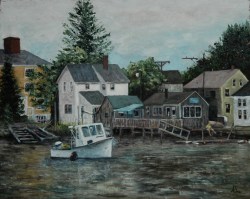
Portsmouth Waterfront 16×20

That is a real boat–it belongs to someone who lives in one of those buildings. This boat “portrait”, painted from a photo reference, undoubtedly helped me in depicting my favorite plein air boat, “High and Dry”, from 2011 below.

My Rhode Island successes had given me the courage to go for boats on my next trip to  Florida; in 2010 I choose this orange catamaran.
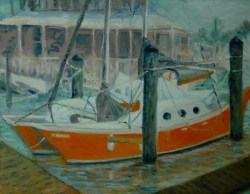
Catamaran

The double hulls made this a complicated project. I was not  thrilled with the resulting portrait.  So I tried again with this one, looking for the magic I seemed to have found in Rhode Island:

Boat Slip

This painting is not about the boat in the background, but about the reflections in the water of the pilings.  But it’s still a boat so it has to count for something.  The boat is certainly better than the Monhegan boats–not as clunky.  But I don’t love it the way I love my Rhode Island boats.  Perhaps I have a bias in favor of working boats.

That Fall (2010) I painted my first New Hampshire boats, but in a way that the painting cannot be assigned a place the scale of good, better or best boats.  These were impressions of boats from a distance, much like my La Napoule boats:

Sunset over Massabesic Lake

The point of this painting, obviously I guess, was the sunset.  The boats are mere window dressing, silhouettes against the light.  Around about the same time, I painted from a photograph taken in Ogunquit, Maine, the following scene:

Reflections

Another case of the boat being window dressing.

This brings me to the most recent predecessors of Rockport Harbor:  two paintings from Florida in March of this year; and one from Wells Harbor in June.

One-story home with Boat

High and Dry (but still perky)

Wells Harbor

Of these three, only “High and Dry” is all about the boat.  “High and Dry” is, in my opinion,  my best boat ever, but it should be:– unlike all other boats, my model for this painting was perfectly stationary.  It’s hard enough drawing or painting a moving object, much less one that demands a level of accuracy approaching portraiture.

Finally, Rockport:
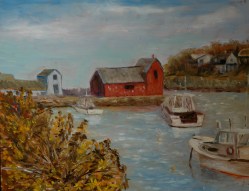
Rockport Harbor, November 2011

Three boats of diminishing size to show perspective, of diminishing detail to show distance, a scene so perfectly matched to the beginning (Monhegan boats) that a comparison is easy.  There has been progress!  But wait–what about progress since Rhode Island boats?  That is far from certain, to me at least.

Aline Lotter is currently exhibiting:

at the Gallery at 100 Market Street in Portsmouth; at the Sage Gallery in Manchester; at the Hatfield Gallery in Manchester; at the Bartlett Inn in Bartlett; at the Red Jacket Inn in North Conway; and at her studio by appointment.

Link to website:  www.paintingsbyaline.com

A Best Week

Some weeks are so full of reportable stuff that I have trouble choosing my topic.  Other weeks, I have trouble scaring up a single decent topic.  I could save up half of the good-week stuff for a dull week, but who wants to plan for dull weeks?  Not me.  On the other hand, I don’t want to bore you either, and really now, wouldn’t  you rather hear about struggles?  This week I can report on a bit of a struggle and its accompanying triumph so that’s what I lead with.

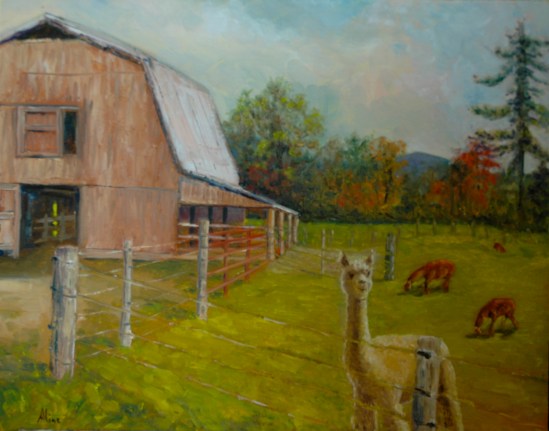
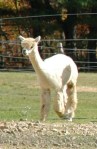
Part I.  Alpaca Love.  You remember the alpaca farm/ranch from last month?

Alpaca Farm v.1

Alpaca Farm in North Conway

This was the plein air painting from the Bartlett weekend, to which, I announced, I would be adding an alpaca closeup.  I had one good alpaca closeup, so I went with that, even though I’d have preferred the animal to be facing more towards the viewer.  My closeup did not include the legs either, so I was winging it with regard to the posture and thickness and general shape of the legs.

Alpaca Farm v.2

Alpaca Farm v.2

Pretty awful, right?.  I wouldn’t even show it to you before–I couldn’t let it sit out there as if finished when I was going to have to repaint the red alpaca closeup.  First, I had to find a better reference photograph.

As it turned out, when I got around to searching my own photographs, I had plenty of good alpaca poses.   Thanks to my powerful Nikon SLR camera, alpacas photographed in the way distance still gave me enough enlarged detail to paint a loveable blond alpaca in just the right pose, in just the right spot.

Alpaca Farm, v.3 (Final)

Part II:  Supercyclists. Earlier this evening, I delivered two paintings to my son in celebration of his birthday.  One of them  you have seen already.

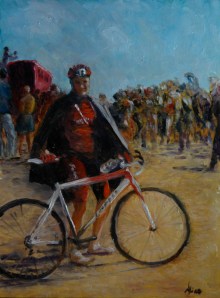
Andy as Supercyclist

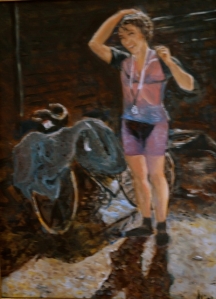
It depicts him right after finishing the race up to the top of the Rockpile (Mt. Washington).  Paint still wet on the second one delivered, is my painting of his friend Kori, from the same time, same place.

Whew!

I love the foreground in Kori’s painting.  Strange that where the focus of the painting is the figure of the cyclist, what I love most is how I painted the ground.  I would have liked to paint the face more expressively, but I didn’t really have room for that.  The two paintings are each 12×9, so the faces are quite small.  I wanted to get the likenesses as close as possible, so I had to be careful.  Andy’s worked out better because I had only light and shadow anyway, but Kori’s nose, mouth, eyebrows had to fall in the exact correct places, and no smearing please.

My major painting plan, for which these two 12x9s have served as studies, is still on, but the faces in the big one are not going to get any bigger since the plan is to encompass the entire rockpile.  I think I need to reuse this scene in a longer painting so as to include more of the shadow, and larger overall, so as to allow more of a slapdash face.

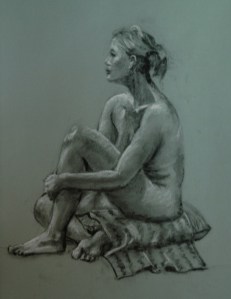
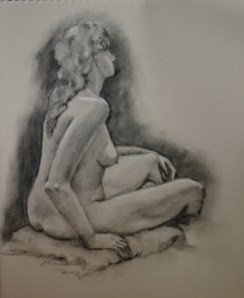
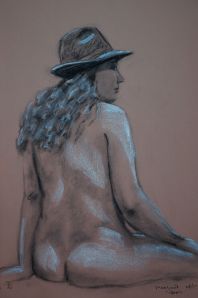
Part II:  Lovely Nudes.  Finally, for a change of pace, how about a collection of lovely nudes from Saturday Life Group?  My best from two weeks ago, and all three from this week:

Arrangement of elbow and knee   

Leg on Blue Draped Pillow

Right Side with bent elbow

The back from a left angle

I am wondering if I am getting too heavy-handed with the charcoal.  The “Leg on Blue Draped Pillow” has more charm to it, I think, because I had the pose for only 20 minutes and had to keep a light touch.  I would like to know if you agree.  Or disagree.  Either way, it was a good week.  Here’s hoping for another one coming up!

Tomorrow (Monday) I pick up my painting from The Rockport (Mass.) Art Association.  Unsold.  They invited me to apply for membership, and I thought I would if my painting sold, but it didn’t, so I didn’t.  A bit far to go for the sheer joy of exhibiting.  Although I do hope to get in a plein air painting day tomorrow, which makes a trip worthwhile.  Also tomorrow, paintings are being changed out at the Sage Gallery in Manchester, 70 Lowell Street.   Please visit this new gallery.

My old website, with multiple painting galleries yet to be transferred to this WordPress location, can be accessed at this address:  www.paintingsbyaline.com.  Also there are  all the images attached to earlier blog entries.  Eventually I will move everything here, but it takes a lot of time.

Tale of Woe

. . . Snow woe?  Weather woe?  Maybe lack-of-power woe.  “Power.”  Have you ever thought about the usages of the word “power”.  We use it to describe an attribute of people who attain positions where they can control the lives of others.  Power is also an attribute of an individual who can control his/her own life.  So why does  “Power” also refer to  electrical current to run lights, furnace, phone, internet, microwave, TV, DVD, and radio, to charge cell phones and Palm Pilots?  Because without all those abilities, one is powerless.

Without power (in the technological sense) One is also cold, hungry, and sleepless.  So I write this tale of powerlessness–obviously not from home–in a state of grogginess.  For the first time in my life, I slept with a Great Dane.   I invited her into bed with me when her “mom”, my granddaughter, bailed on us to go spend the night with a friend with “power”.  Honey, the Great Dane, usually sleeps with Tabitha, my granddaughter.  Tabitha thoughtfully lent us her comforter and Honey was dressed in a woolly sweater.  I wore my thermally correct underwear and a snuggly fleece robe-type thing over that.  We were warm enough.  Well, I was warm enough.  Honey was shivering and twitching all night, while I concentrated on hanging on to my share of the bed and waiting for the sun to rise.

Actually, I wasn’t all that hungry because I got to spend a wonderful 4 to 5 hours at a party with artists earlier in the day.  Mill Brook Gallery in Concord held an opening for an exhibit that was enchanting in its originality and breadth.  http://www.themillbrookgallery.com/  I had been invited by Patrick McCay, one of the featured artists, who is my EEE teacher.  (EEE stands for Explore, Exploit, Express–in whatever medium, whatever style.)  Two of his paintings already had red dots on them when we got there.  “We” because I did not have the use of my car yesterday but got a ride with two other artists, Bea Bearden and David Wells.  Through Bea and David I also found myself welcomed to a pot luck supper after the reception.  What a pot luck supper it was!  It deserves commemoration by publication of the entire amazing menu, but I cannot do it justice on the wing with descriptions like “quiche-type thing” and “rice and beans”.  I didn’t go near the pies–no room for dessert.

So in truth I was warm enough and not hungry at all, and only sleepless now.  Yesterday, before going off and partying, I used a few daylight hours to tinker with three paintings that I had started in EEE.  The third one is my newest one, which you have not yet seen.  In order to get enough light in which to photograph it, I brought it to the office with my camera.  No tripod though, so it looks a little fuzzy.

Taking a Bow

As the cyclists arrive at the top, someone throws a gray blanket over their shoulders, which keeps them from getting too chilled after their sweaty exertion.  The top of Mt. Washington is, even in August, likely to be a chilly place.  Andy, who happens to be my son, appears to be wearing a ribbon of some sort, which I only noticed in the course of working on this painting.  Will have to find out the significance of that.

The train car in the background is part of the  Cog Railway.

In this painting, I believe I have become more of an impressionist, which is kind of  what I have set out to do in the EEE class.  My highest goal is to emulate  Sargent and Sorolla, which to me means using the brush strokes expressively.  I really enjoyed working on this painting.  It is another of the studies for the larger work I am hoping to get to, the one of the whole top of the mountain with the crowds, the cyclists, and the mountain vistas.

Aline Lotter is currently exhibiting:

at the Gallery at 100 Market Street in Portsmouth; at the Sage Gallery in Manchester; at the Manchester Artists Association Gallery in Manchester; at the Bartlett Inn in Bartlett; at the Red Jacket Inn in North Conway; at the Rockport Art Association Gallery in Rockport, Massachusetts.

Link to website:  www.paintingsbyaline.com

Bartlett, October 2011

Bike Race spectator on Mt. Washington

In my EEE class last week, I painted one of my studies for the Mt. Washington Bike Race painting, and since it is my favorite painting for the week, I start with it.  The official title is “On the Top of the Rockpile”.  Mt. Washington is, for those of you not from New Hampshire, referred to affectionately as the Rockpile because above treeline, it seems to be nothing more than pile of rocks–quite a few of them loose rocks, which makes the going tough for hikers.  Here at the tip top, the boulders are more civilized.  I painted this painting on a 9×12 art panel that had been first painted with an acrylic cadmium yellow.  You can see some yellow peeking through a thumb print and some smears in the upper right corner.  I had dropped the painting, face-down, on a cat-and-dog-fur loaded carpet when I got home after class.  The figure escaped undamaged, and the rocks conceal any hairy texture (is the painting now “mixed media”?), but I tried to wipe the sky clean of fur and dirt.

The biannual trip to Bartlett for the artists’ getaway fell on last weekend.  “Fell” seems appropriate because the weather was pretty darn awful.  We could not visit the Rockpile, or any other tempting peak.  In fact, another guest at the Bartlett Inn reported that the Cog Railroad on Saturday started up Mt. Washington but had to back down because of the high winds.  Most of us painters sat out Thursday altogether; painted under a roof Friday (pavillion at Swift River Lower Falls), managed to get a few windy hours in before rain started on Saturday, and finally got a rain-free, partially sunny day on the appropriately named Sunday.  I usually come home with 5 or  6 paintings from a Bartlett weekend.  This time, only three:

Lower Falls

Mt. Washington Valley with Moat Mt. and cornfield

The view above is from the lawn of the Red Jacket Inn.  The painting will be exhibited at the Red Jacket once it is finished and framed.

Alpaca Farm in North Conway

I got out my big Beauport easel and a 16×20 panel for the alpaca farm.  I intend to add a close up of an alpaca, using one of my photographs.  Here is one of my models:

Head Shot

I had to minimize the shadows with my photo editing program (iPhoto) in order to see her amazing face.  She came up fairly close to me several times, but each time I could not get my camera in focus quickly enough to get the straight on gaze that I would love to have in the painting.

Not all of the alpacas were this lovely chestnut color.  I love that red shade because the edges generate such a warm glow.

Gray Alpaca

White Alpaca

Here are two others, who were not disposed to come so close to me.  They are shown galloping toward their owner at the back of the barn, who called them in by shouting “Ladies!”  At all other times, their muzzles are buried in the delicious grass.

Aline Lotter is currently exhibiting:

at the Gallery at 100 Market Street in Portsmouth; at the Sage Gallery in Manchester; at the Manchester Artists Association Gallery in Manchester; at the Bartlett Inn in Bartlett; at the Rockport Art Association Gallery in Rockport, Massachusetts.

Link to website:  www.paintingsbyaline.com

Brave New World

The title of this post has nothing to do with any art that I am sharing with you.   It refers to my destination after Apple’s iWeb stopping publishing updates to my Blog.   OK, I’m not going to complain anymore.  I’m just going to get on with it.

I have lots of art to share: a backlog of nudes, my own “Motif No. 1”, sketches from the Mt. Washington Bike Race, and progress in my class with Patrick McCay.

Let’s start with Motif No. 1:  Every artist should have a version of this red building, which came to be known as “Motif No. 1” because every artist painting in Rockport, Massachusetts, did have a version of this building.   (Google it!)  I painted mine yesterday from the “T Wharf”.  I debated whether to include the pirate ship–thought it might be too much detail.  But I liked the two masts and decided I could handle it.  But the pirate ship kept leaving.  I think they were selling rides.  I would look up to check a detail, and it would have vanished, only to return an hour later.
I was in Rockport to attend the reception for the New England Invitational exhibit at the Rockport Art Association Gallery.   Wonderful, large gallery, great reception food, with wine and champagne.  Much more elegant than I am accustomed to.  On the other hand, they were interested in my name tag, which I bought years ago for Manchester Art Association receptions.  It identifies me as an exhibiting artist.  Apparently, no one has thought of doing that before, but it was definitely useful.  It caused the director to stop and shake hands with me, which I am sure she never would have done but for knowing who I was.

Another plein air enthusiast accompanied me to Rockport and to the reception.  In fact, but for Clinton Swank and his car, I would not have been able to get to Rockport at all.  Clinton is a young 20-something painter, absorbing knowledge and experience like a sponge.  He did not know about Motif No. 1 and chose to paint another scene from the T Wharf even after I told him about Motif No. 1.

The McCay class is called “Explore, Exploit, Express”, maybe not in that order.   In the future I will refer to it as the EEE class.  This week my project was to repaint the first Bedford Farmers’ Market scene, the one with the multi-colored umbrella, but to paint it as if I had only ten minutes to get it down.  It was a mess.  But Patrick advised me to blur all the edges and then come back in with fresh strokes of highlights.  I gave that a try, and there is where it stands as of today:This one is headed back to class for more help Wednesday, but already everyone who has seen both versions has preferred this version to the original.  To view the original, click on the link below.  http://web.mac.com/alotter/Paintings_by_Aline/Index_to_Painting_Albums/Pages/Newest_Additions.html

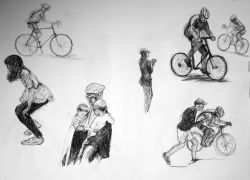
My long range project still involves the Mt. Washington Bike Race.  Here are two pages of vignettes that I hope to piece together in a large painting: 

Before working on the Big Picture, however, I will paint studies from these sketches.  It is my intent, my goal, to keep the brushstrokes loose and fresh.

SLG, or Saturday Life Group, has met four times already!  In years past, we would just be getting started in October, but since we meet in a classroom at the Institute (NH Institute of Art), we are subject to the Institute’s calendar, which means there are some Saturdays when we cannot meet there–when prospective students are invited for tours of the campus, for instance.  We used to be required to stop working and cover up our model to let groups of impressionable youths come in and inspect our goings on.  So instead of suffering such interruptions, we start the season a few weeks earlier.  

Here are my best drawings from the past four weeks:

A 6×6 painting for $66

6 inches by 6 inches has recently become a popular size for two-dimensional art pieces because they are affordable and are highly collectible. But for the past ten years, every year, the New Hampshire chapter of the Women’s Caucus for Art has been organizing a member exhibit consisting only of 6×6 plaques prepared specifically for that purpose, and for that year. The price for each plaque is $66. Every media imaginable is represented. The plaques can even be used to create 3-D artworks as long as they can still be hung vertically.

My Lotus Studies series of four were created for the WCA event in 2009, and when none of them were sold, I combined them into this piece:

Lotus Studies

As this unit, Lotus Studies has been exhibited three times–once at the 2010 WCA “Flowers Interpreted” exhibit (another annual event), then at the Gallery at 100 Market Street in Portsmouth, and finally this spring at the Manchester Artists Association Gallery, where it won the Best in Show award. Though much admired in all these locations, it is unaccountably still available for purchase.

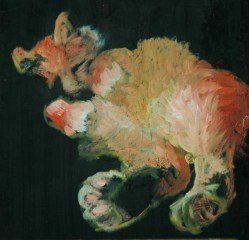
For this year’s 6×6 exhibit, I have decided to feature critters. I led off my blog (up above) with a half-finished study of that most endearing of critters, a sleeping cat. I’m going to call it “At Home”. Ironically, my model is Sundance, a rough, tough rescued cat who ultimately chose to rough it in the neighborhood. He relies on other suckers in the neighborhood to feed him regularly and suns himself on my deck occasionally. So although he looks really “at home” in this painting, he is dreaming anarchy (on my bed, by the way).

I have two other of my critter plaques started:

I need help with the Snowy Egret. There is a lot of empty space on the left of the plaque, which I intend to fill with written words. Poetic words. I am not a reader of poetry, so I don’t have any useful couplets filed away in my brain, but maybe one of my readers does.

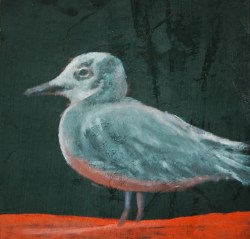
This one I propose to title “Red Breasted Plover”. There is of course no such thing as a red breasted plover (this one is, I think, a black breasted plover in winter plumage). The red breast here is a reflection of the red canopy. Is that obvious enough to explain the title? Or will people think “red breasted plover” is a real species?

If you have been with me for a while, you might remember the Egret and the Plover from my trip to Florida in 2010, the year I deployed the zoom lens to such good effect. If not, you can see them here. Nineteen months later I finally got around to painting these birds!

The WCA 6×6 exhibit this tenth anniversary year will include the 6×6’s from prior years, so I guess my lotuses get out and about for the fifth time. The place of the exhibit will be in Nashua, and the length of the exhibit will be only 2, perhaps 3, days in November. A short, almost “pop up” type exhibit may generate more concentrated interest, and exhibit spaces that we couldn’t consider for a month-long exhibit become feasible. I will post more information about the exhibit when the date draws near.

Since this year we are including past works (retrospective), I will probably offer two that I recently painted on 2010 plaques, covering up what I did last year. (I hated what I painted on last year’s plaques so I didn’t submit them to the exhibit. Lack of inspiration results in worthless artwork.) You may remember these recent portraits from a previous blog entry:

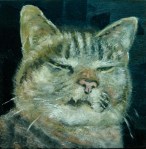
A Blond Akita A Snaggle-tooth Cat
For more about the cat, search “Grace”. I adopted her last year.

I was going to post some pictures of drawings from our Saturday Life Group, but I think this is enough for now. Next week I am sure to have lots to talk about, because I will be attending a workshop with Stan Moeller, the guy who opened up the door to landscape painting for me back in the Fall of 2005. The subject of this workshop is near and dear to my heart:–how to paint people into your plein air landscapes. I have been practicing that very thing in anticipation of this workshop, and now I will learn the real scoop. . . . fingers crossed, that there is a real scoop to be had!

IPAP weekend

IPAP stands for International Plein Air Painters, and every year in September, IPAP, the organization, calls on the painters to get outside on a particular weekend and paint. Our local organization, the NH Plein Air group, or guys, or whatever, responded to the call. It is our tradition to select three different locations over the weekend (weekend for painters generally includes Friday). So while in other parts of the world, I imagine painters piling up at their glamorous locations, we spread it around New Hampshire.

I participated on the first two days of our event. Friday we painted at Twin Bridge Park in Merrimack. It’s one of those places that you would never notice unless you got out of the car and explored. From the parking lot, you take a trail down toward a baseball field and playground, but then veer off into the woods, and descend farther, following the sound of rushing water, to a trail alongside Baboosic Brook. Due to the recent storms, the Brook was a torrent.

My chosen scene, featuring Sharon Allen behind the tree.

Because of last week’s workshop on layering water, for my second painting I chose this scene:

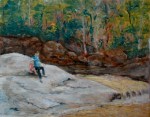
The water was moving very slowly over the flat rock in the foreground, which just happened to be catching beams of sunlight. The light enables you to see the shapes and shadows formed by the rock’s submerged surface, the ripples catch the blue of the sky, there’s foam, there’s vegetation, there’s unsubmerged rock. There’s not enough time! I had only an hour to work on this painting, so I kept my rendition of this scene abstract:

I like this painting for what it is, but I would like to paint another version from my photograph, to see if I can better capture the effect of the light and seeing-throughness, to coin a phrase. (Probably “transparency” is the synonym, but that word has secondary meanings and who needs that?)

Saturday morning I could not give up the new year’s first meeting of the Saturday Life Group, so I was not at the appointed IPAP location until the afternoon. We painted in the most northerly end of the Amoskeag Millyards in Manchester. Old mills, because of their locations on waterways, near falls, offer a large range of subject matter. It was my idea to paint there, but turnout was disappointing. I guess most plein air painters prefer natural landscapes over the man-made ones. I, on the other hand, even welcome the odd vehicle into my paintings from time to time:

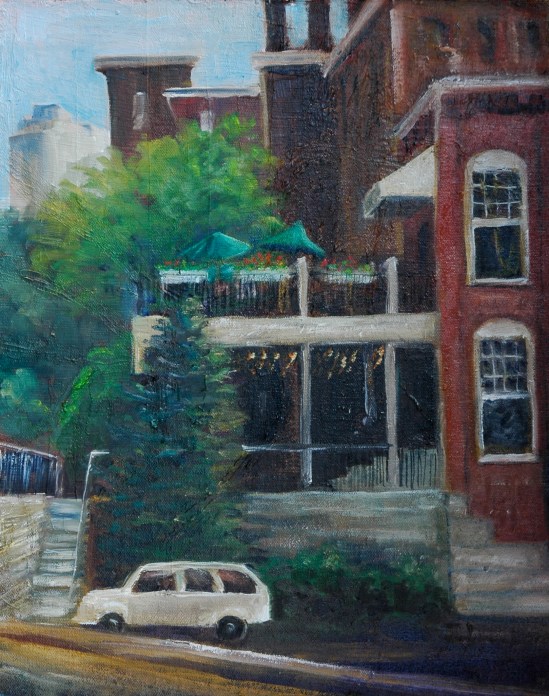
The building in the foreground is occupied by a restaurant (Fratello’s–good Italian fare). All of the buildings in the Millyard have been repurposed of course–there is no milling going on there. In another one of them, at the southern end of the city, is the artist’s studio where we have our figure drawing on Tuesdays.

NEWS FLASH! A new fine art gallery is opening in the arts and cultural neighborhood of Manchester, 70 Lowell Street, just down Lowell Street from the new building of the NH Institute of Art. Called the “Sage Gallery . . . . a Fine Art and Metaphysical Meeting Place” (how quixotic is that!), it is owned and operated by the former director of the Manchester Artists Association Gallery, Janice Donnelly. I have seen the space and it is terrific, and of course the location is also terrific, not to mention the director–yes, also terrific. Yes, I will be exhibiting there. I think the hours are generally 11 to 4. If you can, please stop by and encourage Janice’s courageous venture.

Layering Water

This week I was almost a full-time artist. Tuesday, I attended a figure workshop in the morning and painted at the Bedford Farmers’ Market in the afternoon:

Friday I tended Gallery (Manchester Artists Association) and passed my time by painting a sunset with reflections in puddles, thinking to prepare myself for Saturday:

Saturday I attended another one of our periodic single-issue-landscape workshops with Peter Granucci; the topic of the day was handling see-through water, that is, water shallow enough to allow you to see to the bottom. More about that later.

Sunday Sharon and I met up with other NH Plein Air artists at the Fruitlands Museum in Harvard, Massachusetts. Our mission was to paint, but we also visited the art musuem on the grounds. On exhibit from their permanent collection were paintings by the Hudson River painters; on special exhibit were paintings by New England impressionists from the turn of the century. Only one name was familiar to me–Childe Hassam. My favorite of the heretofore unknown impressionists was a guy called Clifford Grear Alexander. I googled him, but other than his dates (1870-1954), no biographical information is available. Both Sharon and I were struck by the fact that many, if not most, of the paintings in these two exhibits were of New Hampshire scenes.

Farm House at the Fruitlands Museum, 11×14; when I got bored by this painting, I applied high contrast outlines to see the effect. I like it.

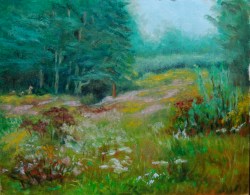
Meadow at the Fruitlands Museum, 11×14.

Monday, today, I put more time in on the Meadow because I had only one hour’s work into it on location. One of the docents had told me she saw a doe with two fawns at the tree line, so I added them to the scene. I wish I had a better grasp of deer anatomy, but people keep referring to our Great Dane as a deer, so I put her in the painting, hoping she passes as a deer from a distance.

The title of this blog, “Layering Water”, comes from the Saturday workshop. The point of the workshop was to learn to see all the layers created by water, and then, armed with that understanding, represent them in a painting. There is the reflection on the water, which requires that the water be relatively still. There is the surface at the bottom of the water, which requires either no reflections, or that any reflected object be in shadow–you cannot see through a reflection if the reflection is lit. If you can see the bottom rocks, mud and whatever, you need to note color changes and value changes but much more subtly than if the water was not present to obscure the view. Sometimes it’s hard to decide whether you are looking at a reflection or at something that exists under the water, especially if your reference has no context. Peter started us off with photographic examples that made our heads spin. Then we worked on two assignments. Here are my results:

The assignment on the left was relatively straightforward. Below, on the left,  is a closeup of one of shadows formed by the submerged rocks.  The closeup on the right is reflected grass–note that the reflection is darker because the underside of the blade of grass is not lit by the sun.


The second photograph was hard to deciper.  We believe that the lighter shape at the top may be an overhanging rock. The middle section is supposed to represent a partially submerged rock extending toward a fully submerged ledge. Why is the water line so dark? I still don’t know what to make of the dark shape between the overhanging ledge and the submerged ledge, but in the middle of it is another rocky shape that suggests the whole dark piece is a shadow cast by — something outside our view, or the overhanging ledge? Peter wouldn’t say. He took the photo but maybe he couldn’t remember, or maybe he just enjoys torturing us.

Views from the Top of Mt. Prospect

Last week I teased you with photographs of the scenes I painted from the Weeks State Park location but not the paintings I worked on there. This week I am making up for my laziness by posting those two paintings as well as two paintings that I started on location at the Bedford Farmers Market.

First, the painting above shows the view from the Weeks house toward Vermont, a northwesterly direction. One of the locals told me that the pond just visible was the Martin Meadow Pond, but I am sure he was wrong about that. My little sliver of a water feature does not even get named on Google maps, while the Martin Meadow Pond is much larger, and is visible from another break in the trees to my left. What attracted me to this view was the little taste of a vista, enclosed by the foreground of foliage. It was a difficult position to manage because I did not feel free to take up the whole path with my easel. That’s always a consideration for a plein air painter–keeping out of the way of the folk who are there for the same view you want to paint. From time to time, the park ranger would wander by to check on my progress. What he would see was pretty much a mess–big smears of muddy colors–until close to the finish, when I cleaned up the edges, hit the shapes with some brighter colors, and refined the details. When he arrived at that point, he was blown away–couldn’t believe it! “Wow!”

Wow is always a good word to use to compliment a painter.

The second Weeks painting was on a much larger panel, 20 x 16, I was already tired, and frankly a bit bored by my choice of subject matter–the tower. There was no reason to continue working on it at home, except that front page article in the Concord Monitor, posted in last week’s blog. So I worked on it yesterday:

On to the next subject–Farmers Market in Bedford. My friend and fellow painter, Suzanne Whittaker, lives in Bedford and was asked to be an attraction at the Market by painting there. She sets up a tent every Tuesday afternoon, 3 to 6, and paints a still life. Other artists join her when they can. My joining her depends on my getting the use of my car on a Tuesday afternoon, which so far I have been able to do twice. Instead of painting her still life, I try to paint a piece of the market scene. Of course, nobody stays motionless long enough for me to capture their image, but I can get the structures and add anonymous figures suggested by the real people. As you will see, I go for colorful stuff:

The Bread Seller, 14×11

The Apple Hill Stand

The guy in the baseball cap noticed me looking his way a lot, so he came over afterward to see what I was doing. Most of my admirers were the children. They always asked the price, bless their uninhibited souls. They always want to buy, and are so disappointed when they can’t afford the price. One of these days I may just bring paintings to give to them. Better than dying with hundreds of paintings that my children will have to dispose of.

Dogs are welcome at the Farmers Market, so I have been taking Justice with me. He is a shy dog, particularly fearful with new men. But he seemed to enjoy our first day at the market, and never barked once. Things were different last week. We were closer to the traffic, hence to the other dogs. But that wasn’t the worst of it. A drum circle came to use Sue’s tent about one hour before closing time. I couldn’t reposition myself at that point, two hours into my painting, so they closed in behind me. Poor Justice huddled under my chair for that hour, frantic to get away but pinned in place by the leash I had him on. So when Mr. Apple Hill came over to check us out, after the drumming had ceased, Justice greeted him like a long lost friend. So funny. So there are worse things than strange men. . . much worse! And then it got pretty good–the vendor next to us sells homemade gourmet treats for cats and dogs, and gave Justice her leftover samples to take home.

So far it is looking good for us to return to the Farmers Market in Bedford tomorrow–if you want to see us there, the Market is located just off Wallace Road in the Benedictine Park.

Making News

The photograph above is one taken by John Tully of the Concord Monitor last Thursday. It led a story by Laura McCrystal on White Mountain painters, then and now. That’s me at the easel, on top of Mount Prospect in Lancaster, NH. Ironically, I had pretty much decided to wipe out that painting, but now that it has been immortalized in print, I may try to rescue it.

How did the Concord Monitor reporter and photographer and I happen to come together at the top of Mt. Prospect in Lancaster? A meeting between the reporter and Sharon Allen, our intrepid leader of the NH Plein Air artists was arranged beforehand, and I just tagged along. It’s a long drive to Lancaster. The article is part of the publicity for the Weeks Act centennial, which I have been mentioning each week in my blog. Mt. Prospect is the site of the Weeks house, now part of the Weeks State Park.

When Sharon and I arrived at the top of Mt. Prospect about 1 p.m., this view toward Vermont was the one that caught my eye. I am very pleased with the resulting painting, but have not yet photographed it for you.

The larger painting that I was working on at 5 p.m. when the photographer arrived is this scene:

Why no photos of the paintings? I apologize. I was so wiped out by what I did Saturday, that I forgot to take care of blog business on Sunday. What was so exhausting on Saturday? How about getting up at 3:30 a.m. to drive up to Mount Washington to watch my son finish the bike race to the top–in the excellent time of 1:11:xx? (xx because seconds don’t register with me.) Here is a photo of him nearing the finish line.

The Mt. Washington race is going to be the subject of my next large complex peopled painting, the second after the Farmers Market painting. I have it all planned out: First I have to compose the course at the top, catching the sinuous curves (is that redundant?) and the distinctive staircase between the summit and the parking areas. At various point on the course I will place some cyclists. Then I will create vignettes of spectators and officials, children and dogs, sketching each group individually. I will position the vignettes on my course. I will draw the entire composition out on paper first, as I learned to do at the Sean Beavers figure painting workshop, then trace it onto my canvas. I can’t wait to get started. It will take months to complete.

More about Portraiting

Above is the final version of my copy of the Annigoni self-portrait. This is what I had to show the class and the Critic Supreme, Cameron Bennett. I wish I could remember his exact words, but they were more complimentary than usual, and he concluded by saying I should post it on my blog. I had to confess that not only had I already having done so, but I also solicited suggestions, which I took, on things to fix.

But not everything got fixed, because after the compliments, he and my classmates proceeded to tear it apart. Here, for the sake of comparison, are both new and old versions of my copy, against the original, which is in the middle:

He rejected my own observation about the face being too wide; that was an illusion caused by the ear being too low. Also the nose was too tipped up, the nostril shadow not extended enough, and the eyes too wide open. Each issue is a matter of millimeters. Millimeters matter. If there were something smaller than a millimeter, it too would matter.

That exercise entailed the drawing of the portrait before the painting of it. Once you have labored over a drawing, the painting phase becomes semi-automatic. As long as you get the colors right, and stay within the lines you have drawn, the portrait comes out okay. This week our assignment is to copy a portrait by a Russian painter (Valentin Serov, one of the greatest Russian portraitists of his time, according to this website) using the “direct painting” method. Skip the drawing. You start by painting an oval for the head. After the outside shape has been refined, you may begin to suggest features within that shape using midtones and shadows. Here is where I was with my copy last night–original is the one on the right:

This morning I corrected the eyebrow on the right; it was arching a little too far to the right. There’s something not quite right with that eye, but I’m not sure whether it is the size or the shape, or both. The iris just seems to be popping out of her head. Perhaps I need to narrow the entire head.

Saturday I finally got outside for a little plein air painting. I joined other members of the NH Plein Air group to help celebrate “Eight Days of Weeks.” A NH native, John Weeks, was instrumental in the passage of the Weeks Act 100 years ago, without which we would have no national forests. So each Saturday during the month of August, we are organizing painting forays to northern New Hampshire, which is dominated by the White Mountains National Forest. For this first Saturday, we were determined to get an early start so as to paint the Turkey Jim Covered Bridge in Campton in the morning, then move to the Forest center in Lincoln for the afternoon. At three o’clock we would then have two wet paintings to offer for sale at the center.

Alas, we couldn’t find Turkey Jim Covered Bridge. This is a bridge now closed to vehicular traffic but looking delightfully paintable in its disrepair–from photographs. Mapquest led us to a point near its western terminus, but we didn’t know that and even if we had, we would have had to climb fences. (Not feasible with painting gear.) Then first one then another “native” gave us bad directions. When we finally found the correct road with the help of a third native , it led us to a field bursting at the seams with RVs, waiting for a bluegrass festival to begin. We managed to talk our way through the field to the other side where our bridge awaited, without buying tickets to the concert. Our reward for all this extra effort and lost time? No good place to set up easels. The only good view of the bridge was from the middle of the stream.

So off to Plan B, Otter Rocks on the Kancamagus Highway, in the White Mountains National Forest east of Lincoln, NH. We picked up lunch in Lincoln and arrived at Otter Rocks about 11 a.m. to find a picnic table waiting for us at a particularly good vantage point for painting the rocks. I ate my sandwich and started painting without changing position.

Otter Rocks was brimming with families Saturday, plus one really interesting dog. I wish I could have included the dog in my painting, but getting those two figures in there was effort enough. I waited until I had most of my painting completed before even considering figures. The painting was thick with paint by then. I focussed for a second on an appealing father-daughter pair and tried to freeze that image in my brain. By the time I had scraped away excess paint to make room for my figures, the father had stood up and I was on my own. Apart from the original gesture, my figures bear no resemblance to the real people who inspired them.

In September, I am taking yet another Master Class workshop, this one with Stan Moeller; he promises to teach us how to people a landscape en plein air. It is definitely something at which he excels. Check out his paintings here. I sure hope he has some tricks to teach us. I was fortunate to have taken landscape painting with Stan at the Institute when I began to paint in 2005. He wasn’t including figures much then. Now he paints hardly anything in which a figure is not the focal point. I want to do the same.

Oh yes–the Rest of the Story. No one came to the wet painting sale. But we shall try again next week because the Flume is scheduled as the site of the next wet painting sale. If we can get into the Flume to paint, chances are better that some visitors will turn into art collectors. The Northern Arts Alliance and other Eight Days of Weeks organizations are to receive a 30% commission on all wet painting sales, although they will have done little to earn that. We had to fashion our own price labels out of scrap paper and prop up our paintings against a fence. Maybe they didn’t expect us to actually show up. Now they know. Crazy artists!

Details (Death to)

“It’s all in the details” — a statement considered wise when the subject matter is policy. What about when the subject is art? Recently, I visited an exhibit of Dutch and Flemish paintings from the 17th-18th century, wherein the details were really important. Before photography, paintings were valued as records; the tiniest of details were appreciated. But in this day and age, details can be a hindrance to artistic expression. Representation, as opposed to abstraction, is even looked down upon in some quarters. Abstraction is the ultimate in detail-elimination.

Only last week one of my followers commented, “Your drawings are magnificent.  Great attention to detail.  Superb!”  Alas, his approval, to the extent based on my attention to detail, may be misplaced. I have to acknowledge a contrary judgment–that in general, attention to detail is not a good thing, and that in particular, my attention to detail is more of a handicap than an ornament to the quality of my output.

Which is just a long way of saying, I expend too much energy on details.  At one point during the Red Chalk workshop, Rob Liberace asked me to dial back on the details–I was making a virtual skeleton out of our lean model.  Referring to the portrait above, “Kitsch,”  Cameron Bennett suggested last Thursday.  Ouch!

Two experts within a short time identifying the same weakness–there must be something to it.  How did I get to this pass?  Certainly my plein air painting never permitted excessive detail.  One theory–my speed in getting to a near-finished state leaves me all too ready to look for areas to refine.  Instead of reexamining the broadest strokes to make sure those are as perfect as I can get them, I start on what I used to consider the next step–developing the details.  Another theory–I am just not that good an artist.,

Take this week’s portrait from a live model, posted as the cover image for this blog.  As soon as I caught Rebecca’s likeness and properly placed and sized all her features, I spent considerable time working on the details, or what I was then considering the nuances of her features–especially her mouth and eyes.  It was at the end of that session that I got the “kitsch” remark. Ouch–that still hurts!
Here is the current portrait next to the earlier one done in black and white. Big improvement anyway. (But we had less time to work on the black and white, I think.)

At least when copying a work done by a master, I cannot be criticized for the sin of detail. The detail, or lack of it, comes already supplied. Here is this week’s homework assignment, from a self-portrait by 20th century Italian artist, Pietro Annigoni.

The whole point of copying, may I remind those of you who abhor the slavishness of copying, is to train the copyist’s eye. If I cannot see how my ear is different from the original’s ear, how can I expect to paint a good representation of a real, live ear? So there is the original, on the right, with my copy on the left. Sitting on my easel, my copy looked virtually perfect to me–I fantasized Cameron accusing me of tracing the image.

Here, not so perfect. A decent copy, but far from perfect. I gnash my teeth in frustration! How did the bloody head get so elongated in the original, with me not noticing? This is why artists resort to projecting drawings onto their canvases from photographs, a practice frowned on by purists, and one that certainly does nothing to train the eye. Fury it is that motivates them!

I hereby resign myself to getting beat up upon by Cameron this Thursday because there is no way I am repainting that ear. (In order to narrow the head, I would have to move the ear.)

But back to the topic–Death to Details. With this new anti-detail directive freshly absorbed, giving a nod to Peter Granucci here as well since he also has tried to wean me away from focusing on details when drawing from a live model, I took out a painting that had never satisfied me.  This was a painting based on a drawing made with a live model.  I had no details to refer to –the painting itself was several references removed from the original drawing since I had painted over it several times trying to find a version that pleased me. Could I solve this painting by eliminating even more details?

The only part of this painting that I liked was the hand and the drape at the bottom, so I felt free to mess with the rest of it.  I tried muting the background.  I changed the hairdo.  I refreshed the skin tones and created large splashes of light. Finally, taking a cue from the hand that I did like, I outlined the figure in black.  Suddenly, it looked interesting.  I never use black ordinarily, so this was definitely weird.  I scumbled (a technique for applying a glaze but with a dry brush) more black into the background and it got even better.

Ultimately the color, and maybe the contrast may save this painting.  But my curiosity to obliterate detail is what motivated me to revisit this painting.  Maybe that makes no logical sense, but hey, that’s left brain for you!

Meanwhile, and D, I’m talking to you, don’t praise my attention to detail.  It’ll just make me squirm uncomfortably.

This blog started out over two years ago (!) with no particular angle on my painting adventures, but has begun to develop as a chronicle of my efforts to grow as an artist. So I have come up, finally, with a name for it: Painter’s Progress–playing on the phrase “Pilgrim’s Progress”, a religious tome from a time period when details in paintings were expected and desired.

Snow Painting

Next August, I plan to participate in a special exhibit at the Arnold Arboretum in Boston, of paintings painted au plein air by members of the New Hampshire Plein Air group at the Arboretum. We are trying to cover all four seasons of the year. So we had to do winter. On January 7, the first group of us (about six in number) descended upon the Arboretum with our usual gear, plus all those things designed to keep us from freezing to death. I staked out a spot on the Willow Path, which is just inside the main gate, not far from the bathrooms in the visitor center. At least I had a bit of a hike to get to this spot. Others who shall remain nameless set up their work stations in the parking lot.


Willow Path in Winter

Willow Path in Winter

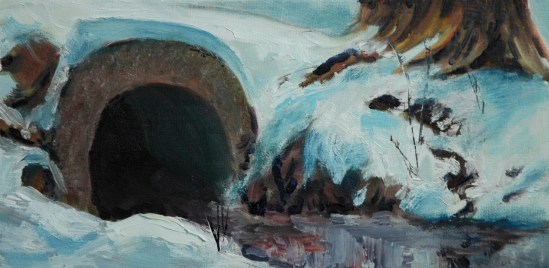
After finishing the painting above, I had a little extra time, so I produced a 6 by 12 panorama of a nearby culvert, which may seem a little weird to you. I chose it to seize the opportunity to include a richly dark area in my composition. Contrast creates drama.

Culvert in the Arboretum

Culvert in the Arboretum