Snow Camp 2011

DSC_1549

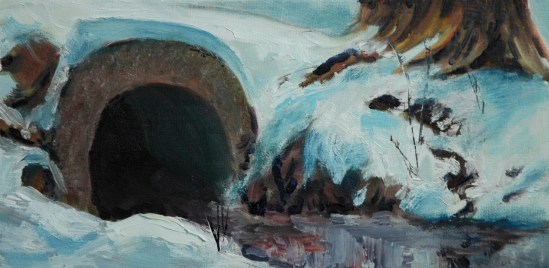
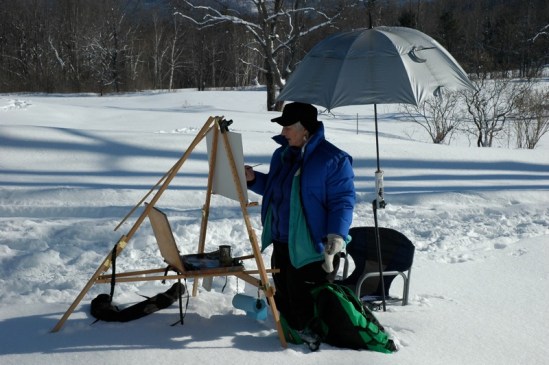
The photo above is me on Day Three of a workshop with Stapleton Kearns. Days One and Two we had no sun and quite a few snow flurries–the more prudent of us stayed on the porch to paint. Stape set up in the field, however. We would start each morning by watching Stape paint. It’s called a “demo”–demonstration, not demolition. Stape is really good at narrating what he’s thinking about, and that is often not about the painting. I guess he doesn’t need to be thinking about the painting to paint a good painting. Makes painting look easy! Here is a photo of Stape setting up on Day One, and another of him critiquing another artist on the porch. Our location was the Sunset Hill House, in Sugar Hill, New Hampshire.

I worked on a single 16 x 20 painting on the first two afternoons. Between the bad lighting on the porch and the weather itself, it took me that long to find my color balance.
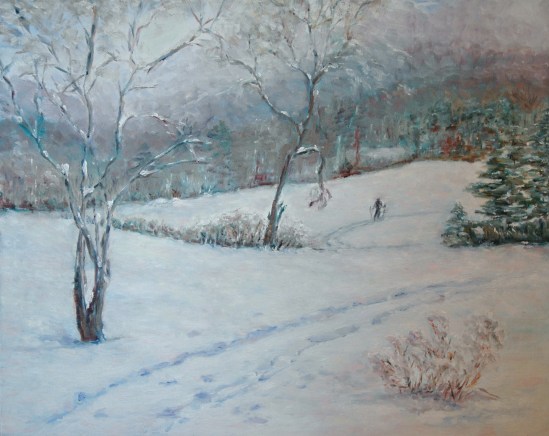
Alone on the Trail 2011

Alone on the Trail 2011

After Day Two

Take note of the tree on the left. It reappears in every scene–including the one with me in the foreground. The third day, we finally enjoyed sunlight and views of the mountains, although it was bitterly cold.
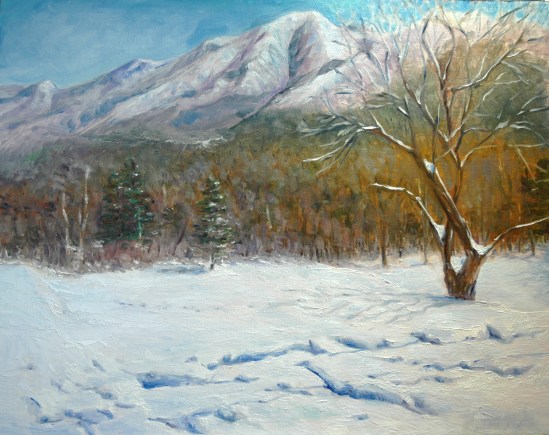
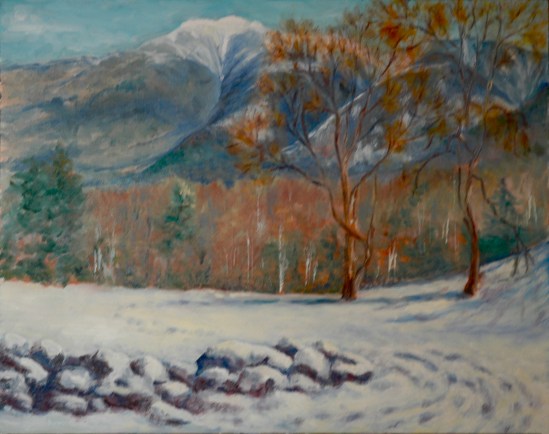
Franconia Notch 2011

Franconia Notch 2011

I forewent the demo and set myself up in the deep snow to paint the scene above, which is very close to what I painted on the third day last year. Here is last year’s version:

Franconia Notch 2010

Franconia Notch 2010

The stone wall was missing this year. Probably not removed, just buried. The innkeeper had remarked on this winter’s gentler winds; normal winds might have exposed the stone walls.

As happens many times, I plan to apply perfecting touches to this painting. Right at the end of my day, I realized that the horizontal surface of the snow was not white. The low hanging winter sun was catching the mounded up snow in a dazzling light that really drove the point home. So the next time you see this painting, quite a bit of the snow surface will be shaded back.

Stape wants us to eat our meals together at his workshops and enjoys his role as our leader, being entertaining and informative at the same time.
Saturday night we were joined at dinner by a person who has become something of a celebrity to Stape’s regular workshoppers–Stape’s wife Kathleen. She was entirely as likeable as Stape had declared. Here is a picture of her next to me at dinner in the “Pub”. Behind me is Nita Casey.

Nita gave me a ride to and from Sugar Hill, on her way from and to Pepperell, Massachusetts. Nita is a “Daily Painter”, and specializes in watercolors. Like me, Nita does not usually paint vistas. Quite a few of Stape’s loyal followers were not there to learn how to paint like Stape, but rather to take it all in a spirit of adventure. The power to observe colors and values can be honed in any kind of painting.

A plug for the venue: The food at the Sunset Hill House was superb this year, and, like last year, I luxuriated in a whirlpool bath each night before hitting the sack. My room had no TV (or phone), but following a day outside in frigid temperatures, then a huge dinner (with wine), and a long soak in the hot tub, who can stay awake?
Still Life No. 1

I love paintings of glass and pewter and copper and fruits, and have collected quite a few of them, but I was never interested in painting them myself. But painting is painting, so when two fellow plein air artists lured me to play hooky from the law office on a cold winter Friday, I went along for the ride. The ride included a morning spent exploring Trader Joe’s–my first trip to that extraordinary grocery store. When we returned to the hostess’s home, we used some of our recent acquisitions to set up a pretty challenging still life: two ceramic parrots — the easiest; three glass containers — doable; collection of vari-colored miniature tomatoes (from Trader Joe’s) — difficult to distinguish from other possible vari-colored round things; and vari-colored tortilla chips with corn relish (Trader Joe’s again)–impossible. Then we ran out of light since we had spent most of our day shopping and eating. (I’m not sure, but I suspect that most still lifes take a few days to paint.) I made major improvements back at home, after consulting my reference photo. Here is the original painting next to the reference photo:

It was that dark shape in the reference photo that convinced me to darken the entire background, much like I remember the Old Masters’ still lifes.

But wait! There’s more! I am taking a course at the NH Institute of Art with Peter Clive on the subject of drawing in color, and he is starting us off with still life arrangements. Here is Still Life No. 2 done in mixed media, to wit, pen and pencil:

I enjoyed this one very much. Crosshatching is fun. We were limited, in this exercise, to complementary colors, meaning we could use yellow and purple, or green and red, or blue and orange, which last was my choice. My favorite object is the pewter pitcher in the foreground–the others are mere stage dressing. I was astounded by the fact that I could convey the idea of gray metal using blue and orange pencils.

News from the Furry Folk

Today I have collected some decent photographs of my furry housemates, and in recognition of my past neglect of one of them, I lead off with his close up. Meet Justice. I did not name him that. A rescue shelter down South picked him up with female puppy on the Fourth of July and named them Justice and Liberty, respectively. We paid to have him shipped up to us via plane, truck and automobile. He is, it appears, mostly border collie and German shepherd, but his black tongue hints at a Chow somewhere in his bloodline. In any event, he is a very agreeable companion, even if a little rough on the cats. Here he is in a typical pose in a typical spot–his corner of the sofa:

You can see that he is ready to spring into action at the drop of a hat. He and Honey are BFFs, and that is Honey’s butt there at the right margin of the photograph.

I had promised photos of Grace, my latest rescue, and of Honey all recovered from her surgical trauma (promises made here and here). Getting a photo of Grace with her eyes open was difficult. Most of them turned out like this:
This was a good angle for viewing her broken jaw. But finally, I snuck up on her and got the eyes open–twice!

These photographs prove that her eyes are green. I think that may be a little unusual for a tabby cat. Look how fluffy she has become! No longer the pitiable creature who hid under the sofa, she has taken over two-thirds of the house and relegated Isis, the white goddess, to the third floor. Female cats can be quite contrary.

Honey’s eyes are as good as they are going to get. The growth on her cornea was successfully removed, but the “face lift” to correct her droopy lids was only partially successful. She seems happier now with her vision improved, and I think she would agree that all that suffering with the cone was worth the result.

The eye showing is the one with the corneal surgery.

Great Danes sleep a lot, and insist on the cushiest spots for the doing of it. But when she goes outside to play, she plays hard, tearing up the yard like a racehorse. (I used to cultivate moss in that yard. Now nothing smaller than a tall bush can survive.) And she digs. For fun! HUGE holes! Justice digs to make a tunnel to escape the yard. Honey digs for the pure joy of it.

Here are two shots of Isis, the white goddess, before she was dethroned by Grace and banished to the upper regions. In the first photo, on the left, she is in full goddess attitude, but the second photo reveals her to be a mortal pussycat after all, vulnerable to a sassy little upstart like Grace.

Back to paintings next time. I have a lot to show you.

Comments Off on News from the Furry Folk Posted in Uncategorized

Here’s to Plans, and Avoidance of Same

Last week I decided to write about planning a painting because I am working on that painting above, which I have planned, sort of. I got started on the blog entry, roughing it in and collecting a few illustrative bits. Then I dropped it. Every day I would think about it, but every day I found more compelling projects to work on. What does this mean? Not only am I averse to planning, but I am also averse to thinking about planning?

If that answer is “yes”, maybe that’s why I enjoy plein air painting. Despite the almost universal recommendation from more experienced artists to make a preliminary value study before beginning a plein air painting, most of the time I dive right in, trying out my choices right there on the canvas. After all, all wrong strokes in oil painting are correctable. Getting the canvas covered as quickly as possible seems important when you know you only have a few hours to capture all the information you need. But I have to admit, the few times that I have taken the time to start with a sketch, the painting has turned out well. Here’s an example.

On the other hand, a few days after I painted the one above, another (the one below) turned out well without any pre-sketching. OK, I have to confess that another painter had admirably captured this scene in the morning, and I decided to try the same scene in the afternoon. Does that amount to using a pre-sketch? No! Inspiration is not the same as a plan, but it comes close enough for me sometimes.

The advantages of pre-sketching, I conclude, lie in my natural reluctance to do something over after I have spend significant time on it. But since pre-sketching is no guaranty of perfection, an oil painter like me must be ready for lots of do-overs anyway.

For painting in the studio, most of the planning has gone into the selection and cropping of a photograph that inspires me. An exact copy of the photo normally does not result. Compare these two photo inspirations on the left and the paintings that resulted, on the right:

The second one is an example of inspiration alone furnishing the plan for a studio painting, somewhat like the plain air painting that was inspired by someone else choosing to paint that particular scene.

But occasionally–well, at least once–I have gone to extreme lengths to plan a painting. (“Extreme” to me is standard operation procedure for many other painters.) In this single example, I wanted to faithfully reproduce the placement of the structures in the photograph. Therefore, I employed a grid to help in the drawing. By the way, the photo on the left is not my original, gridded photograph of the scene; it is a later one that I got when I went back looking for signs of life, i.e., the boat. Thus the angles may look a little different.

2d photo w boat sketch with grid

final painting with boat and boy added

For an earlier and more extensive history of this painting, click here. I added the little boy fishing from the dock after writing that blog entry, which had asked for the readers’ opinion on whether to add a figure.

If the Waterfront painting represents one extreme of planning, the painting below represents its opposite. I started with large smears of dark greens and browns scraped on with a knife, from which I drew out the forms that more or less embodied a piece of forest photo-graphed two days before. You’ll have to take my word for it, because I have lost the photograph, but this painting is way more interesting than the photo.

My current project is the Farmer’s Market, which I mentioned a few weeks ago (here) when it was first getting underway. This is a large painting with lots of figures, and so qualifies, I think, as “ambitious.” I could not grid it like the Waterfront because there exists no single view of the scene that encompasses all of the elements I want to include. I had to piece the composition together from many different photographs. These are a few:

I wisely decided to start with a paper and pencil sketch:

There is a child in the stroller in the foreground whose hands are reaching out to its mother. I decided to make those hands my focal point, so I practiced them in the margin.

Here is where I was last week with it:

I have done some more work on it since capturing this image, and am finding deficiencies that better planning might have protected me from. But that’s OK–I’m not afraid of Do-Overs. Next Monday’s topic may well feature the Do-Overs.

Comments Off on Here’s to Plans, and Avoidance of Same Posted in Uncategorized

Loose Ends

I trust everyone did something special to celebrate the holiday generally known as Christmas. Some people still regard it as a primarily religious holiday. For the rest of us, it primarily means time off to get together with family, eat too much candy, exchange gifts. It’s the candy and gifts that make me dread Christmas. Back in the seventies, I converted to Judaism, but I still have to celebrate Christmas. Once more, I have survived, with the help of the granddaughters. One is the decorator, the other the cook. Pictured above is the decorator, Natalie, trying to stare down Honey on Christmas morning.

With all that help, I should have got a lot more art done, but somehow, that didn’t happen. I did a lot of reading and studying about art, though. I read Steve Martin’s “An Object of Beauty” novel about art as an industry, before giving it to my daughter as a Christmas present. For studying, I leafed through James Gurney’s “Color and Light” and attended online webinars by Johannes Vloothuis.

Sooo, it’s time to tie up some of the tattered ends I left dangling two weeks ago. Number 1: The course at the NH Institute of Art, “Painting Portraits in the Style of Sargent, Sorolla and Zorn” with Cameron Bennett, ended the week before Christmas. My Zorn copy, a 3-week homework assignment, garnered a score in the high eighties (for accuracy), which was what I had hoped for. Cameron didn’t like the ear, however. If you want to take another look, judge for yourself, go here.

A classmate (Ruth) produced an amazingly faithful copy of her print (a Sargent)–indisputably 90%–and I wish I had had my camera so I could share with you. Ruth spent an incredible number of hours working on her copy, whereas I was complaining every week about having to put in a few more hours on mine. I learned a valuable lesson. Just because I can capture a “good” result quickly does not excuse me from trying to achieve the best result, no matter how long that takes.

Number 2. The second 3-hour session of the live half-length portrait was not enough to produce a finished painting. I so regret now having started out with a drawing on the canvas. The drawing absorbed too much of my limited time with the model. I should have dived in right away with paint, as I did with the smaller, head portrait. Drawing with paint comes more naturally to me anyway. Here are the two of them, side by side. To see the charcoal drawing that used up the first 3-hour session, go back to that page where you found the Zorn copy (link is above).

I have started a new painting, which I will probably call “Farmers Market”. I am using assorted snapshots that I took on Marco Island when I was visiting Mary last February. I started this painting by toning a 24 by 30 canvas with Indian red. While it was still wet, I wiped out the bigger shapes. The next day I worked up the simplest shapes–the tents. They may not stay white. I took a quick photo of it this morning, so as to have something to show you. I’m afraid I lopped off the top inch or two, so the composition as presented to you is flawed. Next time you see it, it will look better if only because I took more care in the photographing.

You might object that the buildings in the background look more like Boston than Marco Island. I decided to place my Farmers Market in an urban and urbane setting so as to play off the contrast between farm and city.

Next, I think I will focus on the figures, using large printouts of my digital photos to help with the details. How I wish I had figured out how to project my photos onto my TV screen!

Revisitation

I’m leading off today with a new version of a painting that I posted here back in September. This was called the Ogunquit Roofs, and I painted it from a photograph taken while on a plein air outing. Later I added a few more details–more wires–but I was still not entirely happy with the painting. When I’m not happy with a painting, I keep it near my easel. Every time I have to move it around, I reconsider whether I am happy with it. After a while, I either try to fix it, or I decide to sand it down and cover it with another painting. When the latter occurs, it gets relegated to a select pile of losers. This is one I really wanted to save. My problem was that I could not decide what to change about it. I knew what made me unhappy–it was that flat roof in the foreground. Here is what I was looking at:

So I finally gave myself a metaphorical dope slap and said to myself, “It doesn’t matter that the roof was gray. If I think it needs to be a warmer color, I should just paint it whatever color I want it to be.” As a result of this severe talking to, the roof got warmer, all the “whites” got warmer, the reds got lighter and warmer, and maybe, just maybe, this painting will make the leap out of my studio to my gallery.

My portrait of Isis, posted a few weeks ago, is also still in limbo. The shadow on her rump is not quite right. But I still have not decided what to do about it. Meanwhile, my time was consumed by a few corrections of values to the coat worn by my Zorn copy, and the beginnings of our last project in portraits class.

Cameron has not yet “scored” the fidelity of my copy, so I had the opportunity to correct some colors and values, trying to get closer to ninety percent. This photograph reveals differences that I had not seen before. Discouraging. The most important one is . . . no, I won’t tell. Cameron reads this blog, sometimes before class, so I would like to see if he zeroes in the same flaw or finds a different one. Or maybe it isn’t so bad–maybe it’s just the angle of the photograph. Ora pro nobis.

Here is what I started on for the final project, for which we have live models for two sessions–tonight being the final session:

The canvas is quite large for me–20 x 24 I think. Monday I did nothing the whole session except draw in the head and figure. I’m usually more productive. I think I am feeling intimidated by the size of the canvas.

Perhaps influenced by the size of my portrait project, I also went big with my drawings at the Saturday Life Group. Often I will tear the 18×24 paper in half, but I left it intact for the two “long poses” below.

The paper is black, which forced me to draw with my colored “charcoal”, which is very like chalk. Not like pastels, this charcoal comes is very fat sticks, very soft– gets all over your hands before you even touch the paper with it. And it doesn’t erase too well either. I “erase” my mistakes by covering them with my black charcoal. You can just make out what appears to be a shadow behind the seated figure–that is where I “erased”. The technique is similar to painting, where you remove by painting over. I kinda like that.

That was our last life drawing session for a while. The theory is that everyone becomes too busy with the holidays to meet for life drawing. Bah, humbug!

As a result of no SLG, I will be painting and gallery sitting at the MAA Gallery for the whole day next Saturday, and would welcome visitors. The address is 1528 Elm Street, Manchester. We have paintings large and small and prints and cards for sale–gifts galore.

Break: out, away, up, with and from

This week, let’s take a break from portraiture. I’m not finished with the copy of the Zorn portrait on which I have been laboring, but I don’t think I ever will finish it up to the point where Cameron will accept it as “90%”. Ninety percent is the goal, he says, because 100% would be inhuman. Yes, you guessed it–despite my hope that I was done with the Zorn last week, we spent another three hours on our respective assignments in class, and I tinkered with small adjustments over the weekend. But today I will spare you yet another version of The Head. You have been so patient. (If it reaches 87%, I will post it again; the judgement will occur later today.)

Unfortunately, I have little else to show for my week– one appealing deer head painted from a wildlife photo while waiting for customers who never came — customers who were supposed to be clamoring for quickie portraits done in oil as Christmas presents for their loved ones. Either the advertising campaign fell completely on its face or there is no demand out there for pet portraits. Believing the latter to be false (judging from my own likes), I assume the former to be true. Hmmm, come to think of it, I did not even publicize it through my blog.

The only other event of note was the critique offered at the NH Institute of Art for its continuing education students, of which I am one by virtue of the oft-mentioned course with Cameron Bennett. I carried in three landscapes and three of the recent portraits done for Cameron, desiring to find out if I should vigorously pursue the portrait direction, or ease off the portraits and concentrate on the landscapes. I chose three landscapes that are among my personal favorites–the one that leads off this blog entry (“Griffin Mill Falls”, 8×10) and the two below.

Venite, 10×12 Sunlight on the Pemi, 9×12

The three portraits were the Zorn copy, the copy of the Lady Agnew by Sargent (posted here), and the live model portrait that you may re-view here.

The answer that emerged from my critiquers was unclear, but I got the impression that sticking to landscapes, if that’s what I most wanted to do, would not be such a bad thing. It is anyway too soon to judge my potential as a portraitist inasmuch as I have not yet drawn the attention of the dog and cat crowd. (Next time, I will post flyers at Petco and Petsmart.)

Comments Off on Break: out, away, up, with and from Posted in Uncategorized

Week of Repairs

Pleased as I was last Monday with the previous week’s paintings, the only work I accomplished in PAINT this week was the repairs to last week’s collection. (Drawing in charcoal and graphite not included.) Above is Cathedral Ledge with very little added in the way of actual paint. Dry brushing of the sun’s rays proved to be a winning technique. The only other major change was the addition of green. Before I could think about it twice, I hit that treeline in the distance with a mix of ultramarine and cad yellow. Then I stopped and considered–there could not have been leaves, certainly no green leaves–if those were deciduous trees. I remembered the line as being very dark–but were they leafless or were they evergreen? If evergreen, what I had just painted was wrong shape and the wrong color. Same is true for the shrubbery on the face of the ledge.

Unless one of my learned readers tells me why the green is totally wrong in terms of artistic values, I will leave the green as is, trusting that some good artistic instinct guided me to that place and the place is authentic.

I also had to repair the Zorn portrait. Turns out, we have yet another week on this project, and I am beginning to hate it. The head, Cameron noticed, was a wee bit to far to the left, as oriented to the hands, so I had to start over. This, my third head, is not as good as the second head–it may be in a better place, but it belongs to a different person. Judge for yourself:

FIRST HEAD SECOND HEAD THIRD HEAD
I think tonight we start on a new project, and I am SO ready!

Other repairs:

And finally–after months of agonizing, I plunged ahead to maybe ruin (temporarily) a portrait of the White Goddess, Isis, by imagining the shadow of blinds over her rump, which was so large and white an expanse that I felt compelled to break it up somehow. Success? Or back to the easel? Ideas are welcome!

A Good Week of Painting

For starters, we had a live model in portrait class Monday night, and I am pleased with my painting. The portrait is as close to completion as I could hope for, after only 2 and a half hours. My fellow life drawing folks will, I hope, recognize the model.

Then on Tuesday and Wednesday, after work, I diligently worked on the Zorn portrait that I was copying for homework, to bring it up to the point that you can see at the top of this page. Turned out I had an extra week for this project, thank God! But I was taking off the weekend for plein air painting in Bartlett, NH, so I knew I had to fix the Zorn at night after work. The biggest change is a new head (did you notice how small the head was before?).

OLD HEAD NEW HEAD

It could have used more work, but I had no more time since I had to pack Thursday night and drive up to Bartlett from work on Friday, in the company of Sharon Allen and Sandy Garrigan, from the NH Plein Air group.

In Bartlett, we joined with Byron Carr and a group from the Keene area, all followers of Peter Granucci, at the Bartlett Inn, where the walls are covered by paintings from the diverse collection of plein air artists who manage, from time to time, to get up there for an informal artists’ weekend. A number of those lured by Peter from Keene were new at painting en plein air. To encourage us all, Peter conducted a workshop Saturday morning, and gave us a slide show Saturday night. The weather on Saturday morning did its best to intimidate us, but even the first-timers hung in there. Sunday was our reward.

I worked on three scenes, and each one might be something I either finish or use as a study for a larger painting. First, during the worst of the cold, windy weather, I hurried to record an impression of blasts of sunlight breaking through far off clouds before the clouds overhead dumped all over me. The view is of Cathedral Ledge from the meadow at the bottom of Balcony Seat Road, in North Conway:

After lunch, I set up on the tailgate of Sharon’s Jeep, and painted up the road we took to get to that spot: Balcony Seat Road:

Sunday morning we drove over to Eagle Mountain House in Jackson, and we all three (Sharon, Sandy and I) landed at this scene across the road from the hotel:

I had to change a few things–the building in the valley was actually white and the birch on the right was actually leaning to the right instead of left–insignificant details compared to the moving of mountains done by some famous names. The birch log barricade was the item that first attracted both me and Sharon to this spot, but I see now that I was way too casual in the placement of logs and supports. To be corrected.

These three panels are of slightly unusual size: 10 by 12 instead of the usual 9 by 12. Since I have an ample supply of frames of that size, I ordered some RayMar panels to go with the frames. But I’m not sure I like the almost-square-ness of these panels. They do suggest enlargements though. Is that a function of the shape itself, or did the shape result in more complex compositions suitable for a larger format? Yet again, I end with a question.

Comments Off on A Good Week of Painting Posted in Uncategorized

Special Edition: Honey Report

My last blog update (yesterday’s) was met with a torrent (2 or 3) of demands for an update on Honey’s surgery, which occurred last Wednesday. So last night I took some photos of her and selected a pretty pathetic one with which to lead off. Mouth turned down, ears folded against the plastic collar, she appears to be so depressed that she won’t meet my eye. By the time I had about ten flashlit shots of her, she was feeling assaulted by the camera. Here is how she looked then. Longsuffering.

However, she has perked up considerably since Sunday, after the second anesthesia wore off (story below). You get a sense of perkiness here, maybe because she found a better angle in the cone for her ears.

The cone has been hard for her to get used to. She caught one of my framed charcoal drawings, a big one, and crashed it to the floor sending shards of glass everywhere. Luckily no one was injured and the drawing survived. Here she is, standing in front of the work of art with her tail between her legs.

The cone also failed to protect her eye from her efforts to scratch it Friday morning. Somehow, we know not how, she tore out the stitches and had to be brought back to the veterinary hospital in Portsmouth (an hour away) for repairs. Wouldn’t you know, repairs are not free!

We need to watch her every minute, but there are times when Tabitha has to be in class. Perhaps I will bring her to work. Stay tuned.

Comments Off on Special Edition: Honey Report Posted in Uncategorized

Slogging through quicksand

Sometimes I feel as if I am working really hard just to stay in place and (hopefully) not lose ground. The past two weeks have had that flavor. I worked really hard to make my studio and gallery space presentable and uncluttered for the NH Open Doors event. I worked really hard to organize a garage sale for Honey on the same weekend. I worked really hard to complete two copies of Sorolla portraits for my class with Cameron Bennett that same weekend. I did not even try to post a blog entry that Monday–or Tuesday, Wednesday or Thursday for that matter. I did get my own tax returns filed . . . finally!

But the only thing that really matters is the art. If I can produce something to be proud of, I feel good. If I can’t do that, I get that feeling of slogging in place–or worse. Even if this week I have nothing to crow about, I can feel virtuous about making a lot of effort, and sharing with you all those little mini-victories, which is sort of like celebrating getting out of bed.

Be that as it may, I have gathered evidences of effort: photos of my homework for the portrait course, report on a trip to the museum, and a landscape that resulted from a workshop on painting rocks and other textures. I will compare the new stone wall with one I painted last winter–will it show improvement?

But first, the portraits. I led off at the top with a shot of last night’s work on a copy of a Zorn portrait. I don’t feel good about it. To bring it to the point where I felt good about it, I would need more time. Plus I decided to use the Zorn palette of red, black, ochre and white, but I experimented with Perylene Red instead of Cadmium Red, just to see what would happen. What a surprising difference! Perylene Red is close to pure red. Cadmium Red has more yellow in it. Zorn, by using Cad Red, was actually cheating a little–it is as if he added a fifth color to his palette, that of cadmium yellow. The kind of black (ivory) I use may also make a difference.

Working backward in time, the day before yesterday (Saturday) I met with Peter Granucci and three other artists for an in depth study of the painting of rocks. Below is the stone wall that resulted, next to the stone wall from last January’s “snow camp” with Stapleton Kearns.

Not a fair comparison, I guess, since the January wall was covered in snow. Below is a natural stone wall running along the side of Jackson Falls, done in my carefree, untutored way:

Well, you know it’s a stone wall, right? And it was a plein air stone wall and thus may be forgiven much. The point made by Peter though is that, before you are done with a stone wall, you should be able to view each stone in three dimensions, with lighted side, dark side, and half-light side clearly delineated. And I have to admit, that kind of attention does make for a beautiful stone wall.

Friday I revisited the Sargent drawings on exhibit at the Boston Museum of Fine Arts, in order to reinspire my drawings of hands. I discovered that the Sargent charcoal drawings I had posted here were not the same drawings. Perhaps I made a mistake (relying on memory, after all) or perhaps the MFA changes out the exhibit of Sargent drawings from time to time–they have over 5,000 of them! You can view them all here.

It would have been comforting to suppose that Sargent at the height of his skills still needed to practice hands. However, you can see from these sketches that he was not practicing; he was trying to decide the angles and placements of the hands and fingers, how they would grip a bow and arrow or the reins of a steed. (Gods mount steeds, not horses.)

If you are still with me, here are the homework portraits that I completed during the slow times of NH Open Doors. Both are copies of Sorolla portraits. I had intended to provide images of the originals found online, instead of nasty photos of the copy I had to work from, but I couldn’t find them online. You therefore get no chance to compare. Better for me!

Comments Off on Slogging through quicksand Posted in Uncategorized

NH Open Doors–My Open Studio

I am participating for the first time this weekend (November 6 and 7–Saturday and Sunday) in NH Open Doors. To find out more about this statewide event, go to www.nhopendoors.org. where you can get a list of all participating artists (under the “Crafts” category) in this region (Merrimack Valley) and a map showing how close (or far) they are from each other. My participation consists of throwing open the doors to my home, wherein can be found my studio and all my artworks that are not hanging elsewhere as part of an exhibit or private collection.

If you are a rummager, you will have much to explore: boxes, browse racks, and just leaning against the wall, lots and lots of drawings, watercolor paintings, prints, framed and unframed oil paintings. Framed and hanging on my walls, amongst my own collection of art by other people, are many of my oil paintings. Practically any of it can be bought for the right price.

For fun and also out of necessity, I will be working on my homework for Cameron Bennett’s course on painting portraits in the style of Sargent, Sorolla and Zorn. Pictured above is last week’s homework, a partial copy of Sargent’s portrait of Lady Agnew. Here is a very poor photograph of the print I was working from. The glare is terrible on both my painting and this print. I tried to angle my painting so as to catch less of the light on the glossy surface, and I think you can at least judge the likeness or lack there of between the two.

Although not so obvious in Lady Agnew’s face, I seem to have a problem with noses. I often make them longer than they should be. I have a hard time seeing and correcting the discrepancy before it’s pointed out to me. I have resolved in the future to strive to make all noses shorter than I believe they should be. Then maybe they will come out right.

Below is an example of my long nose syndrome imposed upon a Zorn portrait, which is interesting for another aspect: Anders Zorn, a Swedish painter, liked to limit the colors on his palette to white, black, ocher and cadmium red, so in copying him, we too used only those colors. Green results from mixing black and ocher. I think Zorn snuck in some blue for the stripe in that scarf though. Zorn is on the left and my copy is on the right.

The hours of my Open Studio are noon to five on Saturday, noon to four on Sunday. But Saturday morning, from seven to noon, is a new garage sale to benefit Honey (see previous post here), so come early for a real rummage and stay on for the more artistic and gentile exploration of my studio and gallery inside the house.

Directions: First find Salmon Street in Manchester, then find its intersection with Hawthorne Street (east of Elm Street). My house is on the Southwest corner, and the entrance to both garage and studio is from the Hawthorne street driveway. Frankly, the Salmon Street front door is no longer accessible to normal people: — because of the dogs, we have fenced it in with an extremely cranky gate which only the most determined visitor will mess with. And I don’t bother giving you the street number because no one notices it on the boulder next to the front walk anyway. Oh, okay–the number is 227. That might help your GPS find the right corner.

Last but not least, for those of you who are interested in Honey’s welfare: The surgery has been scheduled for November 10, and we have about $2,700 toward the cost of $3,000 ++. Thank you to all who have donated. And may you be blessed in turn when you are in need.

Comments Off on NH Open Doors–My Open Studio Posted in Uncategorized

What happens to plein air paintings when they go home?

I have no idea if anyone cares about the answer to this question, but I am hard up for images today and here is one that I have. If you have been following along for a while, you might recognize this as the scene that I painted for International Plein Air Painters day, back in September. I made some improvements to it in the studio–improvements that please me, but you might not agree. Here is the original:

Although the water has changed hue, I swear I did nothing to the water except work on the visiting duck. The change in hue must have something to do with the digital manipulations that these photos experience.

What I did do: I lightened up on the dark shadows because they struck me as too . . . well, they STRUCK me and that ain’t good. Then, as I mentioned before, I tried to bring that duck to life. Finally, I added more texture and definition in the foliage by stippling in lighter leaves. The middle ground is now more clearly in front of the background. The trees on the right side of the middle ground have more character.

Altogether, these changes do not amount to much, but I am happier with this painting than I was before.

For those of you who have not been following along, this scene is of a wetland that empties into Lake Massabesic in Auburn or Manchester, New Hampshire. The size of the painting is 16 by 20 inches. The water was rippling like that because of the wind. I prefer to paint reflections in the water, which requires relatively still water, but this was fun for a change.

Comments Off on What happens to plein air paintings when they go home? Posted in Uncategorized

A Show of Hands

Last Spring when I was visiting the Boston Museum of Fine Arts, I spent a long time staring at some studies of hands by John Singer Sargent. Probably these, which I found online:

I felt as if I had never really seen hands before. Thus inspired, at the following Saturday life drawing session, I produced the best hands of my life. See above for the best example.

Sorry to say, that insight seemed to fade over the intervening months, but confident that it must be still in my brain somewhere, I have redoubled my efforts to draw good hands. Just this last Tuesday, I began to reconnect with the Sargent inspiration. Before judging my newest hands, remember that I am drawing studies of a whole figure, not just the hands, in only twenty, thirty or forty minutes. My hands are sketchier than Sargent’s.

Above is where I started in September, when the Saturday Life Group reconvened after the summer break. Servicable hand, but not as wonderful as the Sargent hands. I hope you agree that Tuesday’s hands (20, 20, 40, 30 minutes, in that order) are improvements:

The most helpful points that I take from the Sargent studies are (1) the fingers and the knuckles are considerably distant from one another, and (2) the fingers are not wedded together but have a space analogous to webbing at their base.

Facts are good things to acquire, but when it comes right down to producing a drawing, you are supposed to reproduce what you see, not what you know is there. So, like everything else worth doing in life, it’s complicated.

Honey

This is Honey, as painted by me a few years ago when she was barely full-grown. Sometimes when I paint a cat or dog portrait, it seems almost to paint itself. So it was with this one. I did have to adjust the placement of the rear ear and I may have fiddled with her collar, but everything else was “alla prima” or painted all at once, in one sitting.

The reason I bring up Honey today is a worrisome one. Last week, my granddaughter Tabitha took Honey to see a specialist in the eye problems of critters like her (I’m not sure whether his expertise is limited to Great Danes, or extends to dogs in general, or to all animals). The news was bad. Honey needs an operation to fix a condition that is eating away at her right cornea–an operation that will cost $3,000! Neither Tabitha nor her parents/grandparents have that kind of money sitting around, so we are going to try to raise some of the money with a yard sale. This coming Sunday, on the porch of the building where I practice law, we will set up the sale from 9 a.m. until 1 p.m. The address, if you would like to stop by, is 41 Brook St. in Manchester. The building is on the SW corner of Brook and Chestnut Streets, enclosed by a high brick wall with parking on two sides and the streets–easy access for shoppers.

Tabitha will make her gourmet cupcakes and serve hot cocoa. I am planning to put Honey’s portrait on Artist Trading Cards, and will offer all my unframed 8×10 oil paintings for $50 each. We will also be offering china, glassware, DVDs, CDs, a brand new unused Cuisinart ice cream maker, books, and many more items being contributed by Honey’s friends, who are legion.

Honey will be there too, of course. Sorry, no rides on the Great Dane, no matter how lightweight you are.

Here is a photo of my granddaughter Natalie trying to choke Honey. Just kidding. It was a hug, I’m sure. And a Christmas portrait of Honey with her main person Tabitha. Judging by the ears, Honey is not all that into wearing things stuck to her head. She still had the pink collar.

Fun with Nudes

In honor of the upcoming exhibit at Hatfield’s Gallery (October 1-October 30–reception this Friday at 5:30 p.m.), “I See Naked People”, I bring you today a few examples of my drawings with the SLG (Saturday Life Group). The title of the exhibit is a slogan adopted by the SLG to celebrate the 20th year of its existence, and is a reference to the famous line “I see dead people” from the movie The Sixth Sense. We had t-shirts made with the slogan on the front, and I do wear mine in public and I do get questions about it. The back of the shirt explains that we are celebrating twenty years of figure art, meaning life drawing. “Life drawing”, by the way, is a term of art that means drawing the human figure from a live model. Unless otherwise specified, the model is nude. Just to be sure, I ran it by Google and Wikipedia.

The most interesting poses have some foreshortening, which means you are seeing a body part coming toward you or receding away from you. The buttocks drawing above (done in colored charcoal) is a pretty extreme example. Here is detail from another where the body as a whole was pretty frontal, but the hand was foreshortened.

If I’m not getting enough foreshortening in a pose, I could move myself around the model, but that’s difficult because the room is full of other artists already engaging with their own views of the model. So I almost always settle for what has been given, and try to find something interesting about it.

Here is an example of a really interesting pose–some foreshortening, crossing of limbs, cast shadows–the kind of pose I wish I could have had more time with. (This one was a 40-minute pose.)
The most time we usually get on a single pose is 50 minutes. We often start with a series of 1 minute poses to warm us up and let us capture the gesture, then one for 5 minutes, then 10, then 20, then two or more 20’s on same pose. By the time we are working on a 20-minute pose, it begins to seem like a generously long time. The longer the pose, of course, the less strenuous it can be for the model.

Even when my angle on a pose has no redeeming feature, simply getting it right, with all the limbs and features located in the right place by reference to each other, is always a challenge. It’s like fitting together a jigsaw puzzle. Life drawing is therefore good practice for drawing of any kind, but especially for portraits, where getting the features exactly right by reference to each other is of critical importance.

Below is a 50-minute pose from last week, but not SLG. We have a smaller group meeting on Tuesday mornings now, which I hope we can sustain through the winter. I suppose if it survives, we will call it the TLG or Tuesday Life Group. We lucky folks with the flexible jobs are perhaps more obsessive than your average naked-people-seer.

On my website proper, on a new page devoted entirely to nudes, I have posted many more examples of my drawings from the past couple of years.

Poor Little Kitty

This is Grace. I accepted custody of her on August 30, from the Manchester Animal Shelter. She had only been there a week or so, but she had issues. Temperament was not one of them. She was so nondefensive that I suspected she simply had no energy left to object to any invasions of her space. Her jaw had been broken and apparently healed without human intervention. That’s why she has the peculiar sneer-like distortion on her right side (left in the photo). That’s also probably the reason she was so skinny. How long had she been left to her own devices without the ability to use her jaw for eating? She was nothing but skin and bones.

I went to the shelter looking for a deserving cat who would be hard to place, but OK with other cats and dogs in the household. She fills that bill. Unfortunately, during the time between our first visit with her and the date I could bring her home, she contracted an upper respiratory infection and a problem with her eyes. Twice a day, after getting her home, I had to scoop her up and administer eye drops and antibiotic. The hard part came to be finding her.

In the beginning, she didn’t leave the cat carrier I brought her home in and she wasn’t eating. Then she abandoned the carrier to hide out in some dark corner of the room, but was still not eating, Eventually, she discovered that I could not reach her if she hid under the sofa. That became her refuge of choice.

After a few days of this game, I offered her a can of gourmet cat food, in large part because I was worried that her jaw wasn’t up to the job of chewing dry food. She perked right up and lit into it as if it were the first food she had seen in months. Until that moment, I believe she had given up on life altogether.

Now she hangs out in the open, cuddles up with me and purrs. She has befriended the dogs, her cold is gone, and her eyes are getting better after the vet switched from eye drops to an eye ointment, which is easier for me to get into her eyes. She’s not skinny anymore.

But she still has no sense of play. Even the laser beam leaves her cold. Her estimated age was two years, so she should still have some playfulness in her. Too soon, I guess, after whatever traumatic experiences she survived before rescued by the shelter.

When I can get a photo of her with her eyes open, I will post it. Meanwhile, I have started a portrait of one of my other cats, a white goddess named Isis. I have not photographed that yet, and it is not finished, but I am torn between wanting to share it with you and wanting to get this entry posted on Monday per my self-imposed schedule. As you can see, Monday schedule won. Here is a photo of the goddess:

Easel, Sunset, Aching Back

Last week I told you about the Beauport easel I was going to try out for the first time at the IPAP (International Plein Air Painters) paint out (group of painters congregating outdoors in one area to paint whatever each finds inspiring–not sure why. . . we do look less peculiar in numbers). I had also mentioned that you can’t paint a sunset en plein air. Sharon Allen, who keeps our NH plein air group organized, challenged me on that statement and decreed that we would indeed try to capture the sunset that very day. So I feel obligated to report: 1) the easel was pretty OK, i.e., not as much of a problem getting used to as I had expected; 2) you really cannot paint a sunset en plein air; and 3) my back was killing me by the end of the day.

Above is the 16 x 20 painting I started with, from the bridge on Route 121 near the beachy area on Massabesic Lake, which you can see in the background of the photo below. Here is the easel holding the painting, pochade box, brush holder, towel holder and cup of mineral spirits. Clamps were handy to guarantee no side trips for the painting and for the pochade box, which is attached by its leather handle to the cross bar of the easel.

The easel withstood some pretty good gusts of wind, and my only complaints about its workmanship are the too-snug fit of some components. Rubbing them with a bar of soap might help with that, if I can find a bar of soap.

About the painting–I just want to say that I was trying to show the ripples created by the gusts of wind across the shallow pond water, and then a duck showed up and like a total idiot, I tried to capture her in the painting without first snapping a photo of her for future reference. I must have got the idea that I was some kind of duck expert after the success of my Ogunquit Duck.

The sunset was slow in coming. The three of us who remained foolish enough to attempt the sunset prepared for it ahead of time. I prepared by essentially pre-painting the sunset. Here is my set up:

And here is the actual scene, first while some light was still available for painting, and later when the sun was in the process of taking off with the light we needed to see what colors we were mixing:

Whatever the painting is that I produced from that session, it was not a painting of THAT sunset. Maybe it was a painting of remembered sunsets. Certain elements in the scene before me, pre-sunset elements like the golden light hitting the masts and illuminating the marsh grass, sky lightness reflected in the wet sand, interested me more than the sunsetting sky. Maybe, dare we say, a sunset painting does not have to be all about the setting sun!

Massabesic Sunset, 12 x 16

We started about 1:15 and quit about 7:15. Since one simply does not sit whilst painting on a Gloucester-style easel, I was standing most of those six hours, using my chair to sit down only when I was backing off to get distance from the painting. The pain and stiffness in my back lasted until the next day. Does a back have muscles that react like any underused muscles when they get an abnormal workout? If that is all it is, continued workouts should make a difference. Stay tuned.

Comments Off on Easel, Sunset, Aching Back Posted in Uncategorized

Thursday–the New Monday

Monday of this week got lost between Labor Day and catching up on the workload. And I don’t have much to show for the weekend either! So no new great art today. Instead, some aimless ramblings around the subject of painting en plein air.

Sometimes you hang onto a thing because it represents a memory. Same goes for a painting. The one above depicts the parking lot of the Sears Auto Center in Salem, NH, on the day that I had the flat tire on my way, with Sharon, to paint at the Boston Arboretum. This may not be one of my masterpieces, but I daresay it’s not bad for a parking lot. Especially an empty parking lot. How bad is it when an empty parking lot is the most interesting thing in sight? So I love this one like I love the crippled kitten I just adopted. (Can’t talk more about the kitten until I have a photo or painting to illustrate the story.)

Another memory committed to painting is this sunset, experienced somewhere, not sure exactly where, in Rhode Island this summer.

I believe I can safely posit that no sunset can successfully be captured en plein air. This is therefore obviously from a photograph. The size is 8 by 10, but I am considering a larger version of it. Maybe as large as 30 by 40.

Oh, and speaking of largeness, I just bought one of those Gloucester easels–the type of easel I compared to a teepee in an earlier post. Brand is Beauport, and Artists Supply Warehouse had such a deal on them that I could not resist, with the encouragement of Stapleton Kearns. Not his money, of course, but when one needs someone else to validate one’s crazy spending decisions, one must seek the advice of the one person whom one can count on to validate said crazy decision. Why crazy? Because I had previously resolved to concentrate more on portraiture and studio work as opposed to plein air landscape painting. The Gloucester easel means going big–16 by 20 and up–in format. Going big in plein air painting is a new commitment, a major commitment.

Acquiring the easel is only half the way toward large format outdoor painting–I’ll have to figure out a way to deal with the larger wet paintings. I may need a supply of larger brushes. I’ll need a large paint box to rest on those two bars creating the “V”–my current pochade box has a lid that I’m afraid will cause it to tip backwards if the box is not attached to a tripod. And I will definitely need a sherpa–my granddaughter’s Great Dane might have to be pressed into service.

Tomorrow I will try it out for International Plein Air Painters annual paint out. We will be at Lake Massabesic, with parking close enough that the wet painting and the weight of my gear should not be an obstacle. I should also be able to find something more interesting to paint than the parking lot itself, but who knows? It’s a pretty, woodsy parking lot, and I could be onto a series.

Comments Off on Thursday–the New Monday Posted in Uncategorized

Art in the Park report–Ogunquit Paintings

Weather–fabulous. Traffic–high. People–diverse and appreciative. Effort–out of all proportion to sales. Sales–zero.

But nothing can spoil two good days spent outside in great company, with interested visitors, and best of all, two new paintings. Each day I started on a blank canvas, using as reference two photographs taken on an Ogunquit trip of a month ago. That makes three Ogunquit paintings, not counting the actual plein air painting done from Marginal Way, with which I am not happy and which you will not glimpse until I am happy with it.

My first Ogunquit painting-from-photograph depicts a view from a floating pier underneath the main action. I mention it now because I’ll probably not get a better chance to make it relevant to the discussion. It’s a bit on the abstract side.

Untitled, 11×14

Saturday’s painting is of a duck motoring out into center of a body of water that lets out into the ocean (Perkins Cove). I was looking down at her from the pedestrian drawbridge that spans that outlet (inlet?), mesmerized by the beautiful effect of the shapes of the eddies and reflections. (I just hope that oil leaks from the heavy boat traffic had nothing to do with creating the beauty.) Passersby kept telling me to stop working on the duck. . . the duck was perfect. . .and finally I agreed. Two people mentioned Van Gogh, and I happily agreed to that too. Very satisfying painting.

Perkins Cove Duck, 11×14

Sunday’s subject was roofs, also as seen from that pedestrian drawbridge. Since the sunlight is coming from the South, you can tell this scene was captured just before lunch. That building with the white globes hanging near the window might be a restaurant, but that’s not where we ate. Now I am wishing we had eaten there–makes a better story.

I’m thinking of adding more utility wires after the paint has set up a little. I like wires.

Ogunquit Oceanview, 12×16

These three paintings represent three very distinct and different takes on water. I hadn’t planned it that way, but isn’t it a fun way of thinking about these three? One really shouldn’t be surprised when water figures importantly in every view of a seaside resort like Ogunquit.

Comments Off on Art in the Park report–Ogunquit Paintings Posted in Uncategorized

Art in the Park this weekend, Aug 28 & 29

For the third straight year, I intend to show some paintings at the Manchester Art in the Park, and I sure hope that for the first time, we get to show for both Saturday and Sunday. Last year and in 2008, we had deluges on Saturday and very soggy ground on Sunday. Both of those Saturdays had to be cancelled. Can it happen again? Yes, it can.

Hours are ten to five each day. No entry fee. The Park is Veterans Park, between the Superior Courthouse and Elm Street across from the Center of New Hampshire (Radisson Inn).

This year I am trying to act a little smarter maybe. I have made a list of 20 paintings to show, and 19 of them will feature trees and foliage. Experts advise displaying just one type of art at these shows. If an artist shows more than one style, people are confused about who that artist is. (Unless the artist is Picasso, in which case it doesn’t matter.) I decided to go with the foliage because I think my rendering of foliage may be my most distinctive quality.

The one exception is the Point Judith Lighthouse, which still gives me a thrill whenever I gaze at it. I have given it the best, the widest frame I have, hoping to knock your socks off–if you come visit me this weekend at the show.

At the top of this page is the quintessential foliage painting from my collection. It has suffered through five or six name changes since its creation. I painted it from a photograph I took in 2008 while ignoring the overlook part of a scenic overlook on the Kancamangus Highway. What caught my eye was the slight suggestion of a path beckoning me into the forest. I was barely on my feet after a hip replacement, which maybe had something to do with my being drawn to this opening. Weeks later, I was attending a series of Saturday workshops by Peter Granucci on “Fresh Greens”, and he asked us to paint something as homework that used a lot of different greens. This painting was my effort. So its first name was “Green into Green” in recognition of its status as a workshop assignment. Later, I tried to identify the time of year with “The Greening of the Forest in May”. Now I want to focus the viewer’s attention on that opening, so I have been trying “Opening” and “Forest Portal”. Suggestions are definitely welcome.

Another of the chosen 19 is “Homage to Cezanne”, my copy of Cezanne’s “The Bridge at Maincy”. I looked for an image of the original to share with you, and found two different versions–same composition but radically different coloring. That took me back a bit. If anyone out there has seen the original hanging in Paris’ Musee D’Orsay, let me know. Meanwhile, first is a version nothing like mine, then one a little closer to the print I was copying, followed by my own version, the “Homage”.

Comments Off on Art in the Park this weekend, Aug 28 & 29 Posted in Uncategorized

Learning How to Do Portraits

I am pressed for time, yet I want to stick to the schedule that has developed, whereunder I post a blog entry every Monday. It’s the writing and editing that takes the most time, so for now I am just going to post some photos of exercises that I have done for the class I am taking with Cameron Bennett: Drawing Portraits. Next to each of my drawings is the image that I was trying to replicate, unless there is no image next to my drawing, in which event, I drew that one from life. Hardest is drawing from life, next hardest is drawing from photo, then slightly less hard is replicating someone else’s drawing, but that’s not to say replication is easy. NOT. But it is excellent training for the eye and brain, which is necessary to get a life drawing close to accurate.

This last is my homework for this week, and it is still able to be corrected before I face the teacher.

Comments Off on Learning How to Do Portraits Posted in Uncategorized

Long Shadows

Saturday I ran three pieces over to the Gallery at 100 Market Street in Portsmouth for a three-month exhibit that begins this week. “Shadows, Late and Long” was one of the three. I painted Shadows recently, using a photograph of a house in Bartlett, taken in 2008 when I was up there in August for a workshop. The house is still there, but it’s a different color (tan) and I no longer see the tree that had made the long shadows two years ago. So glad I got that photo in 2008.

How I know an image is a good one for painting: it remains fresh in my memory–the photograph is only a reminder of the initial impact that it made on me. Sometimes, after capturing an image on camera, I can hardly wait to get home before creating the painting, but usually the photos sit in my digital box until I rummage through them, looking for inspiration.

I have my gallery sitting duties at the Manchester Artists Association Gallery to thank for the rummaging effort. Whenever I go to gallery-sit, I take something with which to make a painting or a drawing, which usually means a couple of photographs for inspiration and the whole plein air kit (backpack with palette, tripod, paints, brushes, etc.) and at least two canvases on which to paint. “Shadows” was the product of one of those sitting sessions. The same session also resulted in the painting below, “Spring Runoff”, from a photo taken in 2009 in Kinsman Notch.

Spring Runoff 14×11

To come home with two such paintings in one six-hour session gives my spirits such a lift. The quality of all the wonderful paintings and photographs in the Gallery probably contributes to my inspiration while painting there. Not one painted in the Gallery has disappointed me.

You can catch me painting at the Gallery on most Saturdays, except that I have completed my scheduled duties for August already. In the Fall, my Saturday mornings at Life Drawing will resume, but chances are that I will be at the Gallery, painting, in the afternoon.

Receptions to be aware of:

Friday Aug. 13 in Portsmouth at the Gallery at 100 Market St: 5 to 7 p.m.

Saturday Aug. 14 in Boston at the Arnold Arboretum Visitors Center: 1 to 3 (includes talk by the artists–there are nine of us; I think we will just answer questions people may have about plein air painting in general or specific ones on exhibit).

Canterbury Shaker Village

Every year, the NH Plein Air group participates in the celebration of Mother Ann Day at the Canterbury Shaker Village in Canterbury, NH. Mother Ann was the founder of the Shaker way of life. We paint from whenever we get there, until three p.m., when the still-wet paintings go on sale. “Wet Paint Sale” as it is called. We can also bring framed paintings previously painted at CSV. I have about six of those but was not organized enough to get them framed for this year’s event, which took place yesterday on Sunday, August 1.

In past years, I have finished as many as three paintings in the single day of the wet paint sale, but this year I decided to try a complex subject and spend the whole day on it. Here is a photo of the “Farm Stand” area before I started on my painting.

Note that the big white barn door was closed and the umbrellas were folded–both would change when the farm stand opened for business. I tried to capture the shadows as they existed at this early hour, and I had to squeeze the composition in order to fit in all the elements that interested me. Here is a shot of the painting when it was more than halfway completed.

From there to finished product, it was only a matter of refinements and details.

CSV: Farm Stand 11×14

My painting did not sell. I put a price on it of $380, which maybe was the highest price there for an unframed painting. Usually I discount a wet painting by 25%, but usually I paint at least 2 in a day, so I thought it would be appropriate to leave the price at $380. I hope price was not a factor in its failing to sell. Or maybe I hope it was the price that kept it from selling.

It’s always hard to predict what will sell and what won’t, but one thing I have observed over my short experience: good paintings sell. (Unfortunately, that does not mean that ALL good paintings sell.) All of the paintings bought from me have been among my best, and I respect the intuitive judgement of the buying public. Hence, I am a little disappointed when Farm Stand was left on table. (Five paintings were sold, so there were at least five people there in the market for a painting.)

What I would like to know from my blog readers–is this painting any good? I can see a problem with perspective in one area, which I will now be able to fix, so that is a good thing. Does it have another flaw that I could correct? Or is the composition so awful that I should wipe it out and start over? Maybe I should have kept the wheelbarrow in, or added people. Could still do that.

Likely moral: For wet paint sales, keep it simple. I shall remember that in the future.

Comments Off on Canterbury Shaker Village Posted in Uncategorized

Mysteries from Rhode Island

My Milestone Blog entry of July 12 reported on a 4-day painting trip to Narragansett, Rhode Island, but only discussed my two favorite paintings. Two others–all featuring the rocks on a beach in Narragansett– didn’t make it onto my previous RI blog because they required some touching up, which has now been accomplished. Both were painted from a single spot, which you can confirm by reference to the stone cairn that appears in both paintings. Artistic arrangements of stones have popped up all over this cove, created by person or persons unknown. We suspect a mysterious kayaker who glided by staring at us.

For some quirky reason unrelated to the actual etymology of the word, I think of these cairns as “totems”, so I have used “Totem” as the title of the second painting. The first painting was started when fog lay heavily on the sea; by the time I started the second, the sun had reached the horizon. I may have cheated when I put in the shadow of the totem in the first painting.

Rosa Rugosa 11×14

Totem 11×14
On the last day in Rhode Island, we painted at Beavertail State Park, which boasts a lighthouse with attendant buildings, old fortifications, and terrific surf. Terrifying surf. I had been so diligent a painter in the previous three days that I had remaining only two very small canvases on which to paint. I started with the 7×5 of the lighthouse, with which I opened this blog entry. Here it is again, for your convenience.

This little painting was harder to paint well than the 11×14 Pt. Judith Lighthouse because its composition is more complex (all the extra structures) and the space into which I had to cram my composition is much smaller. Look at the weathervane–it looks so out of scale on the top of the lighthouse. I don’t carry around the tiny 00 brushes because I can’t use them anyway on plein air paintings–to get a fine line on a surface already loaded up with wet oil paint, I will normally use a palette knife. Here, instead of trying the palette knife, I drew in the weathervane with a brush far too fat for the job, and I find myself unwilling to correct it now. I can’t explain why–for some reason (composition, perhaps?), I LIKE that oversized weathervane. If I ever get to be both dead AND famous, the critics/art school teachers will point that out smugly and everyone will feel really happy that I wasn’t perfect all the time.

With an hour left before we had to start back to New Hampshire, and with the teachings of Stapleton Kearns in mind, I thought I would try to construct a breaking wave or two on the even tinier 4×6 canvas. Not up to Frederick Waugh standards, for sure, but it is my first and I only spent 30 minutes on it. I may use it as a study and paint a larger version with refinements based on lessons taken from Waugh and Kearns. It was fun to do.

Surf 4×6

Comments Off on Mysteries from Rhode Island Posted in Uncategorized

About limitations on painting large

One of my Arboretum paintings slipped between the cracks last week, metaphorically speaking, so I thought I would keep to my weekly blogging schedule by discussing it. (And to be honest, I don’t yet have photos prepared for my other potential topics.) I call this one “Among the Japanese Maples”. Along with the Visitors Center painting that led off last week’s blog, it constitutes the largest size that I paint en plein air–16 by 20.

Ironically, my very first plein air painting was 20 x 24–that happened because I just didn’t know any better! It was in a Stan Mueller workshop, and eyebrows went up all around the field when I brought forth my canvas. Would you like to see the result?

York River Meander, 20×24
Not so bad for my first one? Of course, it was the only one I painted that whole day. Nowadays I often complete two paintings if I have both morning and afternoon to work.

If that original workshop had been with Stapleton Kearns, I would still be painting outdoors on the larger canvases. Stape argues that it is easier to paint large. I am a fast painter too, so I think it would have worked for me. But I did not have the right easel for it then, and still do not. For something this large, the best easel is a thing called the Gloucester easel, or a facsimile thereof. Think “teepee” and almost that big. The other two kinds of outdoor easels are the pochade box–basically a box containing paint and palette that sets up on a tripod with your canvas secured to the open lid–and the French or Julien easel, which is a bigger box with legs attached and an adjustable mast to secure large canvases. I have used both, and grew to prefer the pochade box because it is more lightweight and easier to set up.

I stretch occasionally to paint the 16 x 20 on my pochade box easel because (A) I need a large format for some reason–like the huge Arboretum exhibit room, or (B) I happen to have that size canvas on hand. It won’t fit on the lid of my pochade box–in fact it dwarfs the lid– so I have to clip it to one side, which is not very stable. But when you paint en plein air, you put up with a lot of unpleasantness–bugs, wind, cold, heat, sunburn . . . and wobble. I’m sure I am forgetting something else that belongs on that list.

Anyway, my Japanese Maple will be among the largest artworks in the Arboretum exhibit, and I just hope it shows up well in its frame on that wall.

Comments Off on About limitations on painting large Posted in Uncategorized

The Arboretum Project

Although I have mentioned before, and posted paintings intended for, the Arboretum project, the time has come for detail. The culmination of this project is fast approaching: an exhibit at the Arnold Arboretum from August 7 to September 19 of paintings painted on site by members of the NH Plein Air artists’ group. Pictured above is the Visitors Center at the Arnold Arboretum, which I painted mostly on site (I changed the color and value of the red brick when I got home). The exhibit will take place in the high-ceiling exhibit room whose tall curved windows you see on the right side of the building.

It all started more than a year ago, when I noticed a call for artists from the Arnold Arboretum to submit paintings inspired by the Arboretum–an annual exhibit known as “Jamaica Plain Open Studio”. I posted a suggestion on the NH Plein Air listserv that we, NH Plein Air artists, organize an outing to the Arboretum and enter our results to the jury for the JPOS exhibit. Several members were interested, so then I contacted the Arboretum to make arrangements for our visit–parking had to be negotiated to enable some of our mobilely challenged artists (that would include me) to get their gear into the park reasonably near where they wanted to paint. The Arboretum staff were pleased to welcome us– like most other public outdoor spaces, the sight of artists working at their easels enhances the experience for everyone. Even the dogs. (The Arboretum is a major dog-walking site–one of the collateral benefits of painting there is the variety of breeds of dogs you get to meet.)

Only one of our plein air paintings made it into the 2009 JPOS exhibit, but our collective submissions were impressive enough to lead to an invitation from the curator to make our own exhibit in 2010. We accepted with joy and alacrity. Over the next twelve months, individual members and groups of us have visited the Arboretum to create paintings for the upcoming exhibit. Not so many in the winter months, but we do have a few snow scenes. Our challenge was to fill those vast walls with paintings that, being rendered on site, tend to be rather small. I have my fingers crossed that our artwork doesn’t get swallowed up by the exhibit room. I hope you will go to view the exhibit to find out how we did. There will be a reception/artists’ talk (!) on Saturday August 14, at about 1 p.m. until 3 p.m. I went to the website to confirm this info and found one of my paintings used for the announcement–the one from “To Plein Air or Not to Plein Air”–the one I didn’t like but everyone else seems to like. Go here to see.

Because the history conferred on me some kind of ownership of the project, I visited the most times, and produced the most paintings–twelve in all. Some of my Arboretum paintings are already online: see my Blog on the winter visit here, and my Blog comparing a plein air painting to a studio painting from photograph of the same site here.

Here is my most recent painting from the Arboretum, a silver maple that has been at that location since 1887, I believe. The label on the tree identifies its official name, its common name, its native habitat, and the year it was acquired/planted by the Arboretum. The tree’s trunk is striking; it called out to me every time I visited over the past year, so I finally succumbed and painted this 14×11 portrait of a tree trunk. (Since photographing the painting two days ago, I made a few small improvements, so this image is one of a work in progress.)

The Arboretum, for those of you not already familiar with this Boston institution, is a living museum of trees and shrubs, collected from all over the world. Funded by a bequest, operated by Harvard University as a research and educational institution, and overseen by the City of Boston as part of the “Emerald Necklace”, the 265 acres are open without charge to the public. For more information about the Arboretum, visit the Arboretum’s website.

Here are a few more scenes represented by my paintings.

Spring! 11×14

Fall Around the Pond 11×14

Milestone

Just another lighthouse painting, you may be thinking. Doesn’t even include any surf. Truly, I wasn’t very excited about painting these buildings at first. I explored the nearby Coast Guard station (Point Judith in Rhode Island) and tried other angles on the lighthouse, but there was no view of the sea that included the structures. So I selected the simplest view possible, and hoped to produce a restrained and elegant painting. I think I succeeded.

I began with a Lois Griffel underpainting in ocher, viridian, and burnt sienna; the sky started out bright pink. While I was messing about with the underpainting, a fog rolled in, but I stuck with the plan, keeping in mind the blue sky and shadowed planes as I originally found them.

Including the utility pole and wires was an essential element of the painting–it establishes the scale and distance and balances the composition. Getting the shapes and scale just right becomes critically important when there are only three objects in the painting. I had to do a lot of remeasuring and adjusting. My satisfaction, when I saw it was right, cannot be overstated–I felt like crowing like a rooster.

The most challenging elements were the darkest elements–the top of the lighthouse and the pole and wires. Successful painting is all about getting the right paint in the right spot. I wiped and scraped and covered up until I had those darks showing up where I wanted them and not elsewhere. Palette knife — invaluable!

In case you missed the point, I just love this painting. When it was complete exactly as I had intended, I felt as if I had graduated from whatever level I had been mucking about in, to a more rarefied level–”accomplished artist” perhaps?

However, I didn’t move in there permanently. The next few paintings I did during my recent Rhode Island sojourn tossed me back into the floundering, experimenting, discovering processes, whereby you start with an inspiration and a plan and you finish up with a painting quite different from inspiration. Could still be a good painting. For example:

“Mary’s Smoke Tree” had enticed me for days–it was such a gorgeous thing. I would not have chosen to include the difficult circular drive, but I had to plant my umbrella to the side and something of interest had to fill up that space on the lower left. So this painting, unlike the lighthouse, grew out my love for the subject, and the subject took control over the painting. I love this painting too, and it’s OK that I won’t always be able to control my results. Discovering the painting, when successful, is another kind of joy that sets my heart to crowing (see reference to rooster up above).

Portraiture

One of the hurdles for me blogging-wise has been the necessity of providing photographs of something interesting (usually that means a painting or two). Today, I have a bunch of new painting photographs to show off, and the problem has been to pick a subject. I am learning a lot about painting portraits, but there is so much more to learn–so I thought you might be curious about that kind of a groping process.

Like most painters, I don’t have a ready supply of models willing to sit still for hours while I paint their likenesses. That’s why artists have mirrors in their studios. The self-portrait up above is the latest one, the fastest one, and the most fun. Sure, it doesn’t look like me. I apparently look much younger when my face is animated and reacting to other people, or so I am told. But the face I see in the mirror is stern because I am concentrating so very hard on the shadows and contours and the precise placements of eyes, nose, mouth, and that pesky ear, which never seems to live exactly where it ought to. Anyway, I don’t really care if it is a faithful rendition of how I look, because it is really only an exercise.

I think I have been getting better. My first self-portrait was completed over two years ago, and took many hours under the tutelage of Adeline Goldminc-Tronzo. I can’t find a photograph of it–must have been so bad that I deleted it from my albums!

The second one was also forced upon me by Adeline a year later, but I quite like this one.

Finally, the most recent, done all by myself with no tutelage at all, here again in all its glory. Hmmm. Glory not quite the right word!

Painting a portrait from a photograph is hard. You do get an expression that is unforced and lively, but you also get harsh shadows perhaps (depending on the skill of the photographer) and no photograph can capture the delicate variations in skin tone. An expert portraitist can probably supply nuances from memory. If I ever get to be such an expert, I will let you know. In the meantime, here is an example of what I mean. I took a lovely photograph of my two granddaughters and tried to make a painting of it.

They both like the painting, so I succeeded in that way, but can’t you just tell it was painted from a photograph? You can probably also tell that I did not use any mechanical aids or grid to get placements correct. I am trying to train my brain to see correctly without help from a projector or even a ruler. Now for the first time, I see something a little “off” about the left eye on the lower face. What is it? (More than the shift in her gaze from photographer to her sister) Here is the photograph I was using:

Tabitha and Natalie, cavorting in Boston, 2010

For the first day of summer: cool, abstract

The snow painting up there is one of the largest paintings I ever tried–two feet by four feet. You can’t see the whole thing because my web program insists on a certain shape for the featured blog photo. So here it is again, this time with all 48 inches displayed:

I would not have bothered you with this effort but for two of my supporters, who surprised me with their enthusiasm for this unnamed work, which is hanging in the Pantano Gallery in the library of Southern NH University through the end of this month.

I worked on this painting over the winter of 09-10. I started by covering the entire canvas with a layer of “Flesh”, i.e., a light orangy pink that Winsor Newton produces presumably for the painting of flesh tones on white people. Instead of using it for people, I like it for sunsets. I wanted the painting to be suffused with orangy pink because my inspiration had been the sight of the setting sunlight glowing through brown autumn leaves in a twilight scene mostly covered by soft, fresh snow. The location is the view from my bedroom/studio–sort of. More than most, this painting was created from memory. So I was really interested when one of my supporters told me that she thought the painting was “abstract”.

Painters will often remark knowingly that all landscape paintings are abstract paintings. “Abstract” should signify nonrepresentational. So what is it about some landscapes (all landscapes?) that prompts us to call them “abstract”? I think one factor may a quality of “hide and seek”–one of the joys (for me) of this painting, as well as others that border on abstraction, is the ability to recognize familiar objects within the bounds of the painting. But unlike more conventional landscapes, the recognizable objects are not being offered as subjects of the painting.

The whole point of my painting up above is the orange orb, the representation of red sunlight filtered through the dried up brown leaves still clinging to their tree in the face of a heavy snowfall. Kudos to my friend who knew instinctively that this was an “abstract” painting!

Here is another of my paintings that I think may be classified toward the “abstract” end of the spectrum.

I call this one “Spirit Lake”. The photograph that inspired it may have been taken in Alberta Canada–I’m no longer sure. After studying that photograph, way back in 2006, I smeared the canvas (36 x 12) with the paint that you see above, thinking I was setting up an underpainting for the more elaborate version to come. But I stopped short because I liked it just the way it was. Even though this was a very early painting in my so short “career”, I never tire of looking at it, and recognizing with pleasure the suggestion of reeds in the water, the snow on the mountains, and the fir trees ruling the middle ground. Like the orange orb of the later painting, the white orb of the sky reflection in this early painting was the subject, and what could be more abstract than an empty, white orb?

Comments Off on For the first day of summer: cool, abstract Posted in Uncategorized

Monadnock

Last Friday, Sharon and I conspired to take the afternoon off from work and find somewhere to paint near Jaffrey. Sharon had to pick up some frames from an artist friend who is moving to New Mexico (and is inviting us down there to paint) and it seemed a shame to go that far (over an hour’s drive) without having a new painting to show for it.

The Monadnock area is full of fantastic painting locations, but sometimes the best choice is the obvious choice. I have known Monadnock for many years. Back in the sixties, when I was pregnant with my first child, my husband and I spent the summer with his aunt on Snow Hill, and he would run from her house to the top of Monadnock every morning before breakfast. I so regret not trying to keep up with him in those days, but physical exertion was not in my repertory. In the eighties, to make up for my neglect, I would climb Mt. Monadnock at least once a summer. Now I have lost the ability even to do that. But I can paint Monadnock, and that gives the greatest pleasure of all.

This view of the mountain was from southwest on Route 124–near Perkins Pond, I think. The water was teeming with yellow water lilies, which became the big problem–how to represent them? I tried various techniques and wiped them all out. I ended up painting the water and streaking some masses of appropriate lily colors onto the water with a palette knife. The next day, after the paint had set up a bit, I smeared the edges. Since I was no longer in the presence of the real thing, I was satisfied with this result.

Most of my plein air paintings look better when I get them home, where I no longer have the original to compare the painting to. I can almost count on a happy surprise when I open up my wet painting container to view what I did on location. I say “surprise” because when this happens, it is always a gift, never to be taken for granted.

Nevertheless, I must acknowledge that my smear of lilies is no more than a token representation of the blanket of pads and buds that were present last Friday. If I am to paint the lily blanket, I will have to move my focus closer in, and leave out the mountain. Next year perhaps.

Monadnock is painted on an 11 x 14 panel.

Bartlett–Artists’ Getaway–10 New Paintings

I can’t believe it has been so long since my last blog entry! I have been doing a lot of painting, and the most intense period of painting was, naturally, the Bartlett Artists’ weekend of May 13-17. We faced some challenges from the weather, but rain was not our biggest problem. Wind was. In fact, at its worst, I would go so far as to opine that the wind made me more miserable than the subzero temps at the Sugar Hill snow camp.

Fewer artists attended the Weekend than usual, but we had the best time ever, and I personally had my most productive Bartlett Weekend ever. Byron Carr, who lives in Contoocook, is the guy we thank for organizing the weekend, and Miriam and Nick, the Innkeepers, are as much a part of our group as the painters themselves. In fact, Nick has become one of us painters. He has been taking classes in acrylics, and joined us up at Jackson Falls one afternoon.

Peter Granucci, from whom I have taken many workshops, joined us Saturday for his first Bartlett Weekend. Showing us he was no slouch, Peter produced a gigantic (24 by 30?) and brilliant painting on canvas of a Jackson Falls water-and-rocks scene. I was blown away, and I don’t think I was the only one. But the weekend was full of inspiration for me too. Unlike other weekends, I started painting as soon as I arrived on Thursday, and got up with the others, at 5 am Saturday morning–before breakfast–to catch the clouds breaking up over the valley in the scene above.

My roommates for the first night were my granddaughter Tabitha (I’ve mentioned her before) and her Great Dane, Honey (see her portrait here). They left on Friday, when Flo joined me for the rest of my stay. This was Flo’s first Bartlett weekend, and she painted some beautiful paintings, as she usually does.

Sharon Allen can always be counted on for a Bartlett weekend. For my first one, I followed her around like a little puppy dog. Sharon runs the NH Plein Air group, and we so love her for that work. I still follow her around, but less like a puppy dog now. We so often agree on what is worth painting, even though our interpretations diverge widely.

I only have photos of my own work, so here they are:

This was painted from the porch of Willey cabin, which was my assigned room at the Bartlett Inn, on the Thursday evening of my arrival. I am still putting perfecting touches on the road. 8×10

Friday morning, Sharon and I were inspired to paint the Notchland Inn from a parking area on the other side of Route 302. The North Conway Scenic Railroad passes this way enroute to the Crawford Notch Depot, and I made the crossing the focus of my painting. Sharon stayed farther away and left out the tracks. Conveniently, Tabitha and Honey stopped to say goodbye on their way home, and Flo saw us and stopped on her way to the Inn. 11×14

Friday afternoon: This is a part of Jackson Falls. The Falls go on and on, and provide an almost infinite variety of arrangements of water and rocks. After taking this image, I made some perfecting touches, but you get the idea. I used a lot of palette knife on this one. 11×14.

I finished up kind of quick on the painting above, and so I started this smaller one (8×10), looking up the Falls toward the bridge. Sharon and Flo were also painting nearby, and I believe Nick and Byron were there that day too. 8×10

Saturday: Sharon had found such a perfect spot for painting by following a street sign “Balcony Seat View”, figuring it had to mean something interesting. The street wasn’t paved, but it led to a huge meadow in Mt. Washington Valley where we could get fantastic views of White Horse ledge on the left and Cathedral Ledge on the right, with a patch of blindingly yellow flowers in the middle. The place was overrun by cocker spaniels and their owners in the midst of some big deal trials, but they didn’t get in our way and we stayed out of theirs. They came with a porta-potty! Doesn’t get much better than that for a plein air painter. The above is my capture of the ledges. 10×12

After finishing the Ledges above, I moved to a little wooden bridge that connected to the larger meadowlands, and captured this portrait of a fallen tree over the brook. 6×12

Saturday afternoon: Attracted by the redness in the waterline, Sharon, Flo and I tackled this pond from different angles. We were near the Inn, right on Route 302 again.

Saturday night: Like all Saturday nights in the past, we put all our paintings on display in the living room of the Inn, but unlike years past, Byron did not favor us with a demonstration of his watercolor painting. And this year was different in another important way: I sign the praises of Louise, Byron’s wife, who made lasagna for our dinner. It was scrumptious lasagna, and a vast improvement over the traditional pizza that we usually order in for Saturday night. If getting Louise’s lasagna is the price of giving up Byron’s demo, it’s OK by me.

Sunday: We checked out after breakfast, but Flo and I planned to paint before heading home together. The 6×12 painting above is my take on the railroad crossing in the center of Bartlett. Tracks not easy to do. I spent about a hour on location, but made some changes to it when I got it home. Not sure if it is a keeper, but interesting perspective, I guess. Could use feedback.

Sunday. View of Mt. Washington from meadow off Route 302, just inside the edge of the state park. Very, very windy. I set up behind a large boulder, hoping it would shelter me. Flo set up on the tailgate of her SUV, hoping the same. No. The sun was hard to manage too. I don’t paint with sun on my painting any more, not since I tried that once and the painting came out way too dark. This scene is the same as one I painted last fall. You can compare by going to this page where I have set the two side by side. 16×12

Comments Off on Bartlett–Artists’ Getaway–10 New Paintings Posted in Uncategorized

Exhibits

I’m feeling pretty numb right about now. I accepted another invitation on short notice to exhibit my works, figuring ‘tis better to show than not to show. So, yes, another solo show running concurrently with the one in Concord, at the Conservation Center. For this new one, I decided to go big. Big would mean fewer paintings to prep and inventory. The largest is 24 by 48. Unlike the exhibit at the CC, I tried to include at least one animal portrait, one human portrait, and one each with boats and buildings as the principal subject.

Today, my invaluable granddaughter, Tabitha, hung 16 of the 18 prepped, on picture hooks hammered individually for each painting, in the Pantano Gallery of the library of the Southern NH University. If you ever need help with hanging paintings, I recommend her without reservation. I don’t know how she does it, but she can line them up by sight and without getting feedback from an observer.

My Pantano exhibit stays up until June 30. I titled the exhibit “Five Years of Evolution” and challenged the viewer to decide which paintings are more highly evolved than the others. This gallery is located in Southern New Hampshire University’s Shapiro Library and is open Mondays through Thursday from 8 a.m. until midnight, Fridays from 8 a.m. to 8 p.m., Saturdays from 10 a.m. until 8 p.m., and Sundays from noon to midnight. You may call the Library at 603-645-9605 for more information about the Gallery. The University’s address is 2500 North River Road, Manchester, NH.

Yesterday (Sunday) I delivered seven of my plein air Florida paintings to the Manchester Art Association Gallery in Manchester, for its “Sunny Days” exhibit, which will run until the end of June. The day before yesterday (Saturday), I attended a reception at the Long River Gallery in Lyme, NH, where 3 of my works are part of an exhibit of the art of members of the Women’s Caucus for Art. I also have the usual three paintings on exhibit at the White Birch Gallery in Londonderry. That makes a total of 79 paintings and one charcoal drawing on display at the same time. I’m sure this will mark some kind of all-time high water mark for me.

And that’s why I feel a little numb today.

The painting up above has nothing to do with any of those exhibits. It has not been framed yet, and I may tinker with it some more. I painted it from a photograph that I took in the mangroves at the Ding Darling wildlife conservation area on Sanibel Island. I had recently seen two other artists’ paintings of just water, and wanted to emulate them. The rippling reflections and shadows make for a complex and abstract picture. I haven’t figured out whether I want to paint this quickly and intuitively, or slowly and carefully. Too late of course now for the former option, so I may start over anew and then have the two of them to compare to each other. But the one above wasn’t really planned out that carefully either, so that means a third done with painstakng precision. Now that I have no more exhibits to get ready for (and no tax returns except my own to prepare), I may just have the time to do that!

I will be gallery sitting at the MAA on the following Saturdays, all day: May 8 and 22; June 5, 12 and 26. I welcome distracting visitors, even though I will be painting intently–perhaps working on one of those aforementioned water portraits. All day at the MAA means 10 a.m. to 4 p.m. and the address is 1528 Elm Street, Manchester.

51 Paintings Hung

You may remember from last week, if you have been paying any attention at all, that I mentioned this exhibit that I was pulling together, my first solo show, at the Conservation Center in Concord. I prepped 51 paintings, figuring a few would have to be brought back home, but all of them found a spot in the gallery room. The gallery is actually the Center’s conference room, so if you plan to go there to take in the fantastic effect of 51 beauties in one dazzling array, call first to make sure the room will not be in use for a meeting. The number is (603) 224-9945. To find the Conservation Center, take Exit 16 off Route I-93 and follow the brown signs “Conservation Center”. Please let me know if you go.

The image above is the top portion of a small, 6 by 12, painting of Mt Washington that I completed “alla prima” (all at one fell swoop) last fall, when the autumn foliage was still glorious but an early snowfall had blanketed the tops of the mountains. This painting has been sold, but the owner graciously lent it to me for this exhibit. Giclee prints of the image, matted, will be available for purchase at the exhibit.

Florida, Part 3

It has been almost a month since my last entry. Sigh! I’ve got to give up this distracting tax law practice. But everyone’s return (except my own) has now been filed, and I am once again consumed with painting projects. Note that I said “projects” rather than simply “painting”. That’s because I have been busy pulling together an exhibit of 40-50 of my landscapes in a “one-man” (hoping that covers women too) show at the Conservation Center in Concord. It started weeks ago–choosing, varnishing, framing, labeling, inventorying, and packing. Almost ready. Tomorrow is Hanging Day. There is no reception, and the hours during which you may visit are limited to weekday business hours. But I hope you, faithful reader, will find an opportunity to visit the exhibit before I take it down on June 14. The address is 54 Portsmouth Rd, Concord, New Hampshire.

Florida has now become so long ago, it’s almost history. But I have a few more of paintings and bird photos to show off.

The lead photo up there is titled “Fish are Jumping” because they were. Not that any of them posed for me–I had to use a mental snapshot, and was kind of surprised that the fish turned out looking like a real jumping fish. Thus emboldened, I tried the same trick with the canoe and canoers. Harder.

The location was the Collier Seminole State Part, which is more famous as the home of the “Walking Dredge” that was used to build the road into the Everglades. I went there to paint the Dredge, but I couldn’t get far enough away from it, the thing is so huge! And I realized that once I had painted it, no one would know what the heck it was. Sort of a losing proposition, at least until I switch to abstract painting. So instead, here is a photo of the dredge. That is my friend, hostess, and fellow artist Mary Crawford there in the lower left. She dresses better than I do for painting outside.

This next painting is one of the last–boats again but it was the pilings and reflections of pilings that caught my interest.

And now to keep my promise of more birds–I’m not even going to show you any pelican photos. Pelicans are so common in Florida that you could say they are like our pigeons. Cuter though. No, I will show you only the rare birds–ones I had never seen before and whom I had to get help in identifying from the WhatBird website. Enjoy!

Black headed Gull

Pie-billed Grebes

Roseate Spoonbill (sleeping)

Juvenile Yellow-Crowned Night Heron

Osprey

Tri-colored Heron?

Red-shouldered Hawk

Juvenile Great Blue Heron?

Emerald City

We worked two days in Everglades City, which was a 40-minute drive from Marco Island, painting and attending a wildlife demonstration. I haven’t mentioned yet that a third person was part of our little painting club. JE, as I shall refer to her since she is not a professional painter and thus probably not wild to see her name splashed all over the internet, started painting with us because she flew down from NH with me, and ran out of other ways to amuse herself while Mary and I were painting. Anyway, JE could not remember the name of Everglades City. She could remember the name of Emerald City, and it seemed to fit, so Everglades City became Emerald City for us.

Our first trip to Everglades City was on a day of dubious worth. The clouds were thick and depressing. But just when we started to set up, blue skies started to break through in such an interesting pattern that the sky became part of the focus of my painting, shown above. The nominal subject of this painting is a building called “Bank of Everglades Building”. Perhaps it did once house a Bank, when Everglades City had hopes of becoming the hub of southwest Florida, but no more. Its fate is uncertain at this time. The very tall palms surrounding it are Washington palms. This painting will not be officially finished until I scratch in the words “Bank of Everglades Building” up there near the top. I have to consult with my photographs to find out just where those words were.

The second painting is the City Hall of Everglades City. On that day, the sun was out in full force, but so were the winds, and we suffered mightily. Nearby was the Museum of Everglades City, which we gratefully used for bathroom breaks. At the end of our day, the docent commented on my camera, which is a pretty serious-looking SLR, and I explained that I used it mostly to capture references for painting. “Oh, are you the three artists that are painting in the oval?” Word had got around. We did kind of stick out, having taken our vehicle right up on the grass of the large oval, for ease of unloading. But there was a small utility building plus a large truck sharing our oval, and no foot traffic except for a few bold inquisitors, so we had no idea how conspicuous we really were in this small town.

Since you have stayed with me this far, I am rewarding you with the wild critters that we met earlier in the second painting day. The Museum had been celebrating some historical figure, and to dress up the occasion had put on a wildlife demonstration. With my telephoto lens in place, it was hard to keep from getting too close to take decent pictures. But here are some keepers in order of alligator and crocodile (both native to Florida)(babies, of course–so cute!), snake, python, iguana, tortoise (African), barn owl, white skunk, and leopard. (No panther because it was recovering from a spider bite–the brown recluse.)

Beach, Boats and Birds

I am finally getting to my report on the Florida trip. I stayed two weeks with my fellow artist friend, Mary Crawford Reining, at her home on Marco Island. The first painting stop we made was to the public beach known as Tiger Tail. Something to do with how the river bends around the land. Anyway, the weather was chilly and the sun was blinding, so we sought a sheltered spot to paint.

The painting is the one at the top. This was the toddler’s playground, and it was as deserted as I painted it. The ratio of toddlers to adults in this part of Florida must be very small. Later, some older kids came along and tried to use the equipment, but too late for me to capture. And if I had tried to insert them in the painting, they would have looked outsized.

I was attracted to this scene by the patterns made by the shadows on the ground. I did not succeed in making those shadows “pop” the way it happened for me on the scene, but my effort made for a good warmup exercise. I would be doing a lot more of the palm trees in the next 13 days, and every time, I would try a slightly different technique. I THINK they get better, but maybe not. I was also experimenting with fuzzing in a background to suggest activity without actually portraying it. You’ll notice some of that in the next painting too.

For our second painting foray, we sought out boats. At the Rose Marco Island Marina, Mary led me to her favorite boat–an orange catamaran crafted by hand. She had painted this boat from its other side several times in the past and talked to the owner/maker at least once. Since there is nothing like orange to dress a painting, I happily followed her lead.

By the time I left Florida 12 days later, I had painted another boat scene with the same kind of pilings, and was very glad that I had asked someone what the heck those posts were called anyway. It’s really hard to talk about something when you don’t have the right vocabulary for it.

While at the marina, I got some of the best bird close-ups of my life. I had put the long lens on my camera (and I kept it on the whole two weeks after that because of these birds) and discovered that it didn’t really matter that the focus was shaky. The light was good enough to capture a clear image despite the shakiness of my camera. The first bird shown below is some kind of plover–black-bellied in winter plumage, I think; the pink glow on his chin and belly are reflections from the red awning the bird is standing on.

After the plover, I spotted a cormorant hanging out by the orange catamaran. I always thought cormorants were black. Not so! Can you tell how reddish his neck is? The second picture shows it better.

While loitering around the marina office I was visited by this egret first on the red awning . . .

. . . and then the best of all, the incomparable vision of the wind tousling its feathers. So THAT’s why it is called the Snowy Egret!

Comments Off on Beach, Boats and Birds Posted in Uncategorized

A lot can happen in a month

I have been soooo bad! For almost a whole month, I have made no entries in my blog. For 14 out of the past 19 days, at least, I have a good excuse for not blogging: I was on a painting vacation in Florida (Marco Island). This trip will be the subject of a couple of upcoming blog entries–but not this one. I am still finishing up and photographing the paintings, and have not even downloaded all of the 600 + photos I took while there. When I have finished all that prep work, I will have a lot of new material for the blog, including the best wildlife closeups I have ever photographed.

Just before leaving for Florida, I had to spend a lot of time in the office, making sure that I left everything shipshape there. That’s my excuse for the other 11 days of blog-neglect. But I completed some painterly tasks as well. I finished the Snow Camp painting that had been giving me fits, by modifying the snow wall and adding the foot tracks in the snow. The final result is shown above. Tentative title is “Looking South at Franconia Notch.” To see the penultimate version, link here to that blog entry. The original version was this:

The other two snow camp paintings are hanging in the Manchester Artists Association Gallery for its latest exhibit on the theme “Bright Ideas”: “Hammock in Winter” and “Plein Air Painters in Winter”. Perhaps a hammock and plein air painters in winter landscapes exemplify bright ideas only if you appreciate irony.

Because of complications from the power outage that NH suffered while I was in Florida, my granddaughter failed to deliver the two paintings to the Gallery on Sunday, when they were juried, but the director saved the space for me and hung them on the first day of the exhibit, which was last Wednesday. If you get there, look for them on the right as you enter the Gallery.

Earlier in February, the aforementioned trusty granddaughter had delivered three paintings to the Gallery at 100 Market Street in Portsmouth. The current exhibit there is a showcase for two very interesting abstract artists, so my three are helping to fill the walls on the third floor. Two are from the White Mountains/Bartlett weekend (link to that blog here)–Mt. Washington from Route 302 and the Humphreys Ledge view. The third painting in this exhibit is the large gallery-wrap one of the Arboretum pond, painted from photograph (blog link here).

Meanwhile, my gallery in Londonderry (White Birch) is exhibiting two large paintings of mine from past years. One I call “Sailor’s Delight” because it depicts a super-red sunset. See on this web page. The other is called “Cat Contemplating Winter”, a 12 by 36 painting almost monochromatically black (actually not black except for the cat) and white, depicting a close up of a freshly plowed street with a tuxedo cat in red collar looking it over. I don’t know why I chose to paint that picture, but I like it so much that for years I have refused to put it up for sale. You can find it on my website here.

Comments Off on A lot can happen in a month Posted in Uncategorized

Snow Camp paintings redux

I wish I could be sure that “redux” is the proper grammatical form for a plural noun, but since my Latin has been long forgotten, let’s just ignore it. “Redux” is being used here in the sense of “revisited”. I have revisited the three paintings started at Sugar Hill in subzero temps to make adjustments in the warmth of my studio. Not only my fingers but my mind was numbed during the outside painting, and with the luxury of doing without mittens, some fine-tuning has been possible.

The first painting, which I called the Hammock, needed the least amount of adjustment. This did not surprise me. I often seem to take my best shot on day 1. I clarified the hammock a little but that’s all. It remains my favorite.

The second painting needed major work on the tree in the foreground. I added the bark detail. The figures were a little fuzzy, so I tried to sharpen their edges a little. (Painting while wearing mittens is like waxing a floor while wearing a train–as you work on one area you are smearing what you just finished in another area.)

The final painting, the big one, needed the most help, and it is still a work in progress. The foreground still fails to excite me and if I don’t come up with a solution for it, I may saw it off. Just kidding. I have some ideas, and look forward to experimenting with them. Foot tracks, boulders instead of wall, maybe some vegetation poking through (as it did in fact–you can see it in the second painting). I could try inserting a pair of skiers or the cat (“Topper”) who rules at the Sunset Hill Inn–but that would distract too much from the mountains, which must be the subject matter of this painting.

Stay tuned.

Comments Off on Snow Camp paintings redux Posted in Uncategorized

Snow Camp with Stapleton Kearns

Yes, here I am, a survivor of below-zero degree temperatures (Fahrenheit) and harsh winds and forgotten down jacket to write this report of three days of plein air painting in Sugar Hill, New Hampshire, from January 30 through February 1. The lead-in photo is Stape painting his demo painting on day 1. My camera died soon after that because the battery froze. It would come back for a few shots in the morning of each day, and then quit again.

Stape posted photos and reviews at the end of each day–he got some really amusing photos of himself and the artists, some of whom were unrecognizable behind their clothing barricades. You should check out his blog here. By mistake, I left my warm down jacket behind, so I had to wear every piece of fleece I had brought with me. I also wore three pieces of headwear–one to keep the ears warm, one for the whole head, and one for keeping the sun out of my eyes. I show up in two of Stape’s photographs. Look for the tan vest.

Apart from surviving, my strongest impression of the experience was the level of skill brought by the students. The workshop was full of really accomplished painters drawn to Stapleton’s persona and expertise. I was very happy to be in their company.

Not knowing what size painting I would be in the mood for in such harsh conditions, I brought an ample supply of 11 by 14’s, 12 by 16’s, and 16 by 20’s. The first two days, I kept with the smallest. Finally, on day 3 I boldly struck out with the 16 by 20, which won me an approving nod from Stape. He claims larger is easier because of the difficulty of squeezing a big scene onto the smaller canvas. But you can achieve a more finished result more quickly with a smaller canvas. Hence, my big one is not quite what I would wish for. Stape, however, advised me not to try to finish it but to keep it as a study document.

Knowing you are dying to see them, I hereby present the results of snow camp no. 1, in their order of creation.

Hammock in Winter 2010

Hammock in Winter 2010

The Hammock, 11 by 14

Plein Air Artists 2010

Plein Air Artists 2010

Nita, Renee and James hard at work, 11 by 14

Franconia Notch 2010

Franconia Notch 2010

Mt. Lafayette and Franconia Notch, 16 by 20

Comments Off on Snow Camp with Stapleton Kearns Posted in Uncategorized

Preparing for the Art @ Home Show

Saturday, January 23, the Manchester Artists Association is hosting a huge exhibit–actually a collection of individual exhibits–of the works of its members. I will be there, sharing the allotted 10 by 10 (feet) space with Kathy Tangney, who works mostly in watercolor. I don’t know how many other artists have opted to join us, but I do expect you will find a great variety of photographers and pastelists as well as oil and watercolor painters like me and Kathy. There will be a raffle (I am contributing a giclee print of one of my plein-air Mt. Washington scenes)–see photo below) and demonstrations. Since I have to give up the Saturday life drawing session for this, I think I may bring drawing materials to capture quick sketches of some clothed people for a change.

Kathy and I will be ably assisted by Kathy’s grandson Bradley and my granddaughter Tabitha. If nothing else, we intend to have fun. The photo above is part of the same crew working my shared booth with Kathy at the Art in the Park last August. The Great Dane will probably not be allowed in the Center of New Hampshire. Notwithstanding the expression on her face in the photo, she won’t be glad of that.

The specific details: Center of NH/ Radisson Hotel, 700 Elm Street, Manchester NH from 10 until 5.

Here is an image of the giclee print that I am offering up for the raffle. At 12 by 6, the image is full size, and the 2-inch archival mat is white with black core.

Comments Off on Preparing for the Art @ Home Show Posted in Uncategorized

Snow Painting

Next August, I plan to participate in a special exhibit at the Arnold Arboretum in Boston, of paintings painted au plein air by members of the New Hampshire Plein Air group at the Arboretum. We are trying to cover all four seasons of the year. So we had to do winter. On January 7, the first group of us (about six in number) descended upon the Arboretum with our usual gear, plus all those things designed to keep us from freezing to death. I staked out a spot on the Willow Path, which is just inside the main gate, not far from the bathrooms in the visitor center. At least I had a bit of a hike to get to this spot. Others who shall remain nameless set up their work stations in the parking lot.


Willow Path in Winter

Willow Path in Winter

After finishing the painting above, I had a little extra time, so I produced a 6 by 12 panorama of a nearby culvert, which may seem a little weird to you. I chose it to seize the opportunity to include a richly dark area in my composition. Contrast creates drama.

Culvert in the Arboretum

Culvert in the Arboretum

To Plein Air or Not to Plein Air

OK, I do know that “plein air” is not a verb. “Plein air” refers to the process of painting a landscape outdoors, from nature, as opposed to painting a scene from memory, or from fantasy, or from a photograph. Today I offer for comparison two paintings inspired by the same spot. One I painted on/at the spot, “en plein air”. But I took a photograph of the scene and later, in my studio, I painted another version, this time from the photograph. One reason I did this was my dissatisfaction with the original. What had inspired me was more faithfully depicted in that photograph. But that is not a common occurrence. Usually the plein air painting does satisfy my vision better than any photo I may have taken of the same scene.

The advantage of a photo is its ability to confine the vision to the scene framed by the photo. Without that confinement, my eye tends to wander around, and my hand tries to capture little items of interest even as my brain struggles to restrict it. The disadvantage of a photo is the temptation it offers to the artist of over-inclusion of details contained within that frame. In both cases, the artist has to fend off a tendency to include too much in the painting, which distracts from the main inspiration.

So here for your comment is the photo, the painting from the photo, and the plein air painting. What think you?

Comments Off on To Plein Air or Not to Plein Air Posted in Uncategorized

Color and Light Play

Nothing makes me happier than creating a picture that possesses that certain “je ne sais quoi” quality, a quality of worthiness or meaninfulness–or maybe it’s just something I love. This week what has made me happy is one of my drawings from the Saturday life group, again using my color sticks. Last night I propped it up on my west-facing window sill to enjoy it. This morning the rays of the sun coming through my south-facing window played across the drawing and just blew me away.

I’m not sure what I have now, with this digital image of the drawing plus the sunplay. A digital painting?

Just for the sake of comparison, here is how the drawing looks without the drama.

Waterfront Painting

I have been working sporadically on a largish (for me) painting of scene from Portsmouth that captured my fancy back in May, when I was trying to improve my watercolor technique with Dustan Knight. I took lots of photographs and decided to make the most interesting scene into a 16 by 20 oil painting. That was probably in June. Then as the weather and opportunities for painting outside improved, my Portsmouth waterfront painting waited on my studio easel, collecting dust. Here is what it looked like then:

There had been no boats in the picture because there had been no boats in the photograph on the day I was there. Working boats must have all been out working. My photo also had little drama because the day had been overcast. So I went back to try to catch a better angle, late in the day in August. Here is the photo from that visit:

Still no shadows, but at least I caught a boat. About this time, my painting had progressed to this point:

So last Saturday I put in the boat. I like it better with the boat. Without the boat, the painting is too static. With the boat, there is evidence of life. Here it is again with boat:

Is there enough life? I am wishing for some people, maybe a kid sitting on the pier. The windows of the houses need some more individuation and character.

When artists claim they have spent months or years on a painting, is this what they mean . . . dithering?

Let me know what you think.

Playing with Color

I am addicted to drawing live, nude humans. This addiction is not unusual. Every Saturday morning, when we could otherwise have been sleeping in, ten to twenty of similarly afflicted addicts meet at the NH Institute of Art to get our weekly fix. It’s rough when the sessions are suspended from April to September. But in May the weather becomes conducive to playing outside, when plein air painting fills my time.

Because of all those plein air activities, I did not get to the Saturday Life Group until late in October this year. October 24 I tried using compressed charcoal, with disappointing results. Harsh, undifferentiated black, impossible to erase. But I had lost my box of regular charcoal and didn’t realize what a big impact the compressed would have on my drawing. No photos of those results–sorry.

The October 31 SLG session starred my favorite model, Jonathan. For that reason perhaps, I was inspired to bring out my fat colored sticks–a cross between chalk, pastel, charcoal–made by Cretacolor in Austria. I also had a new charcoal sketchbook, with pages of varied different shades. I started on gray paper with a short pose of about 20 minutes, and perhaps I will go back to it someday to finish the background, clean up edges, etc. Here’s that one:

For the second, hour-long pose, I retreated to my comfort zone — just black charcoal — but added white shadings:

But the full glory of color found expression when I turned to a page of green paper for our second hour-long pose:

I’m still running about a month behind, and I’ll probably never catch up. Unless you are waiting with bated breath for each installment (really, is anyone out there doing that?), you don’t care, so I can forgive myself and stop worrying about being timely.

But as a reward for those reading to the end, here’s a bit of timely news: I just signed up for a workshop on painting au plein air in the SNOW, with Stapleton Kearns. Can’t wait for the snow now! Alas, I am giving up one of my Saturday life drawing sessions for this workshop.

October means fall foliage

The first October plein air painting expedition was to Tamworth, NH, at the Remick Country Doctor and Farm Museum. This was my third year participating in this annual fundraising event by the NH Plein Air painters for the benefit of the Museum. The museum is a working farm featuring lots of live animals, which is more fun than Canterbury Shaker Village. Alas, it rained all day. Only five or six artists had the persistence and fortitude to show up, and the wet paint sale at the end of the day drew few buyers.

The painting at the top of this page (“Rocky Pasture”) was painted from just inside the chicken barn, where gusts of wind would regularly splatter me with spray from the rain. The painting below (“Chicken Alley”) was more obviously painted inside the barn, looking down a hallway by rooms of chickens, who were also huddling inside, but you will have to take my word for that. That lovely sunlit opening at the end of the hallway? I lied.

The following Friday, we (NH Plein Air) headed to Holderness for a repeat visit to Tannenruh. Here is my take on Squam Lake from Tannenruh in the Fall.

Mid-October found us trekking up to Bartlett for the semi-annual Artists Getaway Weekend. My artist friend and high school classmate from Rhode Island and Florida, Mary Crawford Reining (still no website to link you to) bravely accompanied me. I say bravely, because the temperature was plummeting and the makings of a snowstorm were heading east. But given that forecast, we were very fortunate, and on our first day painting enjoyed the unusual vision of white-capped mountains rising out of brilliantly colored forests.

Above: View from the scenic overlook in Intervale–Mt. Washington Valley with Mt. Washington itself as the backdrop.

Above: Another view of Mt. Washington from a spot on Route 302 just inside Crawford Notch State Park, in a field where I have it on reliable authority lupines bloom in June. The purple flowers in bloom on this day are asters.

Above: Suspension bridge on Davis Path, off Route 302 in Crawford Notch.

Above: Another view from the Intervale scenic overlook. I believe that is Cathedral Ledge [now identified as Humphrey’s Ledge by more expert observers] in the upper left quadrant.

Above: View from Bear Notch Road overlooking the Route 302 valley. Mt. Washington is out of the frame to the left and the buildings of the town of Bartlett are behind the trees left of center. This small (6 by 12) painting was snatched from icy winds in only one hour–by far the worst conditions that we had to endure the whole weekend.

Before October would be over, I made two more painting trips to the Arboretum in Boston. More about the Arboretum project later.

Comments Off on October means fall foliage Posted in Uncategorized

3 Days with Stapleton Kearns

Continuing with the tale of the marathon workshops, I had a very different experience with Stapleton Kearns, whose plein air landscapes embody classical techniques. I struggled to adjust, without surrendering my newfound Griffel sensibilities.

All three days we would be painting in the middle of a large field in Jaffrey, New Hampshire. On Day 1, I obediently brought out a 16 by 20 panel even though the few times I had painted en plein air on a 16 by 20 canvas I had been disappointed. My brushes aren’t big enough, my easel not big enough, my tubes of paint not big enough. I never finished that Day 1 opus, so I have not yet photographed it. Someday, maybe.

On Day 2, I abandoned the large format and reverted to 11 by 14. Life improved. The 11 by 14 is displayed above. Three silos. My original intention had been to focus on the tracks and shadow in the foreground, and keep the silos as background. But the silos and the shadow on one of them are so irresistibly interesting. (By the way, to use the bathroom on the farm, as we were invited to do, one had to follow those tracks back to a farmhouse that is not even visible on the horizon, negotiating two mysterious (to me) and heavy gates–I ended up slithering under them until I was shown how to unlatch them.)

In the afternoon I started a smaller painting on 12 by 9, one with a view of Mount Monadnock in the background because you can’t just ignore the presence of Mt. Monadnock. This time, though, I kept the focus off the mountain and I daresay you wouldn’t even notice it if I hadn’t told you.

My Day 3 inspiration was a distant view of farm buildings in a different direction, and I tried to translate that distant view into a closer one on an 11 b y 14. I am still fussing with it, and may eventually give up on it, or accept it and photograph it. But meanwhile, I had taken a close up photo of the original inspiration, on our way into the far away field, and from that photo I have recently, in studio, rendered a smaller reproduction of the vision in my head. Here that is:

Stape was incredibly energetic and devoted to us. We literally worked until the sun started to set. He gave long individual critiques, which took him hours because we were spread out all over the farm, long demonstrations, and at least one long formal lecture. He was so full of information, opinions, and advice, and so totally willing to give it all up for us, that I am sure we each were ready to give it all up for him at the end of those three days.

To get a feel for the man, visit his blog, which I try to visit each day. He is so diligent about posting every day that even during the workshop, when he had a long drive to get back home after eating dinner with us, he never missed a blog entry. In fact, if you go back to mid-September, you can read about us in his blog–his assessments of us for the public were consistent with what we heard on the farm. But I make him sound merely diligent, which would be so boring. NOT BORING! Go check it out.

Comments Off on 3 Days with Stapleton Kearns Posted in Uncategorized

Five days with Lois Griffel

In early September, when I launched myself on my marathon of workshops (12 out of 13 days), I started with the 5-day workshop with Lois Griffel. Hard to sum up in a single phrase, but Lois finds shapes and values within competing colors. You MUST follow the link above to understand how exciting, how vibrant her paintings are.

This workshop was unlike any other I have ever taken (ok, I’m not exactly an authority) in that it was structured and progressive. On the first day, we were not to concern ourselves with composition, drawing or any other distracting details. And throughout the workshop we all (including Lois) painted the same scene (from slightly different angles, of course).

We started by laying in the general shapes in underlying colors (burnt sienna, yellow ochre, viridian, pink) that would glow through later. My painting of the tree above represented our first day. Then we practiced layering over without blending, and working in at the edges. Here is the shadowed path that resulted from the second day. (Both days were on Lake Massabesic in Manchester.)

By the third day, we were getting the hang of it. Slowly. Here is my take on the dam in Contoocook on a cloudy, gray day.

Day 4 we stayed in Contoocook but moved over to the gazebo. There were moments of sunshine, but in fact I had to fake the light in order to make this painting come alive. I also took liberties with the setting.

Our last day was a half day. We spent it at Tiffany Gardens, the same bed and breakfast in Londonderry that was a site for the International Plein Air Paintout just a week before. Lois split us into two groups because of the tight spaces, and the subject of my painting was actually the house next door, framed by the garden.

When I finished up at noon that Friday, my white house was a patchwork of bright yellow and blue, and the blues (shadows) were not convincing. Except for the too-light shadows, Lois liked this painting–then. Lois would not approve, but I later toned down the yellow and the blue, proving that I am a slow learner and not quite eligible for the label “impressionist painter”. In my blog tomorrow and subsequent days, I will be talking about the other workshops, and maybe producing a few paintings now and then that reflect what I learned from Lois Griffel.

Comments Off on Five days with Lois Griffel Posted in Uncategorized